|
|
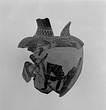
| Mended from many pieces; none of edge of base preserved and most of back, with handle, missing. The right edge of the figured panel remains, but not the left. Band of dotted zigzags at base of neck; row ... August-September 1932 ... ABV, p. 608, no. 4 (P. Rhodes Pelike). |
| The pieces come from the neck and shoulder; b) and c) join. Above a narrow black band, three painted letters preserved.
a)
b)
For the shape, cf. P 1210.
The unglazed surface is grayed and darkened (from ... August-September 1932 ... Paralip., p. 193 (Class of Rhodes 6595). |
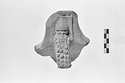
| Upper left corner chipped. Moulded bearded face wearing pointed cap.
Coarse brown clay with bits. Catalogued 26 January 1971. Bought in Rhodes in 1933. Leica, 93-64-9 ... (26 January 1971) ... Bought in Rhodes in 1933. |
Rounded rim flat on top; around neck below rim, several wheelrun grooves; strap handles; raised base, flat beneath. Light buff clay, smooth creamy surfacing. Non-Attic.
Possibly a small simplified version ... Context ca. 500-480 B.C ... Possibly a small simplified version of the Fikellura shape as, e.g., Rhodes 13354: Cl. Rh., IV, pp. 151-152, figs. 149-150 (Grave 56-1); CVA Rhodes 1(9) pl. 1(417) 1-2 but without the well-defined articulation between neck and shoulder. |
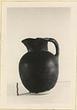
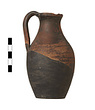
| Intact. Flat bottom; ovoid body; trefoil mouth; handle round in section.
Dull black glaze that stops a little short of the base.
ADDENDA Noted in Rhodes, Camiros, tomb 149, no. 13179, another very similar ... 28 April 1938 ... ADDENDA Noted in Rhodes, Camiros, tomb 149, no. 13179, another very similar. |
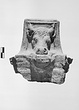
| Chipped. Inner face of lug has moulded head of bull, well modeled. Outer face has rectangular depression outlined with deep groove; vertical projection with dentils, below.
Coarse micaceous red clay, ... (26 January 1971) ... Bought in Rhodes in 1933. |
Handle missing.
Basket. A basket handle was attached inside the pot. Flat bottom; outturned rim. Two bands of glaze on body, small strokes on the rim. Thin glaze wash inside. Cf. 1412.
The type: ABV ... 500-480 B.C ... Another, Rhodes 12305: Cl. Rh., IV, p. 263, fig. 287, second from right (Grave 132). |
Fragment of top side and side. Thin brownish black glaze on inside; dull on outside, brownish in places. Max. dim. 0.072.
Panther (half of head, end of tail missing) to right with left foreleg raised ... Late 5th or early 4th century B.C ... For the panther, cf. Rhodes 14137 (Clara Rhodos 7, 1932--1933, p. 446, fig. 2) and Toledo 76.72 (above, 1173). |
Upper part only, no direct join between the neck and shoulder fragments.
Collar rim; tall narrow neck; double-curved handles from well below rim. Sandy buff clay with remains of banding in thin brown ... Context early 5th c. B.C. (?) ... For the shape and the shoulder banding cf. Rhodes, from Makri Langoni (Kameiros) 13277: Cl. |
Small convex lid with deep downturned rim, the knob an inverted cone. Glaze wash on top and on knob, a narrow reserved and banded zone near the top.
Probably for a small pot of storage-bin shape; see ... Context ca. 430-410 B.C ... Probably for a small pot of storage-bin shape; see the banded example, complete with its jar, Rhodes 14164: Cl. Rh., VI-VII, p. 447, fig. 1, upper right (Grave X-6). |
| Bottom and lower part of body restored in plaster. Round mouth, rather slender body, vertical handle. On exterior, dull, rather flaky black glaze; traces of two lines in added red around body just below ... 2-4 July 1932 ... Class of Rhodes 6595. (See under P 1406), Oinochoai (olpai). |
Fusiform body on flaring base slightly concave beneath. Thickened lip with rounded outer profile; heavy strap handle. Highly micaceous reddish fabric, very thick and heavy; unglazed. East Greek.
Young ... Context ca. 550-525 B.C ... Young (Hesperia, XX, 1951, p. 92) compared similar lekythoi from Sardis and from Samos; others come from graves in Rhodes. For the shape in Corinth see Corinth, XIII, North Cemetery, pl. 32, Grave 219-2 and -4; Grave 220-2 and -3. |
Small Jug?
Two-thirds of lower body preserved.
Lower body probably moldmade. Slightly recessed underside surrounded by low ridge. On body, convex long petals, with groove at base, ridge and row of beading ... Context of 200 to late 1st century ... Somewhat similar stamping is found on a black-glazed feeder from Rhodes (ClRh IV, 1931, no. 3, p. 385, fig. 435). |
Shoulder fragment with start of handle at top. Max. dim. 0.08.
Head of woman (hair with sakkos) to left. At top, next to start of handle, a bit of reserve that may indicate the beginning of a pattern ... Ca. 410-400 B.C ... For the hair and headdress, see the figure of Aphrodite on the hydria in Rhodes, which shows a bridal scene (ARV2 1335, 31; Addenda 365). |
Squat body on low ring foot; short very wide neck, slightly flaring rim, thick strap handles. Hard purplish pink clay; remains of dull black glaze outside and on rim and neck in- side. Added red on lip, ... Context ca. 625-570 B.C ... Similar shape but somewhat more squat and without the red lines, Rhodes 10788, from Ialysos: Cl. |
Upper part.
Tall-necked jug; round mouth with lightly collared rim, double-rolled handle from below rim. Neck set off from sloping shoulder by light ridge; around shoulder, at line of lower handle-attachment, ... Context ca. 520-490 B.C ... Cf. also the gray-ware amphora with double-rolled handles from Rhodes, 10479: Cl. Rh., III, p. 164, fig. 156, center. |
Upper part only.
Broad projecting rim with sharp handle-ridge below it; tall wide neck set off from shoulder by light ridge; sloping shoulder; strap handles. Light reddish buff clay with pale buff slip ... Context ca. 425-400 B.C ... A shape common in Rhodes throughout the 5th century, with minor variations; see, e.g., for an example with un- usually broad rim, Leipsic 3305: CVA 1(14) pl. 50(690) 4, with references to examples from Ialysos; other examples from Ialysos, cf. |
Handle missing.
Flaring foot, concave beneath. Reserved: the upper part of the body and a band at the greatest circumference. Added red: a broad band in the reserved band, a band at the edge of the foot, ... 575-550 B.C ... Two closely similar jugs have been found outside Athens and are doubtless from the same workshop: Rhodes 6595, from Ialysos: Cl. |
Plate.
Part of floor and foot.
Ring foot; beveled resting surface; slightly pointed underside. Band of glaze around edge of underside, glazed circle at center. On floor, red-glazed circle at center, ... 2nd-century context ... For painted decoration on banded vessels see Corinth VII, iii, no. 127, p. 39, pl. 45; FdD V, i, no. 400, pp. 173--174, fig. 728, from a 3rd-century context at Delphi; Giannikouri, Patsiada, and Philimonos 1990, pp. 182--183, pls. 100--102 (Rhodes); Behr 1988, no. 100, p. 174, fig. 22, pl. 18:1 (Pergamon). |
Handles missing.
Moulded ring foot. Concave lip; ribbed wall, joined by arcs at the top. Reserved: underside with band, three circles and dot. Scraped groove at junction of foot and wall. Decoration inside: ... Ca. 420 B.C ... Naples inv. 212: CVA 2(22) pl. 19(1041) 1.
6. Rhodes 14034: Cl. Rh., VI-VII, p. 159, fig. 187, upper left (Grave LV-2).
|
|
|