|
|
| Date of filling early third c. B.C.
Little pottery. Seven stamped amphora handles. Latest coin dates in first third of 3rd c. One small fragment of moldmade bowl of undetermined type. Coins:
12 August ... 310-220 B.C ... Date of filling early third c. ... Little pottery. Seven stamped amphora handles. |
Great Drain: fillings in south part of section; Martyrs I, II and III, all layers (essentially no difference in the layers).
Pottery sorted and recorded by H.A. Thompson 12 may 1950: "Having gone through ... Second half of 2nd c. B.C.-Early 1st c. B.C ... Thompson 12 may 1950: "Having gone through some 40 tins of pottery saved from the three martyrs. ... ... In view of the quantity of pottery & objects already recorded from the drain this pottery has been discarded."
Twenty-five stamped amphora handles; latest of 79 coins date in last quarter of 2nd c.; pottery closely similar to that in Thompson's Group E; two molds, one for long-petal bowl. |
A well (diameter 1m) in the industrial area west of the Areopagus, in the area later occupied by House C. Water level 1.50-2.m Dumped filling of broken bedrock with considerable fragmentary pottery in ... Ca. 500-480 B.C ... Water level 1.50-2.m Dumped filling of broken bedrock with considerable fragmentary pottery in the upper meter and a half. No evidence of period of use and no distinction in date in the filling. |
| A well at the northeast corner of Classical Building, behind back wall. Dumped fill appears to have occurred as a single event as there are joining sherds throughout.
POU date ca. first half 5th c. B.C.; ... 5th c. B.C ... Dumped fill appears to have occurred as a single event as there are joining sherds throughout.
POU date ca. first half 5th c. B.C.; pottery in fill spans ca. last quarter 6th c.-430 B.C.; out of use ca. 430 B.C ... Pottery primarily of the mid 5th c. with the latest sherds dating to just before the last quarter of the century. |
Associated with the Tholos.
Originally a well but after it had been in use for a short time the shaft was partially filled in and the upper part widened to form a large cistern.
The pottery falls into ... 335-250 B.C ... Originally a well but after it had been in use for a short time the shaft was partially filled in and the upper part widened to form a large cistern.
The pottery falls into three distinct groups ... however, the groups are fairly closely contemporary in date. |
A small concentration of pottery in lowest 1.80m., possibly a use fill. Three fills above, with little pottery, ranging from Hellenistic to late Roman in date. Coins:
26 February 1934 #4-#6
27 February ... 325-200 B.C ... A small concentration of pottery in lowest 1.80m., possibly a use fill. Three fills above, with little pottery, ranging from Hellenistic to late Roman in date. |
| Shallow pit below layer I in Stoa Shop VI (Pyre)
Diameter 0.90; D. 0.15m Under shop VI of the Stoa of Attalos Pottery, ash, burning and packing of small stones in pit in stratum. The pyre was covered by ... Ca. 350 or 325 B.C. ? ... Shallow pit below layer I in Stoa Shop VI (Pyre)
Diameter 0.90; D. 0.15m Under shop VI of the Stoa of Attalos Pottery, ash, burning and packing of small stones in pit in stratum. ... Two other pits with ash were found, but without pottery. The pyre must date at least as late as layer II, and probably not too much later. No contemporary structures, wells, or cisterns were preserved in this area, but it is about 10m south of the mudbrick commercial building that functioned in the second quarter of the 2nd c., and had a predecessor of unknown date. One pot shows signs of burning. |
| Rodney S. Young ... RSY/JP Disturbed Geometric burial over "Sacrificial Pit VI" (Grave B 21:22). Grave IX in notebook. Bones discarded?
Pottery found in the upper filling of a sixth century cremation pit, which had perhaps ... Middle Geometric II/Transitional to Late Geometric ... Bones discarded?
Pottery found in the upper filling of a sixth century cremation pit, which had perhaps cut through a Geometric inhumation to which the disturbed human bones close by may have belonged ... Excavation date more likely 31 May 1939 (p. 1929). |
| Pyre in north central room of house, measuring 0.50m east-west by 0.35m north-south. Pottery, bone, and burnt material in pit dug into layer IIb (crushed bedrock floor: lot Ω 464, 4th c.) and covered by ... 350-325 B.C ... Pyre in north central room of house, measuring 0.50m east-west by 0.35m north-south. Pottery, bone, and burnt material in pit dug into layer IIb (crushed bedrock floor: lot Ω 464, 4th c.) and covered by layer Ia (lot Ω 462, second half of 4th c., possibly into 3rd c., containing more fragments of pyre pottery probably from this pyre). The stratigraphy around the pyre cannot be physically connected to the architectural history of the house, but the date of the pyre would be consistent with a dedication at the time of the rebuilding or during the subsequent reoccupation. There were extensive traces of burning, and teh pottery has been burnt. |
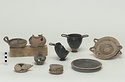
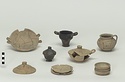
| Marcie Handler ... This pyre was found in the fill under Pyre J 2:23. Unfortunately, no floor surface was found between the two pyres. There were no complete vessels in this pyre. The sherds of the pyre vessels were mixed ... 275-250 B.C ... In addition to the catalogued pottery, fragments of between five and seven additional pyre saucers, one ribbon-handled plate, and one chytridion were left in the pottery bag. The pottery found around the pyre suggest a date after 275 B.C. (west slope ware was present, but moldmade bowl fragments were absent), which is very close to the date for the upper pyre, J 2:23 (1st quarter of the 3rd century B.C.). |
Greek House J, under room 8 of Roman House H.
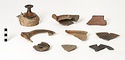
Typical though very fragmentary pyre pottery lay dispersed in a stratum over bedrock with pottery ranging from the 5th to the mid-3rd c.
In same general area ... Early 4th c. B.C.? ... Typical though very fragmentary pyre pottery lay dispersed in a stratum over bedrock with pottery ranging from the 5th to the mid-3rd c.
... If the early date is correct, it falls within the first phase of the house but cannot be related to a construction event. |
| Pocket, identified as sacrificial pyre by SIR. Possibly disturbed. Outside south wall of building. Concentration of pottery in a small pocket below a "Hellenistic" fill. There is no mention of bone or ... First quarter 4th c. B.C ... Concentration of pottery in a small pocket below a "Hellenistic" fill. There is no mention of bone or burning, but some of the pottery is burnt. The pyre dates shortly after the proposed date for the beginning of the second phase of Building E; the chronology may be sufficiently flexible to allow association with this reconstruction of the building. |
| A well in the industrial area of the Areopagus, about 7.00m. west of the West Bath, to a depth of 14.60m. This well was the direct successor to A 17:1, replacing it when it collapsed. The use filling at ... Second quarter 6th. c ... The earth filling of the top 1.90m., where the walls of the well had broken out to form a pit, contained very scanty pottery, of the same date as that of the use filling. ... Dumped filling of same date. |
| Pyre in Room 8 of Roman House H. Concentration of artifacts, bone, and flecks of carbon in stratum, no pit discerned. the pyre lay within a red fill apparently contemporary with it, but with some later ... 300-290 B.C ... The stratigraphy around the pyre could not be related to the architectural history of the house, though the date allows association with the reconstruction of the house near 300. The pottery shows traces of burning. |
Sand fill N of Base A.
... Because of the uncertainty of ground level contemporary with Base A and of the possibility of missing a continuous strosis or disturbance in this soft sandy fill, I have kept ... Last quarter 2nd-first quareter 3rd c. A.D ... Sand fill N of Base A.
... Because of the uncertainty of ground level contemporary with Base A and of the possibility of missing a continuous strosis or disturbance in this soft sandy fill, I have kept the pottery from the separate patches dug separately; hoping that when the pottery of 2nd and 3rd c. A.D is published a more precise date for the lower fill will be possible [p. 3062].
|
| Contents of Pithos Y; probably belonging to sacrificial pyre III.
In northern corner of courtyard. Characteristic pyre pottery in fill of one of two pithoi set into the floor of the courtyard as part ... 400-350 B.C ... Characteristic pyre pottery in fill of one of two pithoi set into the floor of the courtyard as part of 4th c. reconstruction (phase 3). Pottery is very fragmentary and probably not all from the pyre. Perhaps the pyre material was unearthed in the course of later activities and thrown into the pithos, which had gone out of use.
The date of the pyre puts it near the beginning of phase 3 of the house, so it could have originally been buried in connection with renovations that inaugurated that phase. there is no record of burning. |
| Grave over drain A1 (House A). Date based on the fact that the lopas has the upturned handle and the flat rather than domed lid, not found in examples from the later pyres. LT
West of House C. Pottery ... First half of 4th. c. B.c ... Grave over drain A1 (House A). Date based on the fact that the lopas has the upturned handle and the flat rather than domed lid, not found in examples from the later pyres. LT
West of House C. Pottery and cinders in pit in stratum. ... Cinders lay under and among the pottery, so the pyre was probably burnt in situ. |
Burial disturbed. Located in Middle Stoa, north aisle, "upper trench", piers 3 and 4. Two individuals: small child (ca. 5 yrs. old) and adult female.
In its disturbed state the burial was found (at elevation ... First half of 7th c. B.C ... B.C., when a quantity of Proto-Attic and Early Protocorinthian pottery was dumped into the feature. Either at this date or during a later disturbance, the grave "cairn" was leveled, with the cobblestones strewn downward over the earthen slope of the bedrock escarpment. |
| Matt McCallum ... The pyre was uncovered in a small, triangular area between the BZ Building foundations (but at a lower level) and the northern scarp of the current excavation area. It rested in a patch of orange-brown ... 1-7 August 2006 ... At the time of writing, the finds from the pyre and associated pottery (baulk cleaning, 1701, 1702) are still in conservation. ... The preliminary date for this pyre is Early Hellenistic. This will no doubt be refined once the pottery is examined in detail. |
Unfinished well, south of the annex to the Poros Building, west of the Areopagus. The shaft was apparently never used as a well. The lower dumped filling contained a quantity of clean red clay, as if from ... Ca. 350-325 B.C ... The lower dumped filling contained a quantity of clean red clay, as if from an industrial establishment; also some marble chips and a scattering of pottery fragments. The single lamp is of a type which comes into use in the mid-4th c. ... Upper fills of same date, possibly disturbed. |
|
|