|
|
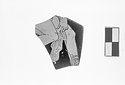
Wall fragment from near handle with a conical protuberance (mastos[?]). Max. dim. 0.091.
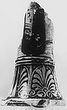
Palmette (ends of fronds).
For a similar protuberance, but as a pair, see the bell-krater, New York, M.M.A. 07.286.81 ... Probably third quarter of the 5th century B.C ... For a similar protuberance, but as a pair, see the bell-krater, New York, M.M.A. 07.286.81 by the Achilles Painter (ARV2 991, 61; Paralip. 437, 61; Addenda 311). |
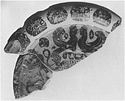
| Two joining fragments give somewhat less than half. Floor: a pair of sphinxes facing, flanked by others. Rim: incised rosettes, two suspension holes. Reverse: part of a large sphinx which fills all the ... End. 2nd. qtr. 6th. c. |
Wall fragment. Max. dim. 0.075.
Wedding scene. At the left is the bride (mostly preserved from shoulders to knees), dressed in a himation, being led by the groom (right arm, his hand clasping her left ... Ca. 430-420 B.C ... For the composition of the pair, cf. Amsterdam inv. 3495 by the Sabouroff Painter (ARV2 841, 76); Toronto 929.22.3 = 635 by Polygnotos (ARV2 1031, 51; Addenda 317; Matheson, Polygnotos, p. 358, cat. no. P 56, pl. 56); once London Market by the Naples Painter (ARV2 1099, 46 bis), which seems closest to 100; Erlangen 301 near the Naples Painter (ARV2 1102, 3); two by the Washing Painter: Vienna 2027 (ARV2 1127, 11; Addenda 332) and Houston 37.12 (ARV2 1127, 13; Addenda 332; Reeder, Pandora, pp. 163--165, cat. no. 23). |
Floor fragment with start of stem. Glaze somewhat pitted on underside. Max. dim. 0.059.
I, youth or man (torso, part of legs) kneeling to right. In front of him, start of another figure, probably a woman ... Ca. 450 B.C ... Red: inscription.
The pair is probably having intercourse. Cf. the Triptolemos Painter: Tarquinia (ARV2 367, 93; Addenda 223). |
| Mouth, fragments from shoulder and from wall missing. General type as P 24533 (ΣΑ 2743). Red line around join of neck.
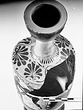
Shoulder: tongues and palmettes with dots (three and two), lotus buds next handle ... May-June 1954 ... Below scene: a pair of red lines.
Near the Gela painter. |
Wall fragment. Some of the glaze drawing flaked. Max. dim. 0.055. E. Vanderpool, Hesperia 15, 1946, p. 288, cat. no. 58, pl. 34.
Youthful trainer (neck to hips, outstretched right arm) standing to left, ... Ca. 490-480 B.C ... Manner of the Antiphon Painter (ARV2 one 237, 81); may be by the painter himself (ARV2 347, 115). The trainer on 1237 may have looked very much like the one who watches a pair of youthful wrestlers on side B of Oxford 1914.729 + Florence 9 B 38 (ARV2 340, 73; Paralip. 361, 73; Addenda 219). |
| Handle, fragments from shoulder and wall missing. General type as P 24533 (ΣΑ 2743). Red line around join of neck.
Shoulder: tongues and palmettes with dots (three and two), lotus buds next handle.
Above ... May-June 1954 ... Below scene: a pair of red lines.
By the Gela painter. |
Two non-joining wall fragments. Very thin, brownish wash on the inside. Max. dim. a) 0.039, b) 0.022.
Fragment a preserves the legs (the left with the top of a boot) of a youth seated to right on a cloak, ... Ca. 400 B.C ... Fragment a preserves the legs (the left with the top of a boot) of a youth seated to right on a cloak, a pair of spears resting against his left thigh in back of his hand. ... E 696 in the manner of the painter, especially for the drawing of the boots (ARV2 1325, 49; Addenda 364; Burn, Meidias Painter, p. 111, cat. no. |
Fragment of cul with start of handle at far right. Glaze much pitted. Max. dim. 0.087.
Chain of double lotuses and encircled palmettes.
For this pattern on the culs of other calyx-kraters, see 270 ... Ca. 450 B.C ... An odd feature of 271 is the pair of lines drawn across each lotus near the top, which does not seem to have an exact parallel. ... PEM 7, pl. 153); also on the necks of these volute kraters, only there and on Ferrara 2892 = T.300), the lines serve to separate long fronds from short petals: Ferrara 2739 = T.749 by the Boreas Painter (ARV2 536, 1; Paralip. 384, 1; Addenda 255; CVA, Ferrara 1 [Italia 37], pl. 5 [1649]:3); two by the Niobid Painter: Bologna 268 (ARV2 598, 1; Paralip. 394, 1; Addenda 265; Prange, Niobidenmaler, p. 180, cat. no. ... GN 62); and Ferrara 45685 = T.19 C VP by the Chicago Painter (ARV2 628, 1; Paralip. 399, 1; Addenda 272). |
Floor fragment with part of bowl and start of stem. Max. dim. 0.165; outer diam. of tondo 0.115.
I, youth (head, feet, draped left leg, right foot) standing frontally, head in profile to right, looking ... Ca. 410-400 B.C ... A--B, two males (lower part of himatia, feet) facing, the right one of each pair leaning on a stick. ... Below, two reserved lines.
The Painter of Bonn 1645 (ARV2 one 863, 2; ARV2 1399, 7). |
| Lower part of neck preserved.
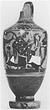
Around bottom, a wide band of ornament: at the front a single palmette framed by lotuses and with one-half palmette on either side; around the back, rays; above are the lower ... 14 July 1949 ... The left-hand figure holds a wide scarf with white fringe. A pair of moulded ridges above and below the ornament band. ... B.C.; something as the Painter of the Athens Wedding. |
| Wall fragments from a thin-walled closed vase; very thin wash inside(?).
a) Legs of a youth, nude, seated right on a cloak, a pair of spears(?) held in his left hand, resting against his knee; high laced ... 9 April 1954 ... a) Legs of a youth, nude, seated right on a cloak, a pair of spears(?) held in his left hand, resting against his knee; high laced boots.
b) Back of head and part of right shoulder.
... Manner of the Meidias Painter (late)?
For the double strokes used in drawing the knees, cf. the squat lekythos from Marion in Cyprus, London E 696, ARV, p. 838, no. 48 (mus. |
Wall fragment. Max. dim. 0.188.
Chariot team (legs of horses), a triga to right. Below, maeander pattern. Preliminary sketch. Dilute glaze: muscles.
For a triga, only to left, see the one driven by Nike ... Ca. 450 B.C ... For a triga, only to left, see the one driven by Nike on Ferrara 2892 = T.300 in the manner of the Peleus Painter (ARV2 1041, 6; Paralip. 443, 6; Addenda 319; Matheson, Polygnotos, p. 443, cat. no. ... The first pair of hind legs are those of the trace horse; the other, one of the pole horses. |
Wall fragment with start of rim. Narrow reserved band on inside near top. Max. dim. 0.044.
Wreathed head of man emerging from between a pair of wings. Preliminary sketch. Relief contour: profile. White ... Third quarter of the 5th century B.C ... Wreathed head of man emerging from between a pair of wings. Preliminary sketch. ... The identity of the figure is puzzling because the presence of the beard rules out the usual characters who appear in a winged context, namely Triptolemos and Hyacinth, also Bellerophon and, occasionally, Apollo (for the latter, see the namepiece of the Painter of Vienna 202, in which the god rides a griffin: ARV2 1523, 1; Addenda 385). A possibility for the figure on 346 is Hephaistos, who appears on a winged throne in the tondo of Berlin 2273 by the Ambrosios Painter (ARV2 174, 31; Addenda 184) and in the tondo of a contemporary unattributed cup, Florence 81600 (LIMC IV, 1988, p. 633, no. 44, pl. 388, s.v. |
Stand mended from many fragments, with the missing pieces restored in plaster and painted. Bottom of lebes preserved. Glaze pitted in places. P.H. 0.232; diam. of base 0.162.
Two pairs of women facing, ... Ca. 430-420 B.C ... The left one of the first pair holds up a wool basket; her companion carries a fillet, as does the next woman, who faces one holding an alabastron in her outstretched right hand. ... The Naples Painter (ARV1 706, 29 bis; ARV2 1098, 37). |
Rim and neck fragment. Edge of rim chipped. Max. dim. 0.09. Schleiffenbaum, Volutenkrater, p. 325, cat. no. V 207.
Symposion. On the right, the top of the filleted head of a symposiast reclining to left ... Ca. 460-450 B.C ... To the left of it, at the lower break, the start of something else, perhaps the end of one of a pair of krotala or the tip of the arm of a lyre. ... The small amount of the symposion that remains bears some resemblance to that on the neck of the volute-krater that is the namepiece of the Boreas Painter, which also has the key pattern to right on the side of the rim (Ferrara 2739 = T.749: ARV2 536, 1; Paralip. 384, 1; Addenda 255). But there is not enough preserved on 240 to be sure of an attribution, though it does seem contemporary with this painter. |
Two non-joining fragments, a of lip and bowl, b of bowl. Reserved line on rim. Max. dim. a) 0.039, b) 0.051.
I, a little of the maeander pattern around the tondo. A (illustrated), youth leaving home ... Ca. 420-410 B.C ... Perhaps these two cups were made as a pair.
The Fauvel Painter (ARV2 one 772, 4; ARV2 1285, 4). |
Half of upper body and parts of handles and lower body restored.
Scraped groove in resting surface; concave underside. Small, delicate foot with high, thin stem. Pointed lower body with scraped groove ... 285-275 ... Rising, flaring spurs. One pair of antithetical leaping dolphins ( possibly originally another dolphin to right) with white dot rosettes between them, above row of alternating hoops and small sprouts on double ground line with row of dots between. ... For scraped groove on body, cf. 15, 71, 84; 71 is very close in size, shape, and decoration and is probably by the same potter and painter. For closely similar hoop pattern see 84, 133, and 407. |
Two non-joining body fragments, a strengthened with plaster and painted. Start of handle at far left of fragment a. Good glaze, slightly brownish on b. P.H. a) 0.18, b) 0.112; max. dim. a) 0.223, b) 0.162 ... Ca. 470 B.C ... Munich 2343 by the Alkimachos Painter (ARV2 531, 27).
For an amphora with somewhat similar decoration, see the pair carried by Herakles on Berlin 4027 by the Pan Painter (ARV2 551, 5); the horizontal lines on the fishermen's baskets on Vienna 3727 also by the Pan Painter (ARV2 555, 88; Addenda 258) and the stripes on the baskets held by the man on the Pig Painter's namepiece, Cambridge 9.17 (ARV2 564, 27; Addenda 260).
Probably by a painter from the group of Earlier Mannerists. |
Most of body of pyxis with flange for lid, part of tripartite foot. On underside of floor, two concentric circles with central dot. Much of the glaze has flaked and abraded. Traces of burning on door (gray) ... Ca. 450 B.C ... Between 1 and 2 hangs a fillet; between 2 and 3 there is a wool basket; between 1 and the door, a pair of sandals hangs on the wall (the glaze around them has abraded).
The Veii Painter (ARV2 one 595, 37; ARV2 906, 114; Addenda 303). |
|
|