|
|
Great Drain north end, filling under tiles (55-58).
Only the finds from 55-58/* are recorded here (as found in the notebooks) although the deposit notebook shows additional finds from the entire sand fill ... 3rd-2nd c. B.C ... Sand fill north end, under tiles |
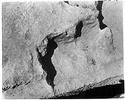
Pit in bedrock (disturbed child's grave?). No bones or ashes. No lots.
No coins listed. P 14520 was certainly from the north end, doubtless a grave offering; few sherds (first half of 5th century) came ... Late 6th - early 5th c. B.C ... P 14520 was certainly from the north end, doubtless a grave offering; few sherds (first half of 5th century) came from the north end as well. |
Great Drain sand fill under Roman bath including small area at north end under tiles that was excavated separately.
See also A-B 19-20:1 for additional Great Drain sand fill at ca. 70-113/* Subdivisions: ... 30 July-11 August 1947 ... Great Drain sand fill under Roman bath including small area at north end under tiles that was excavated separately.
... Subdivisions:
.1=55-58/*, sand fill north end, under tiles.
.2=sand fill south end continuing to north.
55-58/* |
Geometric Well at ca. 21/Κ beneath the west colonnade of the Square Peristyle, west of the north end of the Stoa of Attalos ... Late 8th century B.C ... Geometric Well at ca. 21/Κ beneath the west colonnade of the Square Peristyle, west of the north end of the Stoa of Attalos. |
Well at 8/ΙΑ-ΙΒ, beneath the north colonnade of the Square Peristyle, just west of the north end of the Stoa of Attalos. Quite uniform fill. Diameter 1.15m. No P.O.U. Coins:
4 April 1938 #39 ... 650-600 B.C.
5th c. B.C ... Well at 8/ΙΑ-ΙΒ, beneath the north colonnade of the Square Peristyle, just west of the north end of the Stoa of Attalos. |
Archaic Well at 10/ΚΒ, directly west of the north end of the Stoa of Attalos.
Well, not cleared. a small amount of pottery gathered from the top of the shaft ... 600-550 B.C ... Archaic Well at 10/ΚΒ, directly west of the north end of the Stoa of Attalos.
|
Coins:
30 July 1947 #3-#11
31 July 1947 #4-#19
1 August 1947 #1-#9
4 August 1947 #1-#20
5 August 1947 #3-#20
6 August 1947 #1-#38
7 August 1947 #1-#21
8 August 1947 #1-#41
9 August 1947 #3-#6
57-59/*
66-67/* ... 28-31 July 1947
6-9 August 1947 ... Sand fill, south end continuing to north |
Well Y, in area North of the West end of the Yellow Poros Foundation. The shaft had cut through the wall of an earlier well and the cavity had been packed with stones by the diggers of the new well. In ... Earth 5th c. B.C ... Well Y North of the West End of the Yellow Poros Foundation |
Located beneath line of Poros Gutter, from a square settling basin cut in bedrock at the north end of Trench II, South of Theseion, 1.30m below the modern road surface. The basin is lined with rough-picked ... Last quarter of 5th c. B.C.-early 4th c. B.C ... Located beneath line of Poros Gutter, from a square settling basin cut in bedrock at the north end of Trench II, South of Theseion, 1.30m below the modern road surface. |
Well of Christian Lamp; west of Stoa terrace wall near north end. Pottery spread out June 1952. A big amphora was made up (ΣΑ 1780), but nothing else went together. Fill appeared o be all of one period ... Late 5th-early 6th century A.D ... Well of Christian Lamp; west of Stoa terrace wall near north end. |
| Marcie Handler ... The Pyre was revealed in a layer of 4th c. fill in the north end of Room 6, just south of Wall 8. Room 6 is defined by the street wall (Wall A) on the west, Wall 7 on the east, Wall 9 on the south (preserved ... 4th c. B.C ... The Pyre was revealed in a layer of 4th c. fill in the north end of Room 6, just south of Wall 8. Room 6 is defined by the street wall (Wall A) on the west, Wall 7 on the east, Wall 9 on the south (preserved only as a stub on the east side of the area), and possibly Wall 8 or Wall 6 on the north.
2.5 meters SW of the pyre, a patch of floor surface at J/10-1/20 at 52.188 masl. was found. ... This pyre is the northernmost pyre found in Section ΒΖ North, and its location suggests that the Classical Commercial Building continues this far north. |
| Homer A. Thompson ... PG grave north of Stoa Pier 19 (Grave 6). In some records as Grave XLIII.
Unlined rectangular pit cut into a shallow depression in bedrock that was formed by the collapse of the roof of Mycenaean Chamber ... Developed Protogeometric ... PG grave north of Stoa Pier 19 (Grave 6). ... Unlined rectangular pit cut into a shallow depression in bedrock that was formed by the collapse of the roof of Mycenaean Chamber Tomb Q 8:8. The north end of the tomb had been sheared away for the construction of the Stoa. ... The tomb was oriented south-southwest to north-northeast.
On the floor of the pit, " a few bones and the skull" of the deceased were encountered, the cranium evidently at the south end of the grave. |
| Laura Gawlinski ... Bronze foundry north of bridge on Piraeus street, east of Great Drain.
Keyhole-shaped bronze casting pit, cut into bedrock.
2016: Continuation of the excavation of a rectangular pit with foundry debris, ... Late 6th-early 5th c. B.C.
(Late Archaic/ Early Classical) ... Bronze foundry north of bridge on Piraeus street, east of Great Drain.
... Pit is 2.58m long (N-S), at least 1.35m wide; 0.66m at narrow north end; 1.36m deep. ... Oriented north-south: 2.58m long; 1.35m at widest point; 0.66m at narrow north end; 1.36m deep. |
| Marcie Handler ... The remnants of a disturbed pyre in a layer of dumped Hellenistic fill. The fill was found in the area on top of and east of the eastern wall of the Classical Commercial Building at its north end. Fragmentary ... Ca. 225 B.C ... The fill was found in the area on top of and east of the eastern wall of the Classical Commercial Building at its north end. Fragmentary pyre pots were mixed into the fill, which dated to the period after 225 BC. ... the pyre pottery may very well have come from a pyre buried under a floor in the building just to the west of here. |
| Susan I. Rotroff ... Grave 2. Adult female inhumation. Grave extending under the south retaining wall of the Temenos of the Royal Stoa. It is oriented ne-sw, with head at sw. Grave built of slabs of schist, with packing of ... Final Mycenaean/Submycenaean ... Grave built of slabs of schist, with packing of small stones around north end. Floor was bedrock.
The grave diggers cut into an earlier grave immediately to the north; this grave was found empty. |
| Mycenaean Chamber Tomb SE of Stoa Pier 12 (Burial 8).
Roughly rectangular, measuring 1.70m by 1.40m, and was cut down to within 0.65m. by the construction of the Square Building. A rectangular cutting ... Early Myc. IIIA ... Across the north end lay the single skeleton of a child with head to east, lying on its back with knees doubled up. |
| Pyre in Horos Terrace Trench, East end, set into Strosis 5.
In room 1 (court), near north wall. Concentration in stratum, no pit discerned; described as a "little nest of pots" within layer V (Lot ΜΣ ... 350-325 B.C ... Pyre in Horos Terrace Trench, East end, set into Strosis 5.
In room 1 (court), near north wall. Concentration in stratum, no pit discerned; described as a "little nest of pots" within layer V (Lot ΜΣ 115), which overlay the hard strosis 5, the uppermost preserved floor of the house. |
| Pocket with burning at 60/ΚΗ. "Is this perhaps a disturbed pyre burial." [Nbp. 2928].
Identified as pyre by SIR.
Near north end of corridor, beside its west wall. Concentration of artifacts, tiny scraps ... 4th c. B.C ... Identified as pyre by SIR.
Near north end of corridor, beside its west wall. |
Eugene Vanderpool Homer A. Thompson ... Mycenaean burial (no offerings) in NW corner of Stoa Terrace (original north end).
" It consisted merely of an adult skeleton lying in an extended position with head to east and the left leg slightly flexed ... Mycenaean or Protogeometric ... Mycenaean burial (no offerings) in NW corner of Stoa Terrace (original north end).
" It consisted merely of an adult skeleton lying in an extended position with head to east and the left leg slightly flexed at the knee. |
Pit in Tholos Trench V (below Layer e).
In plan it would seem to have been oval, though its east end is c/../ by the south wall of the North Archaic Home. Its N-S width is 1.25m, its E-W length is 1.40m ... 7th-early 6th c. B.C ... In plan it would seem to have been oval, though its east end is c/../ by the south wall of the North Archaic Home. |
|
|