|
|
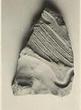
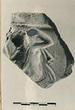
| First interpretation: mold for a sphinx (?).
A thick tile-like fragment, flat in back.
At the top, a bit of the edge of the mold preserved. Preserved is part of a wing, hind-quarters and tail, to left ... 9 March 1933 ... Terracotta Moulds |
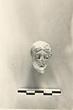
| Broken and chipped at one side.
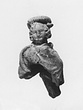
The hair is parted down the center and finely waved up in a sort of thick braid.
The join between the front and back moulds shows badly. Fairly carefully modelled. Modern ... Card: probably 2nd c. A.D ... The join between the front and back moulds shows badly. |
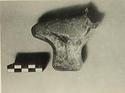
| A bird, on a heavy base.
Intact except for missing head and neck.
Small hole in base.
Crude representation of a bird. Little modelling; grooves where the moulds join.
Much red, white and yellow paint ... 7 April 1936 ... Little modelling; grooves where the moulds join.
Much red, white and yellow paint.
|
| Lower right corner of mold preserved.
Raised band around edge of mould.
The forepart of an animal, probably a cow, standing right.
Heavy fabric.
Coarse reddish-brown clay.
ADDENDA: Forepart of boar. Other ... 10 May 1939 ... Terracotta Moulds |
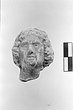
| Broken behind along line of junction between front and back moulds.
Head slightly inclined to right.
White slip on which remain abundant traces of a dull yellow color. Lips red. Agora sample no. 402 ... 6 March 1937 ... Broken behind along line of junction between front and back moulds.
Head slightly inclined to right.
|
| Part of upper edge preserved; from a mold for a plaque.
Upper half of dancing figure.
Fairly coarse fabric; somewhat resembling the moulds for large "architectural" plaques; but thiner, and this at a smaller ... 5 June 1954 ... Terracotta Moulds |
Missing: head, large fragments from the body, base.
An erect female (?) figure right knee slightly flexed standing clad in chiton and himation.
Clay: Fine, pale buff, covered front and back with white ... Mid- fourth century B.C ... Glaze was used the affix the base, white to join two moulds inside. Fully modeled behind. |
| The elbow of a large figure (?).
Mold made, from at least three moulds; hollow. White slip on outside, with bands of blue, red, yellow and black on the elbow.
Smooth red clay.
Cf. T 475. Late Roman fill, ... 8 June 1937 ... Mold made, from at least three moulds; hollow. White slip on outside, with bands of blue, red, yellow and black on the elbow.
|
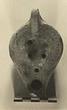
| Intact.
Debased herringbone pattern on rim; cross (or Christian monogram?) on discus. Broad channel on neck.
Solid handle without grooves. Almond-shaped reverse with grooved lines enclosing a palm branch ... 10 June 1937 ... From very worn moulds.
Light red clay and glaze.
|
| Fragment from thigh (?) of nude figure.
Note a small patch over a round hole left probably by one of the rods that held the moulds apart.
Cf. B 591 (ΟΔ 17) and the fragments of bronze statues earlier ... 15 June 1938 ... Note a small patch over a round hole left probably by one of the rods that held the moulds apart.
Cf. B 591 (ΟΔ 17) and the fragments of bronze statues earlier found in this same vicinity. |
Fragmentary.
Mould for top of lamp pattern of long tongue with rows of circles between them. Double groove around filling-hole. On the outside of mould is plain, with two lines cut in one side near the ... 7 June 1934 ... On the outside of mould is plain, with two lines cut in one side near the edge to make possible the perfect joining of the two moulds.
Fine reddish clay. |
| Intact except for minor chips from nozzle. Made from very badly worn moulds.
Globules and raised semi-circles on rim, plain discus. Solid handle triply grooved in front and doubly behind. Circular reverse ... 27 May 1938 ... Made from very badly worn moulds.
Globules and raised semi-circles on rim, plain discus. |
| Preserved above waist except fragment on right side of chest. Three joining body fragments, joining hat fragment. Head reattached.
Similar to T 3806, and from same or related moulds. Hat of different mould, ... 5-9 August 1968 ... Similar to T 3806, and from same or related moulds. Hat of different mould, cushion-like roll nearly encircling head and with projections at both sides.
|
| Seated lion; in the background, above, small running animal (ferret, dog?); beside it head of a lioness, below snake.
Parts of two adjacent edges preserved; broken at the left; knob on the back.
Probably ... 8 July 1947 ... Cast only in Stoa Gallery. Moulds in Cupboard 34. |
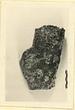
| One fragment, exterior plastered for preservation, of a flat bottomed mold for a large ring shaped object, built upon four parts : blackened core (1) surrounded by a ring of coarse clay (2) containing ... 29 March 1936 ... Misc. Moulds |
| Apparently fragment of piece-mould with, at edge, traces of cord or wire used to trim and separate moulds.
Underside of tail of bird (?).
Cut line curves, so not from ordinary votive dove mold such as ... February 1989 ... Apparently fragment of piece-mould with, at edge, traces of cord or wire used to trim and separate moulds.
Underside of tail of bird (?).
|
| The nose broken off. The height apparently complete.
The head is bent sharply to the figure 's left. Thick lips; bar of Praxiteles.
The undersurface, at the base of the neck, is finished smooth and has ... 13 March 1934 ... Made with two moulds. |
| Mold for animal standing in three-quarter view. Two lion like legs, parts of body and wing preserved. Bottom, front, back and part of one side preserved.
Mold roughly smoothed on exterior.
Fabric gray-pink ... 6 August 1973 ... Terracotta Moulds |
| Single fragment preserving parts of at least four edges.
Clay not well-baked, fired closest to pink 7.5YR 8/4-7/4. The piece is conceivably a mold (?). For similar moulds of later date see Hesperia 46, ... 11 June 1935 ... For similar moulds of later date see Hesperia 46, 1977, pl. 85, nos. |
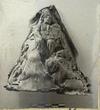
| Conical relief. At the top, Orpheus, seated on a rock, a lyre in his left hand, his locks curling to his shoulders, drapery over his knees. Around him the animals: bear, lions and smaller creatures.
Mended ... 11 October 1947 ... Terracotta Moulds |
|
|