|
|
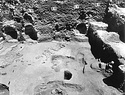
Square pit in bedrock southwest of the Hephaisteion. Many marble chips from the construction of the temple of Hephaestus were found here together with a large quantity of pottery and other objects ... Ca. 450 B.C.
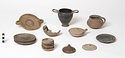
Ca. 390-380 B.C ... Many marble chips from the construction of the temple of Hephaestus were found here together with a large quantity of pottery and other objects. |
Material from trenches:
a) 1.00-7.00m. from East End of Stoa.
b) 18.40-21.40m. from East End of Stoa ... 2nd c. A.D ... Marble working waste |
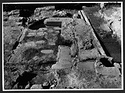
Pit with marble chips (disturbed); working chips of the Hephaisteion construction. A few vases apparently contemporary with the building of the temple ... 5th c. B.C. to ca. 450 but disturbed ... Pit with marble chips (disturbed); working chips of the Hephaisteion construction. |
Well in Marble-Saw Shed. No distinct use filling. Estimated Grid ... Submycenaean ... Well in Marble-Saw Shed. No distinct use filling. |
Pithos in NW corner (room) of Poros Building. Marble chips ... Mid-4th c.? ... Marble chips. |
Marble Chip Fill at 67-69/ΚΑ-ΚΖ (now C 19:5). Asterisk: C 19:15* ... Marble Chip Fill at 67-69/ΚΑ-ΚΖ (now C 19:5). |
Stroses I, II, III, IV in Court J (below marble chip layer), House of Greek Mosaic.
No independently datable objects. Estimated Grid ... Early 3rd c. B.C ... Stroses I, II, III, IV in Court J (below marble chip layer), House of Greek Mosaic.
|
An unfinished well in the northwest room of the Poros Building, west of the Areopagus. Dumped filling. Chips from marble-working, variety of plain and figured wares ... Ca. 400-385 B.C ... Chips from marble-working, variety of plain and figured wares. |
| "Koumanoudes' Well.
Tile-lined well (diam. 0.85m) at SE corner of courtyard of Roman House E, at top built wall of stones and mortar, bedrock at bottom. Coin
7 August 1971 #495-#500
13 August 1971 #507 ... 28 July-6 August 1971 ... Layer 4:16.20-16.66 Construction; marble working chips, plaster, pumice. |
Slag pit in front of South Stoa II. The filling consisted ... of a very miscellaneous lot of stone and marble. ... In among the stones was a loose filling of ash and charcoal and iron slag ... (nbpp. 6510, ... Second half 1st c. A.D ... The filling consisted ... of a very miscellaneous lot of stone and marble. ... In among the stones was a loose filling of ash and charcoal and iron slag ... |
Tiled Well in Square Building Foundations, equipped with evenly spaced hand-holds, with a good supply of water. There was no period of use represented and the dumped fill consisted mostly of chunks of ... Third quarter of 4th c. B.C ... There was no period of use represented and the dumped fill consisted mostly of chunks of bedrock, with many fragments of pebble mosaic and a few marble chips; the pottery was extremely scanty and very fragmentary. the well had been intentionally filled and carefully covered over a large slab in preparation for the foundations of the Square Building over it ... 31 August 1954 the marble slab (I 6694) was found pp. 4107-4109 |
| Well in East Colonnade of Roman House H. Diameter 0.80m, lined with field stones set in mortar. used as a cistern as well.
No useful pottery dates. Capital from colonnade A 3866 and part of shaft found ... 29 July 1970 ... Three marble heads found at -4.65m to -5.25m suggest change from Pagan to Christian in early 6th c. ... See also Q 21:4 from same house. Marble heads (S 2354-2356) deliberately discarded before house went out of use. |
Well at west side of Theseion Plataea, partly cleared to a depth of ca. 5.30m. Dumped filling, apparently the debris from a sculptor's workshop, as indicated by both the quantity of marble chips in the ... Second quarter 4th. c. B.C ... Dumped filling, apparently the debris from a sculptor's workshop, as indicated by both the quantity of marble chips in the filling and a number of unfinished small sculptures. |
| Pyre in Room 1, area west of street (RSY=Pyre 11).
Early in the third quarter of the 4th. c. B.C.
In courtyard. Artifacts, bone, and cinders in irregular pit in floor sequence. The pit had been dug into ... 350-330 B.C ... The pit had been dug into a marble-and limestone-chip layer over bedrock, and was covered by a Late Hellenistic layer with tile fragments. It may be associated with the abandonment of the house, since the marble-and limestone-chip layer was laid down during the structure's last phase. |
Child's burial in south wall of Marble Worker's House.
Bones examined 20 June 1975 and found to be an immature animal, not human (canid-puppy?).
Identified as pyre by SIR. Set into a shallow roughly ovoid ... Late 4th c ... Child's burial in south wall of Marble Worker's House.
|
The data in the Deposit Notebook is presented by trench; an attempt is made here to accumulate data from similar layers across the trenches. Subdivisions:
.1=Post Hadrianic cleanup
.2=Marble working waste ... 2nd c. B.C.-3rd c. A.D ... Subdivisions:
.1=Post Hadrianic cleanup
.2=Marble working waste
.3=Iron working waste
.4=Industrial period
.5=Construction fill of South Stoa II
.6=Drain and drain channels/trenches at Stoa back wall |
Well in Byzantine Room 9. Excavation of the well terminated at 49.00m. due to cave-in danger. Topped by a stone sill and marble putael, the upper part of well is of Byzantine-period stone masonry; lower ... Byzantine ... Topped by a stone sill and marble putael, the upper part of well is of Byzantine-period stone masonry; lower part lined with tiles.
|
This is associated with Building A. It had a circular marble well-head with a rectangular well slab beneath. The construction throughout was of well tiles. It produced little to a depth of -8.60m. Between ... 4th c. A.D ... It had a circular marble well-head with a rectangular well slab beneath. |
| Well at 99/ΜΕ.
Just outside of SE corner of Fountain House. This well was used in at least two periods; the marble well curb of the second period, certainly Byzantine, was found in place. The fill was ... 5 May 1952
5-14 July 1952 ... This well was used in at least two periods; the marble well curb of the second period, certainly Byzantine, was found in place. |
House R, fill under drain tiles and fillings associated with house K in industrial area, including what was C 19:15, plus C 19:16 and
C 19:17.
a) House built as dwelling in second half of 5th.c.
b) Used ... Ca. 5th and 4th c. B.C ... House R, fill under drain tiles and fillings associated with house K in industrial area, including what was C 19:15, plus C 19:16 and
C 19:17.
a) House built as dwelling in second half of 5th.c.
b) Used as marble-workers' shop from beginning of 4th. c. to near middle of century. ... Most of the material comes however from the second and third phases noted above: either the marble-workers' shop, or the heavy filling of dumped earth and marble chips thrown in over the area when the level was raised for the remodelling of the building at about the middle of the 4th c. |
|
|