|
|
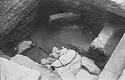
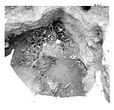
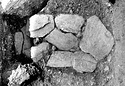
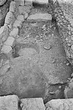
| Pyre in House N, room 2, layer 5 (RSY=Pyre 8).
Near northern corner of room 6. Artifacts, bone, burnt logs, and cinders in square pit dug from level of layer 5, through layers 5 and 6; thin clay floor ... 325-300 B.C ... Pyre in House N, room 2, layer 5 (RSY=Pyre 8).
... Artifacts, bone, burnt logs, and cinders in square pit dug from level of layer 5, through layers 5 and 6; thin clay floor laid over it. ... Coins from layer 4:
18 September 1947 # 7-#11 |
The Building Fill had been badly disturbed and has been divided into several different lots, resulting in two main divisions: layer 5 (upper building fill) and layer 6 (lower building fill). Later investigation ... 23 June-16 July 1973 ... The Building Fill had been badly disturbed and has been divided into several different lots, resulting in two main divisions: layer 5 (upper building fill) and layer 6 (lower building fill). |
| Susan I. Rotroff ... Grave 2 (bis). Cut into by builders of I 5:2. No remains.
Possible contents in I 4-5:1 Layer C (= layer 6, lower building fill), catalogued as ΒΓ 2065 - ΒΓ 2125 ... Middle Helladic or later Bronze Age (date uncertain) ... Cut into by builders of I 5:2. No remains.
Possible contents in I 4-5:1 Layer C (= layer 6, lower building fill), catalogued as ΒΓ 2065 - ΒΓ 2125. |
Exploration over bedrock inside the Tholos; levels of 6th c. B.C ... 6th c. B.C. |
Evidence of stratification into five layers, although joins between the layers. Layer VI added when the construction of the Roman building above required it. No subdivisions assigned.
Flask-shaped cistern ... Early 3rd-late 2nd c. B.C ... Evidence of stratification into five layers, although joins between the layers. Layer VI added when the construction of the Roman building above required it. ... Moldmade bowls with thick walls and small indistinct figures similar to those on bowls in G 5:3 and some examples in Thompson's Group C. ... Coins:
3 June 1937 #1-#4
4 June 1937 #5-#9
7 June 1937 #1-#4 |
| Enclosure within Roman Circular Building. The finds apparently reflect the entire area inside the enclosure. Pottery lot ΒΓ 515 identifies the deposit as layer 10 and coin #895 from layer 11 says "layer ... 12-18 August 1971
9-10 May 1972 ... Pottery lot ΒΓ 515 identifies the deposit as layer 10 and coin #895 from layer 11 says "layer below the deposit" ... Coins:
13 August 1971 #890
9 May 1972 #895 (layer 11, "layer below the deposit")
The Bone bags from J 5:2 were analyzed by Michael MacKinnon: there are domestic taxa represented by a mix of skeletal elements. |
| Pit in Layer 9, lined on the sides and bottom with small stones ... Late 5th c. B.C. |
| Pyre in layer "9d" in SW corner of Room 6 of Greek House δ. Ashes and fragments of small bones ... Ca. 225 B.C. |
Layer 7 in South Peristyle of court of Roman House Ε. Irregular cutting in bedrock with sand, gravel, fallen bedrock. Some burning ... 275-250 B.C. |
| Shallow pit below layer I in Stoa Shop VI (Pyre)
Diameter 0.90; D. 0.15m Under shop VI of the Stoa of Attalos Pottery, ash, burning and packing of small stones in pit in stratum. The pyre was covered by ... Ca. 350 or 325 B.C. ? |
Trench at O/7,8-6/1,5. Layer 5 of Trench A cut in Rooms 1 and 2 of Greek House γ. Soft green clay with bones, ash, much pottery. Probably leveling fill ... Archaic ... Trench at O/7,8-6/1,5. Layer 5 of Trench A cut in Rooms 1 and 2 of Greek House γ. |
Trial cut at 26/ΙΣΤ-ΙΖ, Layer I; Circular Building, 22m south of Eleusinion. P 30171, P 30172, L 5818 added on 7 May 1973 ... 4th c. B.C. |
"Debris Pit" beneath starting line in Panathenaic Way.
Dug as
Trench B (1971), pp. 1631-1649 (notebook not seen, PF);
finds record both Layer 28 and beneath Layer 28.
Trench I, pit 16a, (1973), pp. 3010-3022 ... 2 August 1971
4-6 July 1973
27 June-11 July 1980 |
| Terracotta deposit in SW corner of Room K and E of Roman Wall L. Roman layer of red, compact earth.
Baskets 50,52,54. Coins:
18 July 2002 #1282
19 July 2003 #1295 ... 4th c. A.D. |
Pit in House T, Room 3 (through layer 6), in the industrial area west of Areopagus. Very likely pit may have been respectable archaic context, but nothing to go on beyond the two catalogued pieces (LT ... Ca. 500-480 B.C ... Pit in House T, Room 3 (through layer 6), in the industrial area west of Areopagus. ... No container for this pit, and also apparently none for layer 6? Layer 5 us described as "5th-4th c. |
Connected with G 14:3.
There was a layer of Late Roman fill. It rested over a layer of 2nd c. B.C Hellenistic and then another of 4th c. B.C Hellenistic; the passage between the two cisterns contained ... Late Hellenistic |
| David Scahill ... Behind northeast corner of Classical Building; east wall C. Below Hellenistic levels and early Classical pit. Chamber cut through bedrock, depth ca. 0.90m., diameter ca. 2m., roughly square in shape, angling ... LH III A:1 |
| Susan I. Rotroff ... Grave 4 under Royal Stoa. Cist Grave cut into bedrock and lined with limestone and schist slabs. There were two layers of cover slabs with a layer of dirt between. Grave measured 0.98x0,25-0,32x0,25-0,30 ... Final Mycenaean/Submycenaean |
A filling lying over a cobbled floor in a house-complex on the lower north slopes of the Areopagus.
Area in front of E-W retaining wall, just above cobble pavement, disturbed by coins and pottery as late ... 375-275 B.C. |
| Julia Shear ... Burial. Roman Temple south half, in fill south of temple crosswall and norh of polygonal wall, layer 37a.
Small, roughly circular pit. The diameter of the pit appeared to be only slightly greater than ... Late Helladic IIIC Late-Final Mycenaean/Submycenaean |
|
|