|
|
Dull black glaze.
Other large bases are listed by E. L. Smithson, Hesperia 30, 1961, p. 167, under no. 46. The Hymettos base referred to there is the present one, but it is in the Agora Museum, not the ... Late Protogeometric ... Smithson, Hesperia 30, 1961, p. 167, under no. 46. The Hymettos base referred to there is the present one, but it is in the Agora Museum, not the National Museum. |
Left to right. [--ανέ]θεκε ho.-
We might have expected ανέθεκεν in this inscription. The great majority of early Attic dedicatory inscriptions use the movable nu here, the only exceptions being where ... Early Corinthian ... The erratic use of movable nu among the Hymettos inscriptions is simply an indication that we are dealing with a period before any customary usage was recognized and practiced. |
Stroke polishing on neck.
Unglazed and handmade.
Small, unpainted votives are found in great quantities at many sanctuary sites. Only about 100 were saved from the dump on Hymettos, although the total ... 8th-7th c. B.C ... Only about 100 were saved from the dump on Hymettos, although the total number found was probably much greater. |
Apparently complete in a single letter: A; np letters to either side. Upside down to vessel.
Single alphas are often found on objects dedicated to Athena, undoubtedly as abbreviations of the goddess' ... The significance, if any, of single alpha from Hymettos is unknown. |
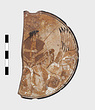
| From a double disc: bobbin or yoyo? Nearly two-thirds of one disk preserved; broken at the left.
On the disc, Helios with the solar disk on his head and a goad in his hand, rises above Mt. Hymettos in ... 12-15 March 1935 ... On the disc, Helios with the solar disk on his head and a goad in his hand, rises above Mt. Hymettos in his chariot which is drawn by winged horses. |
| Eleven pieces comprising two non-joining fragments. To Young's publication of six pieces are now added five more, two of which help to complete to inscription.
Part of the side wall with reserved panel ... 600 B.C ... Hemberg shows that Apollo receives the title Anax in Homer and Classical literature far more often than any other deity, and since, like Zeus, Apollo was worshipped on Mount Hymettos (Pausanias, I, 32,2), it is possible that the inscription is a dedication to both deities.
|
|
|