|
|
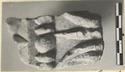
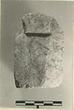
| Three non-joining fragments from drum below capital. Fragments a) and b) from the top, c) from the bottom. The drum was decorated with a band of palmette and honeysuckle in low relief, resting on a plain ... July 1950 |
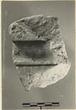
| Small fragment of a crowning molding decorated with egg and dart above a cavetto.
Northeast Stoa series.
Pentelic marble. Destruction debris associated with Northeast Stoa. 2103 Leica, XLV-31 ... July 1950 |
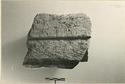
| Part of front face only remains, preserving a corner, with a cyma reversa bed mold. From cornice (?).
Northeast Stoa series.
Pentelic marble. Destruction debris associated with Northeast Stoa. 2103 Leica, ... July 1950 |
| Rough-picked behind; sawn above. In low relief on face, a flame palmette.
Northeast Stoa series.
Pentelic marble. Destruction debris associated with Northeast Stoa. 2103 Leica, XLV-31 ... July 1950 |
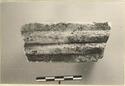
| Rough-picked behind, sawn at edge.
Apparently from border of a panel with plain fillet and border molding. Traces of burning.
Northeast Stoa series.
Pentelic marble. Destruction debris associated with ... July 1950 |
| Front face only is preserved.
Part of two fascia (complete width of neither is preserved). Surface hammer dressed except for a smooth border.
Northeast Stoa series.
Pentelic marble. Destruction debris ... July 1950 |
| Two non-joining fragments from volute.
Both fragments are symmetrical showing volutes on both sides. Traces of burning.
Northeast Stoa series.
Pentelic marble. Destruction debris associated with Northeast ... July 1950 |
| Fragment of volute, with one small joining piece.
The bolster was fluted transversely, with band of astragal between the flutings. The eye is flat save for a measuring point. The details of the astragal ... July 1950 |
| Fragment from bolster preserving parts of two flutings and of the intervening astragal.
Northeast Stoa series.
Pentelic marble. Destruction debris associated with Northeast Stoa. 2103 Leica, XLV-31 ... July 1950 |
| Small fragment from lower front angle. Finished front and bottom with broad chisel, on sides with single point.
Northeast Stoa series.
Pentelic marble. Destruction debris associated with Northeast Stoa ... July 1950 |
| Flake from the periphery.
Northeast Stoa series.
Green-grained white marble (of Karystos). Destruction debris associated with Northeast Stoa. 2103 Leica, XLV-31 ... July 1950 |
| Four joining fragments from a volute. Similar in design to A 1669 (ΣΑ 1375), but there is a marked difference of the edge of the volute and there are no drill holes in the astragal. Traces of burning ... July 1950 |
| Three joining fragments preserving the upper part of the antefix: a palmette.
Traces of burning.
Northeast Stoa series.
Pentelic marble.
Cf. A 1797 (Σ 2258). Destruction debris associated with Northeast ... July 1950 |
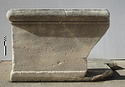
| About half of length and wall to full height preserved on one side.
Rectangular sarcophagus with plain projecting base, straight side wall with small and large half round moldings (archaic) at the top, ... June 1946 |
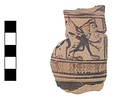
| Two joining fragments preserve part of oinochoe neck. In a reserved panel at front, a winged sphinx marching right. Face and wings drawn in outline. Selected sherds from late and disturbed fills in grave ... 1939-1940 |
Flaring ring foot; horseshoe handles. Glazed all over, save for a narrow reserved band at junction of foot and under- side.
For another skyphos of the same date, see P 10996 B 15:1 Hesperia, XVIII, 1949, ... 425-400 B.C. |
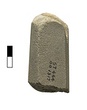
| Broken at both ends; slightly tapering.
Irregularly five-sided; part of a polisher similar to ST 456, made of sandstone.
Worn from use and one of the broken ends also worn smooth.
ADDENDA Identified as ... 1 April 1949 |
| A prismatic-shaped piece of abrasive stone, perhaps used to rub down or polish marble.
Sandstone.
ADDENDA Identified as "TPOXOΣ", and as being sandstone by A. Georgiades.
Cf. H.S.R. "Notes on Agora Stone-Worker's ... 1 April 1949 |
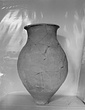
| Mended from many pieces; part of the shoulder and rim at one side missing. Many small chips. Ovoid body with a low flat base; flaring rim, flat on top and grooved on its outer edge.
Coarse pinkish-buff ... 13 August 1947 |
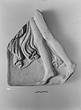
| Lower right corner of mold for large relief.
Raised band around edge of mould.
The positive shows the legs, to mid-thigh, of a girl with floating drapery, dancing to left. Brick Building, below floor of ... July 1950 |
|
|