|
|
Flat bottom; low strap handle.
Two published pieces which belong to the middle years of the century are P 10819 G 12:22 Hesperia, Suppl. IV, 1940, p. 126, fig. 94 c and P 21872 N 7:3 Hesperia, XXII, 1953, ... Ca. 480 B.C ... Two published pieces which belong to the middle years of the century are P 10819 G 12:22 Hesperia, Suppl. IV, 1940, p. 126, fig. 94 c and P 21872 N 7:3 Hesperia, XXII, 1953, pl. 31, 46. |
Ring foot. Flaring rim with thickened edge; ring at junction of neck and wall. Strap handles. Glaze worn and peeled ... Late 6th c. B.C ... Hesperia, Suppl. IV, 1940, p. 30, fig. 22. |
Recessed underside. Rim rounded on top. Totally glazed. Worn and peeled.
Similar, P 12397 G 12:23 Hesperia, Suppl. IV, 1940, p. 133, fig. 98 d. Also like are Oxford 398 A: CVA 1(3) pl. 48(140) 36; and ... 375-350 B.C ... Similar, P 12397 G 12:23 Hesperia, Suppl. IV, 1940, p. 133, fig. 98 d. |
Heavy flaring rim; low shoulder angle ... Context ca. 350-325 B.C ... Hesperia, Suppl. IV, 1940, p. 135, fig. 99 b. |
Resting surface and upper part of edge reserved. Ostrakon of Themistokles Neokleous (482 B.C.) ... Early 5th c. B.C ... Hesperia, Suppl. IV, 1940, p. 32, fig. 24 b. |
Flaring ring foot; horseshoe handles. Reserved: underside with two circles; zone above foot with part of foot, decorated with cross-hatching; handle-panels and just below; inside of rim.
For the date, ... Ca. 350 B.C ... P 12389 G 12:23 Hesperia, Suppl. IV, 1940, p. 133, fig. 98 b. |
Fragment of top side. Thin red wash on inside. Glaze misfired reddish and greenish. Max. dim. 0.085. H. A. Thompson, Hesperia Suppl. IV, p. 130, fig. 97:d.
On each side, a panther (forelegs, parts of ... Late 5th century B.C ... Thompson, Hesperia Suppl. IV, p. 130, fig. 97:d.
|
Flat projecting bottom rising to central tube. Spout nearly vertical. Groove under mouth. Reserved bottom. Glaze fired brown and black.
Contemporary, P 10818 G 12:22 Hesperia, Suppl. IV, 1940, p. 127, ... 475-450 B.C ... Contemporary, P 10818 G 12:22 Hesperia, Suppl. IV, 1940, p. 127, fig. 94f and P 5152 H 6:5 Hesperia, V, 1936, p. 341, fig. 9. |
Ring foot. Decoration inside: four palmettes within roulet- ting. Reserved: junction of wall and foot, and groove in resting surface.
From the same deposit, P 1818, P 1835, P 1837 Hesperia, III, 1934, ... 350-325 B.C ... From the same deposit, P 1818, P 1835, P 1837 Hesperia, III, 1934, pp. 317-318, A 15-17; see also P 13240 G 12:20 Hesperia, Suppl. IV, 1940, p. 135, fig. 99 a. |
Torus ring foot. Rim flat on top, sloping inwards, in- curving. Reserved: resting surface, underside with two glazed circles and central dot, and handle-panel.
Contemporary with this are P 21885-6 N 7:3 ... 475-450 B.C ... Contemporary with this are P 21885-6 N 7:3 Hesperia, XXII, 1953, p. 82, fig. 3, 62-63 and P 10817 G 12:22 Hesperia, Suppl. IV, 1940, p. 127, fig. 94 e. |
Flaring ring foot; high double handle. Glazed: the neck, a band below the handle-attachment, and on the top surface of the foot.
There are three published examples from deposits of the second quarter ... 480-450 B.C ... There are three published examples from deposits of the second quarter of the 5th century: P 5154 H 6:5 Hesperia, V, 1936, p. 343, fig. 10; P 9473 C 9:6 Hesperia, Suppl. V, 1941, p. 138, fig. 64, 25; P 10822 G 12:22 Hesperia, Suppl. IV, 1940, p. 127, fig. 94 b. |
Nipple beneath. Banded decoration; underside reserved with circle and dot.
From the same deposit, similar, P 24974, smaller. Close is P 13350 H 10:2 Hesperia, Suppl., IV, 1940, p. 14, fig. 11 a; XXV, ... 575-550 B.C ... Close is P 13350 H 10:2 Hesperia, Suppl., IV, 1940, p. 14, fig. 11 a; XXV, 1956, p. 370, noted. |
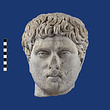
| Broken off at the top of neck; tip of nose missing; traces of fire below.
Bearded and mustached male portrait head. Pupils doubly drilled; iris grooved. Hair of head lightly drilled, of face stippled ... Period of Gallenius ... Pentelic marble.
Cf. Hesperia Suppl. IV (1940), p. 101.
|
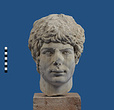
| Head of a young man broken off at the base of neck; tip of nose missing,
He has a mustache and sideburns. The hair is lightly drilled in front, the eyebrows are rendered plastically; pupil drilled in crescent ... 215-225 A.D ... Pentelic marble.
Cf. Hesperia Suppl. IV (1940), p. 101. |
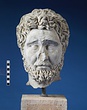
| Bearded male head broken off at root of neck; nose and eyebrows chipped, left ear lobe broken off. The brows furrowed, the beard and hair freely drilled. The hair at back of head merely blocked out. Surface ... Antonine period ... Pentelic marble.
Cf. Hesperia Suppl. IV (1940), p. 101.
|
Unglazed.
Cf. P 2880 G 13:4 Hesperia, III, 1934, p. 326, fig. 9, A 66 and P 13243 G 12:20 Suppl. IV, 1940, pp. 134-135, fig. 99 c ... End of 4th c. B.C ... P 2880 G 13:4 Hesperia, III, 1934, p. 326, fig. 9, A 66 and P 13243 G 12:20 Suppl. IV, 1940, pp. 134-135, fig. 99 c. |
Handle, large fragments of body and base missing. Shallow body, rounded rim; short, broad nozzle. Traces of horizontal band-handle.
Clay: fine grey (burned); brown black glaze inside and out. Thesmophorion, ... 1932 |
Fragment of rim and nozzle only. Shallow body. Short, very broad nozzle withvery large wick hole.
Clay: fine buff, black glaze (worn) inside and out. Assembly Place, filling of Period III ... 1932 |
Back of body missing.
Shallow body, tending slightly to the 'watch shape'. Rather long, blunt nozzle. Very low base.
Clay: fine buff (slightly burned); brownish red glaze (much worn) all over, also ... 1934 |
Fragment of rim and nozzle only.
Typical rim; short, slightly tapering nozzle. Glaze omitted from top of nozzle and from band around filling-hole (apparently colored with miltos).
Clay: fine reddish; ... 1932 |
|
|