|
|
Excavation terminated at 7.39m. due to danger of collapse. All the objects are from section Ω ... Ca. 50-1 B.C ... Excavation terminated at 7.39m. due to danger of collapse. |
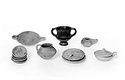
| Excavation of this pit began in 1995, tentatively identified as a pyre. This proved to be so with continued excavation in 1996. The deposits J 2:8 and J 2:9 were combined to become J 2:9. Miniature vessels ... Ca. 300 B.C ... Excavation of this pit began in 1995, tentatively identified as a pyre. This proved to be so with continued excavation in 1996. The deposits J 2:8 and J 2:9 were combined to become J 2:9. |
Hephaisteion Garden; fill beside wall. Loose filling encountered in rescue excavation to examine wall found during construction of public toilet in Theseion Park, outside Agora area. SIR 1991
Originally ... Second half of 4th c. B.C ... Loose filling encountered in rescue excavation to examine wall found during construction of public toilet in Theseion Park, outside Agora area. |
Exploratory excavation trench between east front of Hellenistic Metroon and Great Drain.
Cf. Hesperia Suppl. 4 (1941), p. 106.
Cf. also Metroon Drain Cut I 9:1 and F-G 12:1 and H 12:9 ... 8th-6th c. B.C ... Exploratory excavation trench between east front of Hellenistic Metroon and Great Drain.
|
Dumped filling in the upper part of a well, to a depth of 6.65m. (the excavation could not be completed and the use filling was not reached). Homogeneous fill dumped from nearby. Coins:
1 June 1936 #1 ... Ca. 425-400 B.C ... (the excavation could not be completed and the use filling was not reached). |
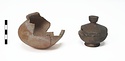
| Disturbed pyre containing only a pyxis and a chytridion.
No notebook account of excavation exists. The pyre may have been located at the edge of an ancient road. There is no record of bone or burning ... 350-325 B.C. (?) ... No notebook account of excavation exists. The pyre may have been located at the edge of an ancient road. |
| Rodney S. Young ... RSY/JP Disturbed Geometric burial over "Sacrificial Pit VI" (Grave B 21:22). Grave IX in notebook. Bones discarded?
Pottery found in the upper filling of a sixth century cremation pit, which had perhaps ... Middle Geometric II/Transitional to Late Geometric ... Excavation date more likely 31 May 1939 (p. 1929). |
Well in Byzantine Room 9. Excavation of the well terminated at 49.00m. due to cave-in danger. Topped by a stone sill and marble putael, the upper part of well is of Byzantine-period stone masonry; lower ... Byzantine ... Well in Byzantine Room 9. Excavation of the well terminated at 49.00m. due to cave-in danger. |
| Tile-lined well. Excavation of the well terminated at 47.548m. due to cave-in danger. Cf. MC 1499 and L 5995 found in vicinity of well; also ST 897, ST 943 and MC 1384 plus coin N 12048 (ΒΕ-1403) found ... 15 June 1993
28 June 1993
23-30 July 1993 ... Tile-lined well. Excavation of the well terminated at 47.548m. due to cave-in danger. |
Mycenaean Grave inside NW corner of N extension of Stoa.
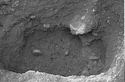
It was set deeply down, ca. 1.50m below the surface. Excavation revealed a single skeleton, extended, with head to east, and legs bent up at the ... Myc. III B ... It was set deeply down, ca. 1.50m below the surface. Excavation revealed a single skeleton, extended, with head to east, and legs bent up at the knees, the arms folded over the abdomen. |
Well. Construction, use and dumped fillings of the Hellenistic period. Tile-lined well with a packing of jars behind the tiles; the well cut through (Fill 4) the passage of a cistern (B 21:25). At 9.00m ... Hellenistic ... At 9.00m. a threatened collapse of the walls caused abandonment of the excavation work at the point when the use-filling had just been reached. |
7th c. well below east part of Odeion Cavea Trench K). Use filling negligible; dumped filling of the second half of the 7th c. B.C.
Brann Well H. Diameter 1.10m. Cut into bedrock. During excavation seepage ... 650-600 B.C ... During excavation seepage water collected. |
Well behind Stoa Shop 18 (Well G: EB). Provides useful antecedents for many later shapes both black and plain.
Diameter at bottom 0.88m. Eight pairs of footholds preserved. The influx of water during excavation ... 650-625 B.C ... The influx of water during excavation was moderate. |
Cistern at 17-18/ΛΑ (Coroplasts' Dump) outside the market square to the southeast, west of the Panathenaic Way.
Upper and lower fill distinguished during excavation, but material from both appears to ... To ca. 330-320 B.C ... Upper and lower fill distinguished during excavation, but material from both appears to be contemporary.
|
A total of 79 ostraka was recovered from Room 5 of the Classical Building.
More of this deposit was excavated in the 2021 season on the opposite side of the scarp of Wall R, up against the face of Wall ... 500-475 B.C ... The excavation produced a substantial number of new ostraka. |
Mycenaean Tomb to E of Stoa Shop 19 (ΣΑ 2).
Found while digging just east of Stoa Shop XIX, when came upon some bones, Mycenaean sherds and a pot. As the excavation was enlarged the legs of two skeletons ... Myc. III A:2 (2nd half of 14th c.) ... As the excavation was enlarged the legs of two skeletons were exposed in a trench about one meter wide, with the whole pot and the coil of lead wire found between two sets of legs. ... Although the excavation of this tomb was incomplete, it was clearly a chamber tomb with multiple burials, and contained some very fine and unusual pottery (ritual character-burial of a person of some religious stature). |
Cistern with two tunnels, the one entering its neck cut off by an early Roman well, the other, at the bottom not excavated.
Chamber conical in shape, with a depressed draw basin in the center of the floor ... Early Roman-3rd c. B.C ... No stratigraphy noted during excavation, but analysis of pottery suggests three fills, of which the lower two are potter's dumps.
Subdivisions are based on containers at time of excavation.
Middle fill: Only stamped amphora handle comes from Late Corinthian jar of second half of 3rd c. |
| Well at 89-90/ΙΗ-ΙΘ (diameter at top 1.10m), between the southeast corner over the mouth of of the Odeion and the Panathenaic Way. The well lay a thin layer of dug bedrock containing a few Hellenistic ... 650-625 B.C ... The inflow of water during excavation was rapid. |
| James Artz Pirisino Daniele Kylindreas Miltiades ... Excavation in Room 3 of ΒΘ West revealed 5 ceramic vessels in a row against the eastern face of Wall 12. 3 complete vessels (ΒΘ 122, 124, and 125) were catalogued, along with the base of a plain glazed ... 9th-11th c. A.D ... Excavation in Room 3 of ΒΘ West revealed 5 ceramic vessels in a row against the eastern face of Wall 12. 3 complete vessels (ΒΘ 122, 124, and 125) were catalogued, along with the base of a plain glazed flat-bottomed basin (ΒΘ 121). ... Fill below the end of season stopping point (elev.: 53.509) may contain sherds that join with those from the 2012 excavation season. See also ΒΘ Lots 139, 239 and 240 for possible joining sherds from previous excavation seasons.
2013 Addendum:
During the 2013 field season, excavation in Room 3 of ΒΘ West revealed 3 ceramic vessels at approximately the same elevation as the pots assigned to Deposit K 3:2 during the 2012 season. ... The floor was left in situ at the end of the season.
2017 Addendum:
In 2017, we resumed excavation of Room 3, concentrating our efforts on the high baulk at the northeastern part of the room.
|
| "Koumanoudes' Well.
Tile-lined well (diam. 0.85m) at SE corner of courtyard of Roman House E, at top built wall of stones and mortar, bedrock at bottom. Coin
7 August 1971 #495-#500
13 August 1971 #507 ... 28 July-6 August 1971 ... Layer 1 :0-13.20 Backfill from Koumanoudes' excavation. |
|
|