|
|
Above well at 48/ΙΕ (J 15:1) ... Early Roman |
Pocket on the line of the early (Archaic) peribolos wall at entrance on the south side. Uncatalogued material: 215 sherds, 186 + frags. plemochoai and 4 objects.
Classical Ware : black glaze; mug; rilled-rim ... 3rd quarter 4th c. B.C. |
Located just north of the stepped retaining wall between the Great Drain and the Poros Monument (Propylon).
Short period of use; dumped filling above, mostly cemetery debris ... Early Protogeometric |
Clearing bedrock on line of early (Archaic) peribolos wall, east of entrance on the south side, west end. Uncatalogued material: 50 sherds, 83 fragments. of plemochoai.
Classical Ware : lekythos; plemochoai ... Early 2nd c. B.C. |
| David Scahill ... Behind northeast corner of Classical Building; east wall C. Below Hellenistic levels and early Classical pit. Chamber cut through bedrock, depth ca. 0.90m., diameter ca. 2m., roughly square in shape, angling ... LH III A:1 |
Located in front of west end of Stepped Retaining Wall, Heliaia. Filled in and covered in last stages of grading of area after construction of Middle Stoa.
Pottery from settling basin nondescript. Single ... 175-150 B.C. |
Plaster dump at Q/2,5-6/7,9.
Layer 5 in "Wall Painted Room" of Roman House ε. Layer resting on bedrock and covered partially by good strosis (55.26m.). Fill was red with mudbricks, tiles, much plaster ... Late 1st-early 2nd c. A.D. |
Double Well by E. Entrance to Square Building (Well A) (formely a O 8:1) Coin
21 April 1951 #1 (disintegrated) Carefull there is two O 8:1, the actual one is a filling around rubble wall at 35/ KE.
Estimated ... 750 to early 7th century B.C. |
42-50/Ζ-ΙΑ: below uppermost Byz. Floor at level of top of railroad retaining wall (cf. also 50/Ι: from packing of floor). Coins:
24 March 1936 #18-#22
26 March 1936 #9-#10 ... Early Byzantine |
| Dorothy Burr Thompson ... Child's Grave (E.L. Smithson: Grave XXVIII: G).
Cf. Container Lot ΣΤ 165 (fill over geometric grave).
Neat, rectangular, unlined trench, cut into bedrock to a preserved depth of 0.20m,below the level ... Early Geometric I |
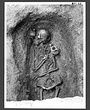
| John Camp ... Protogeometric grave (female inhumation) located about 0.60m northwest of T 15:1. It consisted of a roughly rectangular pit, with the corners slightly rounded, oriented approximately north-south. The pit ... "Submycenaean"/Early Protogeometric |
Well E (diameter 1.10-1.20m) just outside the northwest corner of the southwest Fountain House.
Dug initially as a pit (J 15:2) partially covered by an early Roman wall ... Early 7th c. B.C ... Dug initially as a pit (J 15:2) partially covered by an early Roman wall. |
Well ΑΒ located on the lower terrace to the north of the sanctuary(diameter 1.10m). Foot-holes were cut into the shaft at intervals of ca. 0.40m. The fill consisted mostly of small stones, dug bedrock, ... Second quarter of the 6th century B.C. |
Mycenaean Well (S/1,2-13/20,14/1). Underneath the NE Room of the Library of Pantainos, along its S side, as a cutting in bedrock containing reddish fill with bits of green bedrock. The feature is rectangular ... 30 June-23 July 1975 ... B.C.) seems to indicate that the shaft of S 13:2 may not have been filled to the top originally (or the fill settled over centuries), and had been covered in some way, not to be rediscovered until the early Roman period.
The location of the well immediately beside a wall of the library main room, as well as the coincidence of the top edge of the well with the bottom level of the library Main Room wall, would suggest that the shaft was cut into during preparations for the construction of the library, which also removed any structural remains that may have been associated with the use phases of the Classical wells.
|
| James Artz Pirisino Daniele Kylindreas Miltiades ... Excavation in Room 3 of ΒΘ West revealed 5 ceramic vessels in a row against the eastern face of Wall 12. 3 complete vessels (ΒΘ 122, 124, and 125) were catalogued, along with the base of a plain glazed ... 9th-11th c. A.D ... Excavation in Room 3 of ΒΘ West revealed 5 ceramic vessels in a row against the eastern face of Wall 12. 3 complete vessels (ΒΘ 122, 124, and 125) were catalogued, along with the base of a plain glazed flat-bottomed basin (ΒΘ 121). In addition to the vessels along the face of Wall 12, 5 coins were found within the fill, as well as a bronze ring and fragments of painted plaster (ΒΘ 134) from a wall.
... Many fragments of a deep bowl with poorly preserved glaze (ΒΘ 171) were wedged between the wall of the pithos and the southern face of Wall 23. |
Fillings associated with Southwest and North Buildings (78-99/ΙΣΤ-ΚΘ) and early walls to west of Great Drain.
pottery p. 1189, vol VII ... Subdivisions:
.1=Filling over bedrock.
.2=Fillings behind retaining ... Various levels and dates ... Fillings associated with Southwest and North Buildings (78-99/ΙΣΤ-ΚΘ) and early walls to west of Great Drain.
... Subdivisions:
.1=Filling over bedrock.
.2=Fillings behind retaining wall and in road.
.3=Dumped fillings probably of construction of Great Drain.
.4=Fillings of reuse of walls in north part of area.
.5=Late fillings over early walls. |
| Disturbed pyre in NE stoa area.
In western room of westernmost shop building. A patch of ash i or at the level of layer 2 (lot Ι 189d), partially destroyed by modern wall. Pottery from layer 2 dates ... 400-350? ... A patch of ash i or at the level of layer 2 (lot Ι 189d), partially destroyed by modern wall. Pottery from layer 2 dates at least as late as the early 4th c. |
| Laura Gawlinski ... Well in courtyard of Early Building I, adjacent to wall of Room B. Tile lined; upper course in situ, lower two collapsed probably in antiquity. Letters inscribed on rims (eta, phi, omicron, theta). Medium ... First quarter of the 4th c. B.C. |
| Osteotheke. (Group N). Coin
7 May 1938 #7 83/ΜΔ (83-84/ΜΓ-ΜΕ: If I judge from p. 811, this grid would be the concrete retaining wall). Somebody else wrote the following grid on page 878: 83-85/ΜΓ-ΜΣΤ ... Early 7th cent. |
Two chambers connected by a tunnel, all filled at the same time, but with slight Hellenistic disturbance. Chamber A, to west at 14/ΛΗ, B to east at 14-15/ΛΒ on grid for section RR.
Cistern system ca. 20.00m ... Ca. 325-275 B.C ... Abandonment of cistern and source of contents probaby attributable to an undetermined event in the early part of the decade 310 B.C.
In the early 3rd c. B.C. very possibly ca. 277/6 (see Garden article), the southerly side of Kolonos, outside the Precinct Wall, was levelled off and the double cistern were cut down and filled p. 833 ... Coins:
4 February 1936 #1
5 February 1936 #1
6 February 1936 #1-#2
8 February 1936 #3
10 February 1936 #1-#3
12 February 1936 #1-#13
13 February 1936 #1-#6
14 February 1936 #1 |
|
|