|
|
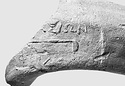
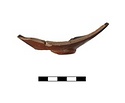
| Finished Fountain House Porch; various remains of Hellenistic and early Roman fills. [Θ]ασίων
ladle
Φε̣ί̣δω̣ν Leica ... 26 May 1954 ... Fountain House Porch; various remains of Hellenistic and early Roman fills. |
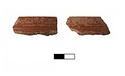
| Early Roman stamped ware showing remains of three impressed tree motifs around center of plate. High ring base.
Clay gray at core, orange at surface; covered on inside of plate only with thin purplish-brown ... 10 March 1932 ... Early Roman stamped ware showing remains of three impressed tree motifs around center of plate. ... Joins with P 693.
Early Roman Stamped Ware. |
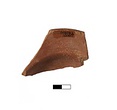
| End of nozzle and part of bottom.
Remains of letters in relief.
Black glaze.
Type XVIII (post Sullan) of Corinth collection, Miscelaneous Moulded type of Agora collection.
Hellenistic-early Roman fill ... 3 March 1936 ... End of nozzle and part of bottom.
Remains of letters in relief.
... Hellenistic-early Roman fill. |
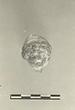
| Faces and part of conical headdress preserved.
Much white remains and a few traces of yellow over.
Dark red to buff clay. South of north wall V A, layer 11.
Early Byzantine. Leica ... 20 May 1939 |
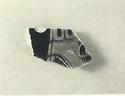
| There remains only part of the cock from the top of the left column, along with a little of the tongue pattern above. Filling of early water basin in disturbed deposit with late Roman sherds. Leica ... 6 July 1933 ... There remains only part of the cock from the top of the left column, along with a little of the tongue pattern above ... Filling of early water basin in disturbed deposit with late Roman sherds. |
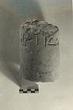
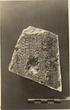
| Inscribed fragment of columnar grave monument.
Circumference preserved; broken above and below.
One line of the inscription preserved, and remains of another above.
Pentelic marble.
Early Christian. Found ... 16 March 1936 ... One line of the inscription preserved, and remains of another above.
Pentelic marble.
Early Christian ... Found in mixed late Roman and Turkish context, in front of the north end of the Stoa of Attalos. |
| Inscribed fragment.
Right side only remains.
Five lines of the inscription preserved, traces of sixth and seventh lines; stoichedon.
Hymettian marble. Found in late Roman destruction debris of large monument ... Early 3rd. century B.C. |
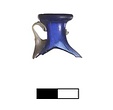
| A single fragment preserves the neck, the flaring rounded rim, and one handle, with the upper attachment of the other, of a miniature amphora.
Dark blue glass; the handles white glass. For contaxt see ... 2 July 1947 ... Filling over marble chip floor in a Roman House (House C) built over the remains of the Poros Building west of the Areopagus, area room 7.
Early Roman(?) |
| Fragment of top only.
Recessed center panel, and cross panels, on rim. On discus, four masks, of which two remains.
Unglazed.
Fine buff clay.
Type XXVII of Corinth collection.
ADDENDA Late 1st. early ... 16 April 1952 |
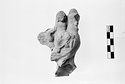
| A large cock, right; on its back, seated sideways, a child, with his left arm apparently around the bird's neck; in his right hand some object - a pot? ; drapery over his lower legs. The back plain, with ... 13 October 1947 ... Considerable remains of white, and a few traces of light red or orange color.
... ADDENDA Cf T 2008, probably Early Roman; Herakles deposit ... Roman Bath: red fill in compartment under Hypocaust Room; probably early Roman. |
| Female head, wearing elaborate headdress (or helmet with turned-up cheek-piece?) over curling locks.
Face and left side of head preserved; broken all around.
Remains of red wash on face.
ADDENDA Probably ... 26-27 May 1949 ... Face and left side of head preserved; broken all around.
Remains of red wash on face.
ADDENDA Probably helmet; cf. Late Roman Helmeted Head.
... Area of 13th. and 14th. piers; early Byzantine fill below general level of house walls. |
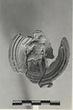
| Preserved are most of rim and discus, a little of wall and base. Fragmentary.
Very low foot ring set off by grooves. Narrow grooved rim. Discus shows gladiator facing, right arm raised, holding a weapon; ... 16-27 April 1936 ... The end of one nozzle-volute remains.
Type XXII of Corinth collection ... Early Roman well. |
| Two loose rim sherds, surfaces flaking.
Vertical rim: S-curved exterior with grooves marking off convex bands; slight flange at bottom (remains of rouletting). Concave band between fine grooves on upper ... 27 May 1938 ... Vertical rim: S-curved exterior with grooves marking off convex bands; slight flange at bottom (remains of rouletting). ... Early Roman Fill. |
| Broken, burned, and chipped; the handle and most of the left side missing.
A raised edge around a ribbed top; two ridges around filling hole continuing along top of nozzle. Simulated ring foot.
Remains ... 21 February 1936 ... Simulated ring foot.
Remains of black glaze.
... Strosis 1, late Hellenistic-early Roman context. |
| Half of base with lower wall with small piece added (a), loose fragment of lower wall with scar of base (b).
Flat base (two grooves on bottom) with sloping edge marked off by a groove. Oblique lower wall ... 27 May 1938 ... No handle remains preserved.
... A.D. series: end 1st or early 2nd c. A.D ... Early Roman fill. |
| Right side of lamp preserved.
Panelled rim, with scroll pattern.
On discus, two fishes, left; filling hole beneath; two ridges separating rim from discus.
Nozzle, set off from rim by two diagonal grooves ... 2 June 1932 |
| Part of rim and side.
Sloping rim with slightly knobbed lip marked off on top by a groove; remains of a domed top (treatment at center unknown.)
Red slip, perhaps later Çandarli fabric: brick red, with ... 20-21 May 1937 ... Sloping rim with slightly knobbed lip marked off on top by a groove; remains of a domed top (treatment at center unknown.)
... Residual find (context 4th century). Early to mid 2nd century? ... Bottom fill: 4th c. Roman glazed ware. |
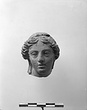
| First interpretation: head of woman.
Head of Apollo, at fairly large scale, tipped slightly to his right.
Broken off at neck; chips missing.
The hair is parted in the center and drawn over the brows to ... 20 May 1939 ... Made hollow; no remains of color. Good work.
... Over late Roman water channel, layer III.
Possibly from Koukla Factory fill.
Early Roman. |
| Chips missing; something broken from the top; bottom edge worn, perhaps original.
Two zones of stubby grooved leaves at the bottom, volutes beneath the abacus at the corners, and a rosette on a twisted ... 25 May 1939 ... Considerable remains of white, with traces of red over.
... House K, brown early Roman fill. |
| One side of body with a little of rim; foot almost all lost. Another element once attached to flange and rim on one side; only the clay attachment preserved. Slightly burnt patches and reamains of a white ... 5-9 March 1936 ... Flat floor, continued as a flat external flange; low outcurved wall/rim, remains of a high flaring footring, luted on to the body. (An elaboration of the normal local Early Roman 'incense burner'.)
|
|
|