|
|
| Burned Deposit. A thick deposit of ash, cinders and pottery fragments extending alongside wall of cemetery. Character of pottery like the pyre of F 12:2 ... Late Geometric ... Burned Deposit. A thick deposit of ash, cinders and pottery fragments extending alongside wall of cemetery. Character of pottery like the pyre of F 12:2. |
Ash and Carbon Dump in Corridor directly behind Room C of Brick Building.
This material comprises what appears to have been a household dump associated with the period of use of the Brick Building, but ... To mid-2nd century |
A dumped filling including red figured fragments of the second quarter of the 4th c. B.C. Coins:
25 June 1931 #12 (in strosis above pottery deposit) 15 November 1952, going through the containers Tin 59-Box ... Ca. 375-350 B.C ... A dumped filling including red figured fragments of the second quarter of the 4th c. ... Coins:
25 June 1931 #12 (in strosis above pottery deposit) |
Irregular pit in bedrock; deposit chiefly of terracotta figurines, with a small amount of pottery ... 6th c. B.C ... Irregular pit in bedrock; deposit chiefly of terracotta figurines, with a small amount of pottery. |
A well on Kolonos Agoraios. The upper dumped filling, a heavy deposit of pottery, was separated from the lower filling of similar character by several meters of plain mud. No use filling. Coins:
8 April ... Ca. 375-325 B.C. with disturbance of 250-225 B.C ... The upper dumped filling, a heavy deposit of pottery, was separated from the lower filling of similar character by several meters of plain mud. |
Tiled Well in Square Building Foundations, equipped with evenly spaced hand-holds, with a good supply of water. There was no period of use represented and the dumped fill consisted mostly of chunks of ... Third quarter of 4th c. B.C. |
East of Classical Building II backwall, above Mycenaean chamber tomb K 2:5. Rough circular pit of reddish brown fill cut into geometric fill that extends down inside tomb. Some evidence of burning on pottery ... Ca. 460 B.C ... East of Classical Building II backwall, above Mycenaean chamber tomb K 2:5. ... Some evidence of burning on pottery and in fill. Large deposit of fragmentary pottery. |
Pocket of late Geometric pottery in bedrock behind Stoa Shop V; apparently a household deposit ... 750-700 B.C ... Pocket of late Geometric pottery in bedrock behind Stoa Shop V; apparently a household deposit. |
Diameter 0.83m. Water level -4.20m. Tiled well; height of tiles 0.60m. Heavy deposit of pottery throughout; stamped amphora handles, five Knidian; one Rhodian; one Parian. Semi-coarse stamnos; funnel-mouthed ... Ca. 120 B.C ... Tiled well; height of tiles 0.60m. Heavy deposit of pottery throughout; stamped amphora handles, five Knidian; one Rhodian; one Parian. |
| Burned deposit: Middle Terrace, south of Archaic cemetery.
RSY: Pyre 10.
Pottery, burnt bone, charred logs, and heavy burning, recovered by tunneling under the cement floor of a Late Hellenistic workshop, ... Ca. 325-300 B.C ... Burned deposit: Middle Terrace, south of Archaic cemetery.
RSY: Pyre 10.
Pottery, burnt bone, charred logs, and heavy burning, recovered by tunneling under the cement floor of a Late Hellenistic workshop, between two lekanai set into the ground and functioning with the cement floor. |
Washed-in filling at the base of the Acropolis cliffs, some 7m. east of the Klepsydra; the fill was characterized by teh fragments of a series of red-figured oinochoai of special shape, of the late 5th ... Late 3rd c. B.C ... The filling which had been undisturbed since antiquity, was in places as much as 0.80m deep and produced a great quantity of pottery. Much of the pottery was coarse, fragments of rooftiles, storage jars and so on; but it included fragments of at least eight very curious oinochoes.
The deposit seems certainly to have been formed at one time; the latest sherds and the coins show that this must have been as late as the end of the third c. ... Although the character of the pottery precluded the possibility that this was a sanctuary dump, it seemed probable at first that the pit was in part artificial, and that the pottery had been deliberately deposited there. |
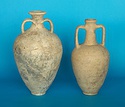
| Marcie Handler ... A deposit of six amphorae and one micaceous water jar was excavated between 20 June and 6 July 2005 in the area north of Wall K. The neck and one handle of one of the amphorae (BZ 1213) had been poking ... Ca. 1st c. A.D ... A deposit of six amphorae and one micaceous water jar was excavated between 20 June and 6 July 2005 in the area north of Wall K. ... Along with the one whole amphora (BZ 1213), two mended amphorae (BZ 1262 & 1263) and the micaceous water jar (BZ 1264), there were also in-situ fragments of three other amphorae, but the necks, handles, and/or bases of these amphorae were missing and the vessels were therefore not mended (the fragments of these three amphorae can be found in the pottery tins).
... The remaining fragments of amphora BZ 756 can be found in the pottery tins BZ 1540-1541. |
Packing under cobblestones 7 or 8 meters west of the Temple of Hephaistos. A similar filling found in a small hole in bedrock three or four meters north of the Temple. The high quality of the pottery from ... Ca. 500-440 B.C ... Packing under cobblestones 7 or 8 meters west of the Temple of Hephaistos. A similar filling found in a small hole in bedrock three or four meters north of the Temple. The high quality of the pottery from this deposit and the fact that some of it shows signs of burning has suggested that it might have come from a sanctuary destroyed by the Persians. ... Agora XXX: This deposit will have to be down-dated to 440 B.C. because of 231, which should be dated ca. 440 B.C. |
Well at 115/ΣΤ (all the 5th c. fills of 116/ΣΤ). The lower part of the shaft contained a heavy deposit of pottery and other objects of the late archaic period, both coarse and finer wares; probably a post-Persian ... Ca. 500-480 B.C.-Roman ... Well at 115/ΣΤ (all the 5th c. fills of 116/ΣΤ). The lower part of the shaft contained a heavy deposit of pottery and other objects of the late archaic period, both coarse and finer wares; probably a post-Persian clean-up. ... Little pottery catalogued ... Deposit Lists file has the 5th c. objects from this deposit listed together with those fallen in from D 15:2. |
Brian Martens ... This deep stratum (ca. 030m) is delayed Persian destruction cleanup deposited in the 470s B.C. it contains about one generation's worth of pottery, almost exclusively dating between about 500-470 B.C ... 29 June-19 July 2017
12–15 July 2022 ... The stratum abutted E-W polygonal Wall 8 and was laid down for Post-Persian renovations of the building. The dump of pottery raised the floor level of the building; atop J 1:18 was a layer of crushed bedrock and a renewed floor surface.
The deposit joins fill taken in 2013 that runs under the scarp of Wall G.
Addendum 2022: The collapse of Wall G’ allowed further work on deposit J 1:18 in the 2022 season. |
Dumped debris filling east of East Building, badly shattered. There is a small amount of disturbance from the filling immediately above, but the bulk of the pottery is consistent, and very close to that ... Ca. 470-460 B.C. |
Construction fill below floor of Brick Building.
Areas involved:
a) Western portion of Room A: packing below floor.
b) Room B: packing below floor of northern,larger room.
c) Fill over water channel in ... First quarter 2nd century, before its end |
Pottery Deposit at 57/ΙΔ (also 57/ΙΣΤ and 63-66/Κ-ΚΕ). Contents of pit range from Mycenaean to Turkish; apparently the dump of a modern antiquities dealer ... Modern Context ... Pottery Deposit at 57/ΙΔ (also 57/ΙΣΤ and 63-66/Κ-ΚΕ). Contents of pit range from Mycenaean to Turkish; apparently the dump of a modern antiquities dealer. |
Small amount of fill accumulated at bottom of well during use sealed by deposit of some 7.00m. of dug bedrock, thrown in to fill well to level of bottom of new cistern. Pottery closely similar to that ... 335-294 B.C ... Small amount of fill accumulated at bottom of well during use sealed by deposit of some 7.00m. of dug bedrock, thrown in to fill well to level of bottom of new cistern. Pottery closely similar to that of
F 11:2. |
| Pyre in House T (= House D), Room 2 (5th c.) and fill east of pyre.
Earlier than the other pyres of this house.
Pottery, slivers of burnt bone, and heavy deposit of carbonized material and cinders in ... Ca. 420-410 B.C ... Pyre in House T (= House D), Room 2 (5th c.) and fill east of pyre.
Earlier than the other pyres of this house.
Pottery, slivers of burnt bone, and heavy deposit of carbonized material and cinders in pit in floor sequence, with some pottery and burning found outside pit. ... It was probably deposited in the course of the first phase of the house, when the floor was renewed. |
|
|