|
|
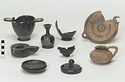
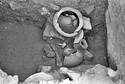
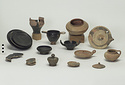
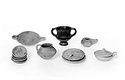
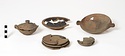
| Classical Pyre between floors in Room 2 of Classical Building II.
Below floor at 51.66 7masl. Broken pyre pots in fill of ash and carbon, from 51.541-51.513, resting on next floor at 51.513 masl, next ... Ca. 400-390 B.C ... Classical Pyre between floors in Room 2 of Classical Building II.
|
| Classical dump at N/1,6-6/6,8.
Layer 14 in Early Trench E. A tremendously thick layer of dumped fill with ceramic contents ranging down through the second half of the 5th century and into very early years ... Late 5th c. (Early 4th c.) ... Classical Dump |
East of Classical Building II backwall, above Mycenaean chamber tomb K 2:5. Rough circular pit of reddish brown fill cut into geometric fill that extends down inside tomb. Some evidence of burning on pottery ... Ca. 460 B.C ... Archaic-Classical |
| Classical Building II, Layer 7B ... 1st c. A.D ... Archaic-Classical |
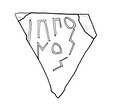
| Layer of crushed bedrock with ostraka, behind Classical Building ... 17 June-17 July 1996
28 July 1997 ... Layer of crushed bedrock with ostraka, behind Classical Building. |
| A well at the northeast corner of Classical Building, behind back wall. Dumped fill appears to have occurred as a single event as there are joining sherds throughout.
POU date ca. first half 5th c. B.C.; ... 5th c. B.C ... A well at the northeast corner of Classical Building, behind back wall. |
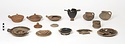
| Sacrificial Pyre I, Classical Building II.
The pyre was set through the original floor level of the northern room of the Classical Building and apparently is the remainder of a ritual conducted when the ... Ca. 375-350 B.C ... Sacrificial Pyre I, Classical Building II.
The pyre was set through the original floor level of the northern room of the Classical Building and apparently is the remainder of a ritual conducted when the old floor was raised. |
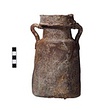
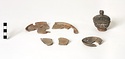
Classical commercial building, room 3, against south wall. Small fragments of pottery dispersed in fill overlying two floor levels (at 51.897 and 51.941 masl). Five objects of pyre type: ribbon-handled ... 4th c. B.C ... Classical commercial building, room 3, against south wall. |
A total of 79 ostraka was recovered from Room 5 of the Classical Building.
More of this deposit was excavated in the 2021 season on the opposite side of the scarp of Wall R, up against the face of Wall ... 500-475 B.C ... A total of 79 ostraka was recovered from Room 5 of the Classical Building.
More of this deposit was excavated in the 2021 season on the opposite side of the scarp of Wall R, up against the face of Wall 4. |
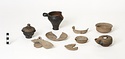
| Marcie Handler ... It was situated in the NW corner of Room 3 in the Classical Commercial Building, just S of Wall 11, the cross-wall that divides Room 3 from Room 4 to the north. The pyre pots were found surrounded by ... Late 4th c. B.C ... Archaic-Classical |
| Handler ... Found in an area of disturbed fill north of a floor surface in Room 4 of the Classical Commercial Building. The floor surface (n. 3 on the west side of Room 4) was preserved at 52.503-52.544 masl., and ... 2nd half 4th c. B.C ... Found in an area of disturbed fill north of a floor surface in Room 4 of the Classical Commercial Building. |
| Marcie Handler ... The Pyre was revealed in a layer of 4th c. fill in the north end of Room 6, just south of Wall 8. Room 6 is defined by the street wall (Wall A) on the west, Wall 7 on the east, Wall 9 on the south (preserved ... 4th c. B.C ... This pyre is the northernmost pyre found in Section ΒΖ North, and its location suggests that the Classical Commercial Building continues this far north. |
| Tile-lined well. Excavation of the well terminated at 47.548m. due to cave-in danger. Cf. MC 1499 and L 5995 found in vicinity of well; also ST 897, ST 943 and MC 1384 plus coin N 12048 (ΒΕ-1403) found ... 15 June 1993
28 June 1993
23-30 July 1993 ... Archaic-Classical |
Ione Shear ... Tile burial of an adult male found in 1991 on top of cover slab of south channel of river ... 27 June-3 July 1991 ... Archaic-Classical |
Anne McCabe ... Pithos D, adjacent to Pithos A at the NE, is built of stone and broken tile, beehive-shaped, unlined, with no floor. The wall of Pithos D appears to have been cut by the construction of the mortar wall ... 4-6 July 2007
31 July 2007 ... Archaic-Classical |
| Destruction Fill in channel of Apsidal Building.
Cf. nb.p. 989 for continued digging in this channel. Coins:
24 July 1990 #202, #204, #208
27 July 1990 #219-#222
30 July 1990 #226
31 July 1009 #236
1 August ... 14 June-3 August 1990 ... Archaic-Classical |
Well West of N-S Street. Coin
2 August 1982 #704 ... Ca. 115-75 ... Archaic-Classical |
| Excavation of this pit began in 1995, tentatively identified as a pyre. This proved to be so with continued excavation in 1996. The deposits J 2:8 and J 2:9 were combined to become J 2:9. Miniature vessels ... Ca. 300 B.C ... Archaic-Classical |
| Hellenistic Pyre below packed clay floors of Room 2; west of Late Roman wall extension, below tile platform terracotta drain installation, bordered on the north by bedding foundation stones of crosswall ... Ca. 300 B.C ... Archaic-Classical |
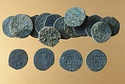
| Coin hoard. Room 2: soft soil north of floor surface. Coins:
23 July 1999 #924-#944. Anonymous folles with the head of Christ on the obverse dating between 770-1059 ... 23 July 1999 ... Archaic-Classical |
|
|