|
|
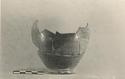
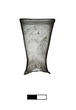
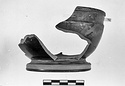
| Thin-walled type. Most of body and rim, with both handles missing. Shallow widely flaring ring foot, and eggy body, drawn in at lip.
Black glaze over all. Well, late 5th.-4th. c. B.C. Leica ... 18 May-4 June 1937 ... Hesperia 18 (1949), no. C 26, p. 318. |
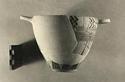
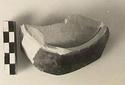
| Much missing from wall and rim. Restored in plaster. Similar to P 7154 but with low flat ring foot. Decoration: rays and a zone of fine bands to handle zone; handle zone divided into panels by vertical ... 10-16 March 1936 ... Hesperia Suppl. 2 (1939), no. C 26, p. 144, fig. 101. |
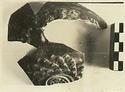
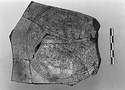
| Rim and most of the side wall missing. The medallion is centered with a 6-petalled rosette, around which are four overlapping rows of ribbed leaves. Goats rampant about kraters in the frieze. In the field ... 1932 ... Hesperia 3 (1934), no. C 26. |
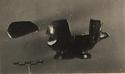
| A slender instrument with a point at one end and a small spatula at the other. Burned fill of bronze casting pit. 2287 Leica, 87-427, 79-4-8 2249-4 ... 18 April 1956 ... Hesperia 46 (1977), p. 356, pl. 86, no. C 26. |
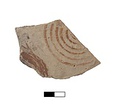
Fragment of a krater, buff clay.
Orange red glazed decoration: dashes on rim, band on body.
ADDENDA 2018: Single sherd to a krater with horizontal, flat rim.
The exterior decoration consists of a narrow ... LH IIIC ... Hesperia 8 (1939), p. 352, fig. 26,c. |
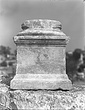
| Some edges chipped. Square plinth with moldings at top and bottom; Ionic base with torus, scotia, torus.
White fine-grained Pentelic marble. Trench Α, reused in 5th c. A.D. wall. 1635-1638 84-157 PD 1418 ... 22 April 1965 ... Hesperia 35 (1966), p. 82, n. 4, pl. 26 c. |
| Mouth preserved.
High rather narrow spreading neck, with plain lip, slightly thickened.
Pale greenish glass. Well, lower fill C. Containers 26-32.
3rd c. A.D. pre 267 A.D. Leica ... 21 June 1939 ... Well, lower fill C. Containers 26-32.
3rd c. |
| Broken at one end.
A flat square-headed blade at the other end. Well, lower fill C. Containers 26-32. Leica ... 21 June 1939 ... Well, lower fill C. Containers 26-32. |
Most of handles missing.
Moulded foot, concave beneath, with reserved groove in resting surface. Decoration inside: four palmettes within a spiral of rouletting. Glaze very thin in parts, giving an uneven, ... Ca. 375 B.C ... Hesperia, XXIV, 1955, p. 184, fig. 3, 26 and pl. 70, 26 a-c. |
| From skyphos with ring foot; incised inside the foot on the bottom:
The resting surface and the space inside the foot reserved, washed with pink. Well 5. Leica PD 788, PD 1133-12(C 26), DA 15237 ... 16 April 1935 ... Agora XXI, no. C 26, p. 14, pl. 6. |
| Preserved are ends of deep drapery folds caught up toward right edge of fragment by sandaled foot (toe missing), which rests on the back of a crouching beast, probably a lion, of which trunk and outline ... 2 February 1932 ... Delivorrias (1974), pp. 103 ff., Taf. 26 a-c, Falttaf. 1. |
| Base and most of central medallion preserved. On the central medallion an elaborate design in which appears a seated lion, his head front, his body following the contour of the circle, against a rinceau ... 9 May 1935 ... Hesperia 7 (1938), no. C 4, p. 462, fig. 26. |
| High ring foot and plain rim slightly offset on the inside only. The horizontal rolled handles are missing, and much of the rim and walls. Rouletting around center of floor. Reserved circles beneath foot ... April-May 1936 |
| Fragment preserving most of foot, part of wall and rim and part of one handle. Moulded ring foot; flaring wall; lip slightly offset inside only; rim slightly out-turned.
Stamped decoration: on floor, ... March 1937 |
| Single fragment, broken on all sides, preserving small portion of shoulder and handle scar of wheelmade vessel.
Shoulder curving in. Paint fired red. To left decoration (perhaps bow) of handle. To right ... 3 June 1937 ... Hesperia Suppl. 20 (1982), p. 149, n. 36, no. OA 314-26, pl. 22 c. |
| From the upper part of a cup with offset lip. Nothing of the medallion preserved.
On the outside, a dancer moving right (maenad), looking back. She wears a kerchief around her head and a chiton decorated ... 1936 |
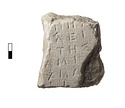
| Inscribed fragment.
Fragment ΟΑ 147 a), inscribed face only preserved.
Five lines of the inscription prreserved, part of sixth.
Fragment ΟΑ 220 b), inscribed face only preserved.
Seven lines of the inscription ... 4th. century B.C ... Fragment ΟΑ 228a c), part of the right face.
... b) (ΟΑ 220) T 26-27
c) (ΟΑ 228a) T 26-27
c) (ΟΑ 228b) T 26-27 ... a) (ΟΑ 147), found at surface, on the Acropolis north slope.
b) (ΟΑ 220), c) (ΟΑ 228a) and (ΟΑ 228b), found in original fill of the late Roman Fortification, over the paved court below the Kerameikos. |
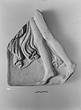
| Lower right corner of mold for large relief.
Raised band around edge of mould.
The positive shows the legs, to mid-thigh, of a girl with floating drapery, dancing to left. Brick Building, below floor of ... July 1950 ... Hesperia 20 (1951), p. 53, pl. 26 c. |
| Base ring and profile complete, but only a little of the wall, with the stump of one handle. Cup skyphos, the general effect similar to P 24584 (ΣΑ 2794), but the details different, and bowl deeper in ... May-June 1954 |
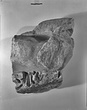
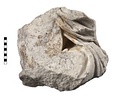
| Fragment from a large draped statue, probably in himation. It is not immediately apparent to what part of the statue it belongs. Joint-surface for an inset member shows that the statue was pieced.
Carefully ... Late 4th c. B.C. or Hellenistic. |
|
|