|
|
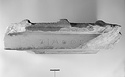
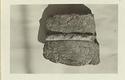
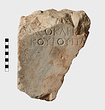
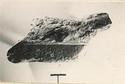
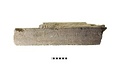
| Inscribed fragment.
Broken all around.
Fragment preserves part of crowning moulding.
Hymettian marble. Found in early Byzantine context over a Byzantine house, east of the altar of Ares. Leica ... 5 June 1950 |
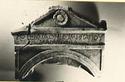
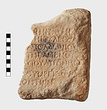
| Inscribed fragment.
The left part of a crowning member for a monument with recessed niche, and with horizontal cornice, not pediment.
Broken at right; top roughly picked with front sloping down and small ... 30 April 1947 ... Found in the wall of the Byzantine House I east of the Great Drain, in the industrial area. |
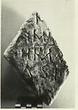
| Inscribed fragment.
Inscribed face, top, and left side preserved.
Hymettian marble. Found in wall of Byzantine pit under modern house 636α/5 [636/5 on Vrysaki map], west of the late Roman Water Mill. Leica ... 4 June 1951 |
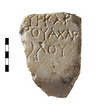
| Inscribed fragment.
Face and rough picked back preserved.
Pentelic marble.
Byzantine or later Christian. Found in the wall of the modern house 636α/1 [636/1 on Vrysaki map], over the northeast corner of ... 7 January 1935 |
| Inscribed columnar grave monument.
Full height preserved, but much worn and battered.
Three lines of the inscription preserved.
Hymettian marble. Found in a wall of the Byzantine House III west of the ... 30 April 1947 |
| Inscribed fragment.
Front face and one side preserved of a section of the left shoulder.
Fragments of three lines of the inscription preserved.
White marble; front face is polished.
Cf. I 7537. Finished ... 26 June 1981 ... White marble; front face is polished.
Cf. I 7537 ... Found in area I in fill in Room 7 of the Byzantine House Complex; layer VIII. |
| Inscribed fragment of grave stele.
Broken below.
Fragment preserved pediment, inscription and part of background for relief.
Both lettering and treatment of stone rather crude. Rough picked back. Two cuts ... 4 April 1951 |
| Inscribed fragment of early Christian Epitaph.
The left edge preserved; other edges broken.
Part of three lines of the inscription preserved.
Pentelic marble. Found in Turkish well, east of the Southwest ... 21 April 1934 |
| Inscribed columnar grave monument.
Fragment from the front, with part of the ring preserved.
Six letters of the inscription preserved in one line, and the tops of two in the line below.
Hymettian marble ... 27 February 1934 |
| Inscribed fragment.
Inscribed face and part of right side preserved; also sloping top with cutting at edge of break.
Probably a Herm.
Seven lines of the inscription preserved.
Pentelic marble. Finished ... 13 June 1947 |
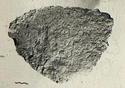
| Inscribed fragment.
A hunk of stone with letters on a very rough surface. Edges and back very rough, but may be contemporary with inscription.
Conglomerate; mortgage Horos.
Five lines of the inscription ... 13 June 1947 |
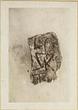
| Inscribed fragment of early Christian Epitaph.
Fragment preserves right side of an inscribed Latin cross with parts of four or five letters below and to right.
Coarse marble with greenish veins. Found ... 1931 |
| Inscribed fragment.
Left side preserved; all of the sides are broken except for the left side which is smoothly dressed. The stone suggests a base.
Parts of two lines of the inscription preserved.
Hymettian ... 2nd. century A.D. |
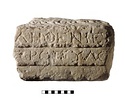
| Inscribed fragment of epistyle block.
Dedicatory inscription on two of three fasciae; reworked on adjacent side, in Byzantine times, with a rinceau at the top and part of some sculptured representation ... February 1953 |
| Inscribed fragment.
Letters inscribed on a partially smoothed down broken surface; back worn smooth; worn breaks at sides and top, in crude pediment form, may be contemporary with inscription; broken at ... 1st. century B.C. |
| Inscribed fragments.
Three joining fragments broken all around.
Original monument of large proportions.
From same and adjoining wall three more large uninscribed fragments (no joins) of same stone.
Stone ... 29 April 1950 |
| Inscribed fragment of statue base.
Broken to left and above, but part of cutting for statue preserved in top surface.
Part of a rough picked right face, and bottom worked in the same way, also preserved ... 5 June 1950 |
| Broken at the bottom; rough picked at the back; a pediment on top with akroteria, mostly broken away.
On the right, the side is original; on the left it has been cut back with filled flutings and a clawed ... Ca. 20 B.C ... On the right, the side is original; on the left it has been cut back with filled flutings and a clawed foot, probably a Byzantine reuse. The surface has a little mortar on it and is somewhat worn and peeled, particularly at the bottom.
... ADDENDA For the Byzantine reuse cf. I 918 (Θ 1539), and notebook p. 1149 ... Found, upside down, in a late level, in loose filling in Trench Σ, over House G, over the Civic Offices; with I 806. |
| Inscribed fragment.
Parts of crowning member of naiskos; face and rabetted bottom surface preserved; broken above towards front, at back and at sides.
Inscription on a plain band below mouldings now broken ... 20 April 1951 |
| Inscribed fragments of statue (?) base.
Fragment ΠΠ 108 a), possible traces of original surface on the under side. Top, sides and recut, with evidence of more than one reuse.
Fragment ΠΠ 108 b), preserves ... a) (ΠΠ 108) 3 July 1947
b) (ΠΠ 108) 10 October 1947 |
|
|