|
|
| Pocket with burning at 60/ΚΗ. "Is this perhaps a disturbed pyre burial." [Nbp. 2928].
Identified as pyre by SIR.
Near north end of corridor, beside its west wall. Concentration of artifacts, tiny scraps ... 4th c. B.C ... Pocket with burning |
| Pit with traces of burning ... Probably 3rd qtr. 5th c. B.C ... Pit with traces of burning. |
Pit 6 in Grave area. South cut, Metroon Section. Pit with burning ... Late 5th. c. B.C ... Pit with burning. |
Shallow pit containing pottery, burning and tiny fragments of bone. A dumped group of pottery in an amphora pit, ca. 1.00 m. in diameter, 0.60m. in depth. Many tiny fragments of bone were in the fill ... 375-325 B.C ... Shallow pit containing pottery, burning and tiny fragments of bone ... Many tiny fragments of bone were in the fill and a great deal of burning. |
Layer 7 in South Peristyle of court of Roman House Ε. Irregular cutting in bedrock with sand, gravel, fallen bedrock. Some burning ... 275-250 B.C ... Irregular cutting in bedrock with sand, gravel, fallen bedrock. Some burning. |
Pit on north slope of Kolonos Agoraios. Traces of burning in the dirt fill; mixed in with this many fragments of fine pottery ... Ca. 450-420 B.C ... Traces of burning in the dirt fill; mixed in with this many fragments of fine pottery. |
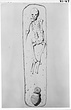
| Child grave. Grave 21 in notebook. No burning. No offerings. Covered by a 5th c. filling disturbed in Turkish times. Neg. ΚΚ 83, shows skeleton. Possibly discarded? ... 27 March 1936 ... Grave 21 in notebook. No burning. No offerings. |
Deposit of black glazed table ware found with a mass of bones, iron waste and burning. Coins (from above Hellenistic/associated floor):
7 April 1948 #10-#11 ... 375-325 B.C ... Deposit of black glazed table ware found with a mass of bones, iron waste and burning. |
Red fill with burning over south part of Heliaea. Post Herulian Metal- Worker's establishment. Coins:
20 May 1953 #1-#2
4 May 1953 #1 P 30199 (Κ 4282), B 1544-1546 (Κ 4281, Κ4283-4284) catalogued on May ... Late 3rd. c. A.D ... Red fill with burning over south part of Heliaea. |
Indicated as "Grave 6" in notebook but recognized as not a grave: "probably a rubbish pit" [deposit notebook summary]. Concentration of pottery, burning, animal bones, snail shells and seashells, probably ... Late 4th-early 3rd c B.C ... Concentration of pottery, burning, animal bones, snail shells and seashells, probably a refuse pit [Agora XXIX, p. 453). |
| Grave (?). Identified as pyre by SIR.
Pyre pots dispersed in fill over a pebble floor, with pottery ranging from the 5th c. B.C. to 3rd c. A.D. (lot ΑΑ 168), and lying directly below modern fill. No burning ... 400-350 B.C ... (lot ΑΑ 168), and lying directly below modern fill. No burning or bone was recorded. |
Pit at 57/ΚΑ; small pit on the lower north slope of the Areopagus, measuring 1.05x0.80mx0.80m deep. There were traces of burning and a few bones in it, since none of them are recognizably human it is probably ... 480 - 470 B.C ... There were traces of burning and a few bones in it, since none of them are recognizably human it is probably a refuse pit rather than a grave. |
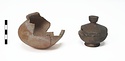
| Disturbed pyre containing only a pyxis and a chytridion.
No notebook account of excavation exists. The pyre may have been located at the edge of an ancient road. There is no record of bone or burning ... 350-325 B.C. (?) ... There is no record of bone or burning. |
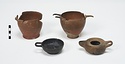
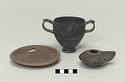
| A compact group of four complete vases and a lamp, found on a house floor; possibly the remains of a sacrificial pyre but without evidence of burning or the characteristic votive vases.
Layer II, "nest ... 425-400 B.C ... A compact group of four complete vases and a lamp, found on a house floor; possibly the remains of a sacrificial pyre but without evidence of burning or the characteristic votive vases.
... The surfaces of the lamp and the Corinthian skyphos show traces of burning. Neither burning nor bone is recorded (Young has not identified as pyre probably because of the early date, which would have made its burial after the abandonment of the house impossible). |
| Margaret Crosby ... Grave, disturbed.
Rectangular cutting in bedrock 1.70m long and 0.60m deep. The north half was cut away by a modern cellar wall and only 0.20-0.10m of fill was left. A the bottom there was a thick layer ... 510 - 490 B.C ... A the bottom there was a thick layer of burning. also present fragments of long bones and ribs, probably animal. |
| Initially was recorded as disturbed saucer grave, but identified as pyre by SIR.
Found by gardener washing out of scarp during the winter rains. The location is just south of an east-west road; there ... 1962 ... There are signs of burning on some pottery. |
| Grave 14 in notebook.
Length of shaft 2.12m; width 0.46m; depth from cover 0.60m. Man's skeleton stretched NE-SW with head at NE. Offering at foot of shaft, with the skyphos in the mouth of the pitcher ... 750-725 B.C ... No signs of burning. On the NE edge of the cover slabs was a small flat stone, perhaps to support a grave marker. |
From disturbances in original floor of Tholos with ash and burning. Probably reflects the military and political conditions of 307 B.C.
The broken pottery, both that left lying on the floor of the building ... Ca. 340-295 B.C ... From disturbances in original floor of Tholos with ash and burning. Probably reflects the military and political conditions of 307 B.C.
|
| Small pit (in Layer I) = Grave ("Pyre") Identified as pyre by SIR.
Pottery and burning ("pit filled with black") in pit slightly west of Panathenaic Road, dug into layer I (lot AA 180, much earlier 6th ... 275-250 B.C ... Pottery and burning ("pit filled with black") in pit slightly west of Panathenaic Road, dug into layer I (lot AA 180, much earlier 6th c. material with later disturbances), and directly under post-antique deposits. |
East of Classical Building II backwall, above Mycenaean chamber tomb K 2:5. Rough circular pit of reddish brown fill cut into geometric fill that extends down inside tomb. Some evidence of burning on pottery ... Ca. 460 B.C ... Some evidence of burning on pottery and in fill. |
|
|