|
|
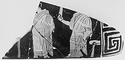
Shoulder and neck fragment. Max. dim. 0.08. Choes and Anthesteria, p. 91, cat. no. 233.
Frieze of upright encircled palmettes and lotuses. Below:
Below, at right break, part of a thick fillet tied around ... Second quarter of the 5th century B.C ... The pattern has a parallel on Munich 2493, a middle work by the Berlin Painter (ARV2 210, 187). |
Fragment of knee end. Max. dim. 0.061.
Woman's head (face) to left, facing a spiral decoration. Preliminary sketch.
For the composition, cf. especially the namepiece of the Painter of Berlin 2624 (ARV2 ... Ca. 430-420 B.C ... For the composition, cf. especially the namepiece of the Painter of Berlin 2624 (ARV2 1225, ---, 1) and one near him, Athens, N.M. 2182 (ARV2 1225, ---, 3). 1645 may be by this painter. |
Wall fragment with start of mouth. Max. dim. 0.062. H. A. Thompson, Hesperia 17, 1948, pl. 66:2.
Man (left hand, legs missing) to right, leaning on a stick, his right hand on his hip. He wears a himation; ... Ca. 500 B.C ... White (flaked): leaves of wreath.
The Painter of Berlin 2268 (ARV1 115, 50); Recalls the Painter of Berlin 2268 (ARV2 158, ---). |
| Two fragments, a) mended from three, b) from five, preserve part of the open end of one side, with the start of the curve at the closed end.
Around the open end, rays; then a laurel band. Around the closed ... 15 March 1937 ... ARV, p. 759, no. 2, near P. of Berlin 2624 ... ARV2, p. 1225, Near the Painter of Berlin 2624, no. 2. |
Wall fragment with start of mouth. Max. dim. 0.04.
Outstretched right hand and tattooed forearm of figure to left. Below, just above the break:
retrograde. Relief contour. Dilute glaze: tattoo. Red:inscription ... Ca. 500 B.C ... For tattoos, see 226.
The Painter of Berlin 2268 (ARV2 157, 81). |
Wall fragment. Glaze pitted in places on outside. Max. dim. 0.076.
Man (lower part of fringed garment, start of legs) pursuing a woman (drapery, right hand about to take hold of a fold) to right. Preliminary ... Ca. 460 B.C ... For the loose tunic without many folds, cf. Berlin 2186 by the Berlin Painter (ARV2 208, 150; Kaempf-Dimitriadou, Liebe der Götter, p. 36, fig. 6); Naples, inv. 81529 = 3139 from the Circle of the Pan Painter (ARV2 560, 3; Addenda 259); two by the Euaion Painter, Frankfurt VF 406 (ARV2 796, 117; Addenda 290) and Athens, N.M. 1586 (ARV2 798, 146; Addenda 290); Basel, Antikenmuseum und Sammlung Ludwig, LU 53, a stamnos attributed by Lullies to the Christie Painter (Kaempf-Dimitriadou, pl. 28:3; Matheson, Polygnotos, p. 373, cat. no. |
Mended with small missing pieces restored in plaster and painted. Lip offset on inside; foot offset on underside. Glaze slightly abraded on handles. H. 0.074; diam. of rim 0.18; W. with handles 0.238; ... Ca. 510-500 B.C ... Kossatz-Deissmann).
The Berlin Painter (ARV2 213, 242; Paralip. 344, 242; Addenda 196). ... Paul Getty Museum and attributed to the Berlin Painter by Frel, sheds a completely new light on the early work of the Berlin Painter, namely, that at times he was directly influenced by Euphronios (M. ... Moore, "The Berlin Painter and Troy," J. |
Fragment of slightly domed lid. Slipped on underside. Max. dim. 0.058.
From knob out: rays in black; below, swan's head and neck (back of klismos); next to it on the right, upper left corner of an object ... Probably mid-5th century B.C ... For rays instead of the more common egg pattern with dots or the zone of tongues around the base of the knob, see Taranto/Reggio, no no. by the Berlin Painter (ARV2 212, 215; Addenda 196); Ferrara 3095 by Hermonax (ARV2 490, 125; Paralip. 379, 125; Addenda 249); and Naples 2638 by the Niobid Painter (ARV2 607, 89; Prange, Niobidenmaler, p. 204, cat. no. |
Pyxis, preserved except for attachment to stem of knob. Chip in rim. Glaze much abraded on underside. P.H. 0.031; diam. 0.071. Roberts, Pyxis, p. 117, cat. no. 3, pl. 72:1.
On concave side, laurel wreath ... Second quarter of the 4th century B.C ... For a similar knob, but for the lid of a pyxis Type B, see Berlin 2518 related by Rhode to the Group of the Drouot Painter (CVA, Berlin 1 [DDR 3], pl. 43 [154]:1). |
Wall fragment. Glaze has a greenish cast on outside near top.
Streaky glaze on inside, partly misfired red. Max. dim. 0.07.
Satyr (beard, left arm, a bit of torso, most of bent right leg with right forearm ... Ca. 500 B.C ... Probably by the Painter of Berlin 2268, who is the only painter to specialize in this type of oinochoe in the late 6th century. There is some resemblance to the figures on these: side A of Vienna 3448 (ARV2 156, 68 bis); Paris Market (ARV2 157, 70); Berlin 2319 (ARV2 157, 78); Providence 25.073 (ARV2 157, 88). |
Floor fragment with stem and fillet. Incised line at top and bottom of fillet. Max. dim. 0.035.
I, satyr: long beard, start of outstretched right arm, part of chest and abdomen, left hand holding the ... Late 6th century B.C ... The position of the satyr's left hand, loosely gripping the shaft of the thyrsos, resembles these, all trumpeters: one by the Bowdoin Eye-Painter, Berlin inv. 3217 (ARV2 168, 15); Louvre G 70 by the Scheurleer Painter (ARV2 169, 6; Paralip. 338, 6; Addenda 183); and Louvre G 73, near both painters, the tondo (ARV2 170, ---). |
Two non-joining rim and neck fragments from each side of the vase. Dull glaze, abraded on rim on b. P.H. a) 0.055, b) 0.053; max. dim. a) 0.096, b) 0.089. Schleiffenbaum, Volutenkrater, p. 323, cat. no ... Probably mid-5th century B.C ... For an earlier example of the lotus-palmette festoon on the neck of a volute-krater, see Louvre G 166 (joining Louvre Cp 10799) by the Berlin Painter (ARV2 206, 129--130; Addenda 194). |
Rim and wall fragment. Glaze misfired slightly in upper right on both inside and outside. Max. dim. 0.092.
Youth (left forearm and hand, both feet missing), perhaps Ganymede, running to right, looking ... Ca. 450 B.C ... If the identification of the subject is correct, Zeus would have been on the other side of the skyphos, a division of the subject similar to the one on Louvre G 175 by the Berlin Painter (ARV2 206, 124; Paralip. 342, 124; Addenda 193) or the unattributed neck-amphora Oxford 1871.84 (LIMC IV, p. 156, no. 20, pl. 77). |
Fragment of flanged handle, the underside indicating the curved surface of the loop. Glaze blistered in a few places. Max. dim. 0.117. Schleiffenbaum, Volutenkrater, p. 324,cat. no. V 204.
On flange, ... Probably mid-5th century B.C ... For spirals on the flange, see Louvre G 166 (joining Louvre Cp 10799) by the Berlin Painter (ARV2 206, 129--130; Addenda 194) and three by the Niobid Painter: Bologna 268 (ARV2 598, 1; Paralip. 394, 1; Addenda 265; Prange, Niobidenmaler, p. 180, cat. no. ... For olive leaves on the back of the handle, see Naples 3240, the namepiece of the Pronomos Painter (ARV2 1336, 1; Paralip. 480, 1; Addenda 365). |
Wall fragment with start of base. Greenish glaze on inside. Max. dim. 0.059. H. A. Thompson, Hesperia 6, 1937, p. 13, fig. 6.
Symposion. Outstretched left foot and lower leg of a figure reclining to left ... Ca. 500 B.C ... Relief contour.
The Painter of Berlin 2268 (ARV1 115, 45; ARV2 157, 76). |
Bowl fragment. Max. dim. 0.032; est. diam. of tondo 0.14. H. A. Thompson, Hesperia 28, 1959, pl. 22:a, c.
I, around tondo, stopped-maeander pattern with cross-squares. A, nude man or youth (from the waist ... Ca. 490-480 B.C ... Dilute glaze: muscles.
The Berlin Painter (ARV2 214, 243). In ARV2, Beazley remarked: "The maeander is not the least like the Berlin Painter's patterns." ... Kurtz (p. 70) in a brief mention of 1419 notes: "Dyfri Williams has recently assigned it [ 1419 ] to the Foundry Painter." This seems to be likely, particularly because the frontal leg does not resemble very closely those by the Berlin Painter. |
Wall fragment from near rim and part of reserved resting surface. Dull brownish glaze. P.H. 0.065; W. 0.086.
A woman wearing a chiton and himation stands to right, holding a mirror in her left hand. Facing ... Ca. 430-420 B.C ... Dilute glaze: folds of chiton.
The Painter of Berlin 2624 (ARV2 one 759, 4; ARV2 1225, ---, 4). |
Floor fragment with stem. Two incised lines to simulate fillet. Max. dim. 0.073.
I, woman (head, both feet missing) seated to right, holding a nude male child (head missing) in her outstretched arms ... Ca. 510-500 B.C ... The lively, but rather rough, drawing bears some similarity to that on two cups by one hand, a painter in the Wider Circle of the Nikosthenes Painter: Boston, M.F.A. 08.30a (ARV2 135 [a]; Addenda 177) and Berlin 1964.4 (ARV2 1700; Paralip. 334; Addenda 177). |
Mended from many fragments, with missing pieces restored in plaster and painted, notable among them the left horizontal handle and part of the wall below it. Glaze fired greenish around left handle; abraded ... Ca. 430 B.C ... Münster, no no. by the Eucharides Painter (K. Stähler, Eine unbekannte Pelike des Eucharides-Malers im Archäologischen Museum der Universität Münster, Cologne 1967, pls. 2, 4:a); Berlin inv. 4496 by Syriskos (ARV2 262, 30; Addenda 205); London Market, attributed to the Methyse Painter (Cat. ... E 719 (ARV2 1560, ---); Naples inv. 126055 by the Persephone Painter (ARV2 1013, 13); Petit Palais 318 by the Barclay Painter (ARV2 1068, 20); Newton, Walston, akin to the Clio Painter (ARV2 1083, 1); Berlin 2393 by the Cassel Painter (ARV2 1085, 33); Athens, Vlasto by the Kleophon Painter (ARV2 1147, 60; Matheson, p. 419, cat. no. ... CURM 2: manner of the Curti Painter).
Manner of the Kleophon Painter (ARV1 788, ---, 2; ARV2 1149, 24). |
Two non-joining fragments, a of wall, b of rim and neck with start of handle zone at far left. Glaze pitted on inside of a. Max. dim. a) 0.077, b) 0.14; W. of rim 0.025; H. of neck 0.063. W. B. Dinsmoor, ... Ca. 480 B.C ... Hektor may have looked something like his counterpart on the volute-krater in London by the Berlin Painter that names the figures (E 468: ARV2 206, 132; Paralip. 343, 132; Addenda 194) or the kalpis in the Vatican, H 545, by the Eucharides Painter (ARV2 229, 38; Paralip. 347, 38; Addenda 199). ... E 165 by the Tyszkiewicz Painter (ARV2 294, 62; Addenda 211). ... The ornament on the side of the mouth and on the upper zone of the neck is best paralleled on two volute-kraters by the Berlin Painter, London, B.M. |
|
|