|
|
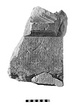
Rim Of Covered Bowl: Corinthian?
Fragment of rim with spout.
Rim inset from flange and inclined. Tubular spout with flaring mouth projects horizontally. Wall pierced for spout to communicate with inside ... Roman context |
Pnyx 173
Clay; dull buff with dark core; containing a little grit but no mica. Assembly Place, Filling of Period III ... October 1932 |
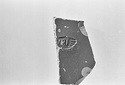
Part of back and dorsal fin of fish, right (?).
No relief contour; the body brown, with black dots.
Down-turned rim grooved at upper part. Shape as N.Y. Shapes, (2), 144 and P 92.
Another is Olynthus, ... 1931 |
Preserved only from waist to knees
The front part of the figure was shaped in a mould and then a solid mass of clay was applied to it's back which part remained unmolded. A female figure clad in a chiton ... Mid fifth century B.C. or later. |
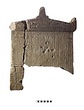
| Many small fragments of an inscription.
Treaty between Athens and Sikyon.
Fragments (Ξ 197) and (Ξ 229), all have inscribed face only preserved, except fragment m), on which the original right edge may ... 302 B.C. |
| Part of lower stem and about two-thirds of base preserved. Edge of base has moulded profile in two parts. Underside completely glazed with grooves through glaze, one around outer edge, the other around ... April 1959 |
Partly broken. Convex on both sides, roughly finished edge. Two suspension holes.
Clay: buff, traces of mica. Assembly Place, filling of Period III ... 1932 |
Incised on top: circle (after firing)
Equal sides, almost vertical.
Glaze: ---
Clay: orange, with grits. Assembly Place, filling of Period III ... 1932 |
| Fragment from the top of an unglazed jug. The tall neck is finished with a projecting lid-like top closed save for a small central opening. Vertical handle on neck below top. Neck dented in making.
Gray ... 8 April 1937 |
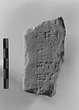
| Inscribed fragment.
Part of left side, picked smooth preserved; otherwise broken.
Pentelic marble. Finished Found in late context, east of the Propylon to the New Bouleuterion. Leica, III-2 ... Mid. 3rd. century B.C. |
| Inscribed fragment.
A sort of finished surface at left back; otherwise broken.
A vertical line at left of face.
Dedication to Hadrian.
Part of five lines of the inscription preserved.
Hymettian marble ... Ca. 132 A.D ... Hesperia 21 (1952), p. 369, no. 12, pl. 93 ... Agora III, no. 700, p. 211 ... Agora XVIII, no. H312. |
| Fragments from wall missing. Massive fabric; stout shape, unbroken upper wall. Ring foot. Line of glaze scratched from junction of foot and wall exposing a miltos-covered surface. Well by Stoa Pier 3 ... 12-15 March 1935 |
| From the floor of a stamped Western Sigillata dish.
Part of a foot-shaped stamp: Theseion cut III, black earth. Leica, 93-33-13 PD 1172-7 ... 9 March 1936 |
The two faces are only very slightly convex, nearly flat. Contours irregular. Two suspension holes rather close together.
Clay: gritty buff-red, little mica. Assembly Place, filling of Period III ... 1932 |
The weight is convex on both sides, the edges rather roughly finished. Two suspension holes. Part of the edge is trimmed off to form a base.
Clay: reddish-gray (burned). Assembly Place, filling of Period ... 1932 |
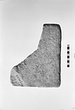
| Fragments of an inscribed stele.
Two joining fragments show letters; thickness of stone preserved; back rough picked.
Left side shows toothed chisel, with drafted edge; right side possibly cut subsequent ... Early 3rd. century B.C. |
| Inscribed fragments of stele.
Decree relative to the arrest of two men by the Truchonians and the Athenian request that they be released. The decree is important historically because it furnishes new evidence ... 367/6 B.C. |
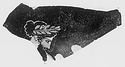
| Fragment from the upper wall of a round-bodied pot, probably an oinochoe, shape III; thin brown wash inside. Male head, bearded, facing right and looking down. The figure's long hair is looped up over ... 1 October 1947 |
The feet were made separately and attached, they have broken away. Probably hollow, no vent.
Probably a common hen, with neck outstretched. The neck feathers indicated by channeling.
Clay: Fine, buff ... Probably early fourth century B.C. |
| A few wall fragments missing; restored. Round-bodied but with shoulder angle; band handle.
Thin red micaceous fabric, blackened from use. Well in Stoa Shop III, lower fill. Context ca. 525-500 B.C. (R ... March 1955 |
|
|