|
|
One handle and parts of upper body restored; lower body missing.
Partially scraped groove at greatest diameter. Upper wall straight, inclined. Ivy-leaf thumb rest. Grapevine running right with single ... 275-250 |
Wall fragment with start of neck. Thin, brownish glaze on inside. Max. dim. 0.057. Choes and Anthesteria, p. 91, cat. no. 236, fig. 191.
Boy (left hand, legs missing) running to right. Around his head ... Early 4th century B.C. |
No. 84. Nb. No. 5. ΕΠΙ ΔΑΜΙΟ[ΡΓΟΥ]
ΚΛΕΥΠΟΛ[ΙΟΣ] 1156 ... Late 2nd century to 86 BC |
Plump body on ring foot; side handles; neck flares sharply to thickened rolled rim. Coarse gray to red clay with pro- nounced red core and many large white bits, surfaced outside and inside neck with cream-colored ... Context ca. 375-330 B.C. |
Body fragment. Irregular, thin, brownish wash on inside. Glaze partly abraded on outside. Max. dim. 0.125; P.H. 0.10. Choes and Anthesteria, p. 84, cat. no. 191, fig. 99; Burn, Meidias Painter, p. 110, ... Ca. 410 B.C. |
| Level, broad, start of right angle curve.
Coarse clay; grey at core.
Impression incomplete below; much worn. Publ: a worse ex than TD 6862 (VG)* Lowest red stratum. Ἐπὶ Ξενο[κλ]έ
ο[υς Ἀ]θα[ν]οκ
ρί[του ... 1 March 1932 |
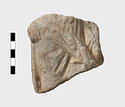
Rim and wall fragment. Reserved line on inside of rim. Max. dim. 0.046; est. diam. 0.14.
Youth (head, neck) to right.
A reserved line on the inside of the rim of a skyphos is unusual. For other examples ... Ca. 430 B.C. |
Small portion of wall, rim, and foot; center of floor missing.
Slightly flaring foot; flat resting surface. Angle near top of wall.
Slightly downturned, rilled rim with two scraped grooves. Broad scraped ... Ca. 275 |
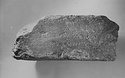
| Inscribed fragment.
Broken back, left side and right corner.
Top finished with toothed chisel; bottom rough picked.
Right side damaged but part of rough picked surface preserved.
Dedication of Archonship ... 100 B.C. |
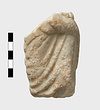
| Broken at waist and proper left side. Large chip on drapery in front.
Back quite worn and flattish (intentionaly?) with some traces of features: large cloak over peplos. Standing female figure with ... Agora XXXIX, no. 7, p. 191, pl. 3. |
Part of rim, wall, cul, all of one handle. Glaze abraded on handle. P.H. 0.075.
On body, four bands: 1 and 3: tongue pattern, 1 above a row of dots; 2 and 4: laurel wreath to right with fruit. On cul: ... Last quarter of the 5th century B.C. |
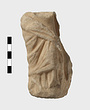
| Broken at top and bottom. Very worn.
Preserved from waist down to just below knees. Right leg straight; left slightly bent. Draped with diagonal folds over front and back; additional folds over waist ... 20 July 1981 ... Agora XXXIX, no. 6, p. 191, pl. 3. |
| Broken at waist and ankles. Break along right side.
Half-draped figure with nude torso. Himation wrapped around hips and down right side. From a type of Aphrodite leaning on a post.
Pentelic marble.
Cf ... 12 July 1978 ... Agora XXXIX, no. 8, p. 191, pl. 3. |
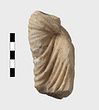
| Hip-section, broken at waist and through thighs.
Figure, wearing chiton and himation, stood in strongly hip-shot position with weight on right leg, probably leaning on support to her left. Right hand on ... 25 July 1978 ... Agora XXXIX, no. 5, p. 191, pl. 3. |
Center of cup preserving part of wall with vertically incised ribs and central boss which is marked off by a scraped groove outside. The boss itself is in the form of a plastic negroid head. Glazed all ... 350-325 B.C. |
| Head, feet, and legs save left hind, missing.
Tail down the right leg.
Horse painted red, except for underneath.
Pinkish buff clay. East of pillar. Leica, 3-46 ... 31 March 1932 |
Mended with the missing pieces restored in plaster and painted, notably much of the lower part of the body and most of the floor. Glaze abraded and misfired on mouth; abraded on neck on Side B. Rest. H ... Ca. 460-450 B.C. |
Krater.
Most of rim, part of body, and one handle restored. Foot chipped, hole in floor (probably intentional); some appliqué figures partly missing.
Molded foot; broad, flat resting surface. Low, hollow ... Context of 150-110 |
Fragment of shoulder.
Shoulder slightly convex. Decoration in brown glaze: broad band at angle with two narrow bands above; tendrils of ivy(?) garland on shoulder. Hard, friable, light red fabric (2.5YR ... |
Bowl fragment. Max. dim. 0.032; est. diam. of tondo 0.14. H. A. Thompson, Hesperia 28, 1959, pl. 22:a, c.
I, around tondo, stopped-maeander pattern with cross-squares. A, nude man or youth (from the waist ... Ca. 490-480 B.C. |
|
|