|
|
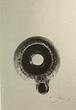
Slight nipple on underside. Glazed inside and out. Reserved: the resting surface and the junction of wall and foot. Glaze fired red.
Similar, P 6366 D 15:3 Hesperia, XVIII, 1949, p. 329, fig. 5, 155 ... 375-350 B.C. |
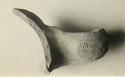
| Level, broad, widening to neck; broken at curve.
Very coarse red clay, grey at core; light slip.
Right end of the impression broken away; incomplete below; flaw in stamp along upper edge; surface damaged ... 13 February 1932 |
Toe, both handles and frag- ments of wall missing.
Stamped decoration: ovules, linked palmettes pointing upwards, linked palmettes pointing downwards, meander, linked palmettes pointing downwards.
For ... Ca. 420 B.C. |
One handle, half of the other, and part of wall restored.
Low foot, square in profile, with scraped groove on side and in broad resting surface; pointed underside. Upper wall almost vertical. Comic-mask ... Ca. 300 |
| Short nozzle; no handle; central socket partly broken away. No foot.
Black glaze.
Type IV (late variants) of Corinth collection, type 27 variant of Agora collection. Well, in north cistern arm. Leica, ... 5 March 1934 |
Ring foot with two torus mouldings at the edge. Straight stem. Mouth flanged to receive a lid, the vertical projecting edge bevelled. The handles are double tubes, vertically pierced for string. Reserved: ... Ca. 500 B.C. |
Mended with the missing pieces restored in plaster and painted, notably much of the figured part. Glaze has abraded in many places. The panel is not placed exactly opposite the handle but slightly to the ... Mid-5th century B.C. |
Plate Or Bowl: Central Italian.
Foot and part of floor preserved.
Angular ring foot; rounded resting surface; pointed underside. Three circles on floor: four stamps within inner two circles; very fine ... Context of 150-86 |
Plate With Upturned Rim: Campana B.
About half of rim and parts of wall restored.
Flaring ring foot, concave to outside; wide, flat resting surface; unevenly pointed underside. Resting surface and underside ... Context of 110-75 |
Flaring ring foot. Concave lower part of wall, a groove at its junction with the upper part. Reserved: underside with glazed band, two circles and dot. Decoration inside: palmette cross on a circle.
The ... Ca. 400 B.C. |
Part of spout and top side. Thin brownish glaze on inside; on outside, reddish brown in places. Max. dim. 0.07.
On one side, a duck or swan (part of head and wing) to right; on the other, a panther (part ... Early 4th century B.C. |
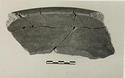
| Thickish and slightly arched; part of rim preserved.
Distinct dark grey core.
Impression incomplete above and to the right below, but sharp. Large letters.
This seal not found in Dumont (1872) with Menestratos ... 8 March 1933 |
Floor fragment with stem and start of fillet. Incision at edge of fillet. Max. dim. 0.069.
I, runner (head, upper part of right arm, right leg from the knee down and left foot missing) to right. In his ... Ca. 520 B.C. |
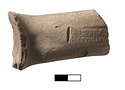
| Thick, high rising; broken at curve.
Typical Rhodian.
Right ends of the impression broken away; much worn; large thick letters for Rhodian. Finished Ἐπ' Ἰερέως
Ἀριστωνίδ̣α̣ Leica ... 8 March 1932 |
Lower half of body, all of torus foot, start of handle B/A. Strengthened with plaster. Thin reddish glaze on inside. Misfired reddish in places on outside. Pitted here and there. P.H. 0.035. R. R. Holloway, ... Ca. 440-430 B.C ... Holloway, Archaeology 19, 1966, p. 113, figs. 1--3, p. 114, fig. 6; Beck, Album, pl. 44:237, 238; Goddess and Polis, fig. 38; Matheson, Polygnotos, p. 445, cat. no. ... E 460, a calyx-krater in the manner of the Peleus Painter (ARV2 1041, 2; Addenda 319; Matheson, p. 442, cat. no. PEM 3). There, the moment shown is a slightly earlier one, for the musician mounts the bema. ... For two or three continuous units with saltire-squares, see Syracuse 44291, a bell-krater in his manner (ARV2 1041, 9; Addenda 319; Matheson, p. 444, cat. no. PEM 10, pl. 155). |
Lower part of wall and all of ring base. On underside of floor, three concentric circles with central dot. Most of the glazed fired red on the inside and on the outside below the figures. P.H. 0.15; diam ... Ca. 430 B.C. |
| Shows marks of chisel. Polygnotos Street, east cut II, stroses 1-3. Leica ... 7 May 1959 |
Four non-joining wall fragments, a, c, and d with part of outturned rim. Max. dim. a) 0.055, b) 0.071, c) 0.04, d) 0.169; est. diam. at rim 0.26. H. Riemann, AA, 1937, p. 94, fig. 3 (fragment d); ILN, ... Ca. 470-460 B.C. |
Six non-joining fragments, a of rim, neck, shoulder, and start of one handle column, b + d of shoulder with swelling for handle root and part of wall, c, f, and g of wall. Glaze dull in places on outside; ... Ca. 480 B.C. |
| Seven joining fragments preserve some of rim, wall and floor. A large steep-walled bowl with bulging rim and flat floor.
Dull dark red glaze on interior and outer edge of rim. Exterior unglazed. Very ... 27 April 1940 |
|
|