|
|
Both handles restored.
Moulded foot, concave beneath, in several degrees, with reserved groove in resting surface. Short fat stem. Deco- ration inside: four palmettes within rouletting. Glaze peeled ... 375-350 B.C. |
Widely flaring mouth, flat projecting bottom, reserved. High breast; fat handle. Dipped. Glaze peeled for the most part ... 375-350 B.C. |
Foot and lower part of wall missing.
Hollow-rimmed mouth, shaped like a funnel inside. Small body with indented wall. Vertical strap handle from shoulder to mouth. Offsetting at base of neck. Thin wall ... 375-350 B.C. |
Ring foot; rilled rim, horizontal. Totally glazed ... 375-350 B.C. |
Recessed underside. Rim rounded on top. Totally glazed. Worn and peeled.
Similar, P 12397 G 12:23 Hesperia, Suppl. IV, 1940, p. 133, fig. 98 d. Also like are Oxford 398 A: CVA 1(3) pl. 48(140) 36; and ... 375-350 B.C. |
Small parts restored.
Beveled resting surface. No scraped groove below rim. Molded rim with scraped groove in outer face. Upper handle attachments flanked by knobs painted with orange and white asterisks ... Ca. 140 |
Globular body on high base, flat beneath; straight neck, flaring trefoil rim; rolled handle from rim. Corinthian tile fabric, handbuilt.
The high foot and bulbous body are traditional in Corinth in this ... Context ca. 600-575 B.C. |
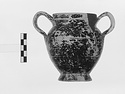
Plump body on ring foot; side handles; neck flares sharply to thickened rolled rim. Coarse gray to red clay with pro- nounced red core and many large white bits, surfaced outside and inside neck with cream-colored ... Context ca. 375-330 B.C. |
Tall-necked trefoil jug, rim ridged. Coarse buff clay; dull red glaze wash reaching to near foot. Imitation Cypriot (?).
The shape is like the Attic 4th century jugs such as 1621, Pl. 73, but the fabric ... Context ca. 375-350 B.C. |
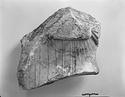
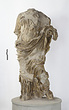
| The fragment first found comes from the middle of the back of the figure. The hair, worn in a heavy mass, square at the bottom, falls nearly to the small of the back. The folds of the garment, drawn tight, ... Early Roman Period (?). |
Floor fragment with start of stem. Part of surface pitted. Max. dim. 0.082. H. A. Thompson, Hesperia 23, 1954, pl. 15:d.
I, symposiast (head, shoulders, upper part of left arm, both legs from the knee ... Ca. 500 B.C. |
Three non-joining wall fragments. Dull, hard glaze on inside. Max. dim. a) 0.091, b) 0.075, c) 0.071. L. Talcott, Hesperia 8, 1939, pp. 268--269, figs. 1, 2 (the fragments have been relettered since this ... Ca. 470-460 B.C. |
Part of mold for upper half of lamp.
Red clay.
For lamp of type XX of Corinth collection. Byzantine fill. Leica ... 5 June 1936 |
| Mended from five pieces; about one-quarter of the rim and a piece of one side missing. For the shape cf. P 1820 and P 1821. Here the clay is pinkish buff, the dull mottled glaze chipped all over. Traces ... 4 April 1933 |
Single fragment, preserving one upturned edge, and the stamp complete.
ΑΔΙΟΝΙΣΙΟΥΙ series.
Coarse red clay, buff surfacing. Building P, Room 6; destruction fill. 1245 Leica ... 23 March 1948 |
A fragment of the top only, with elaborate decoration of raised chevrons and dots on the broad rim.
Dull purplish wash.
Pinkish-buff clay.
Type XXXII of Corinth collection. In disturbed area. Leica ... 17 April 1934 |
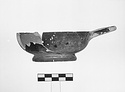
| Mended from three pieces, about one-third of rim missing. Ring foot convex on outside. Rim slopes inward. Triangular handle. Underside glazed, resting surface reserved.
Glazed red to black, peeling ... 27 June-5 August 1972 ... Orange clay.
Cf. Agora XII, no. 760, 375-350 B.C ... Leica, 87-23-31, color slide |
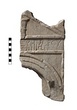
| Upper right corner of stele inscribed above niche.
Back rough picked; right side and top roughly dressed; bottom and left side broken. Central akroterion broken.
In the center of the small pediment is ... 2nd. century A.D. |
No edge of the sharply cut rim remains. The rim has a sharp edge at the level of the top of the handles; a groove at the junction of approximately vertical neck and swelling sides; ring base. Traces of ... 4 May 1933 |
| a) Fragment showing folds of himation over left arm. Arm was inset and attached with a square dowel.
b) Draped torso (?) fragment. On one face flat folds appropriate to himation on back of figure. This ... a)-c) (ΚΤΛ 375) November 1954
(Ι 1680) 1959 |
|
|