|
|
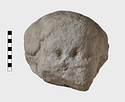
Left to right. -ΕΝΑΙΛ- Votive dump. -ΕΝΑΙΛ- |
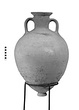
One handle, top of the other, and small part of rim restored.
Scraped groove in resting surface; conical underside. High, thin stem. Pointed lower body. A: spearhead necklace with thin band and single ... Ca. 275 |
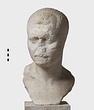
| Upper part of much damaged head, over life-size. Back of head broken away. Remains of close set eyes and upper part of nose; spreading ears. Front hair waved, bordered at brow by row of flat ringlets ... Julio-Claudian period. |
| Nose broken away, a deep score in the forehead; surface much rubbed. Eyes, mouth, chin and ears damaged.
Portrait of a man of mature years; the head turned slightly to the left, the hair close-cut and ... Middle of 1st c. B.C. |
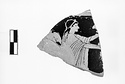
| From wall of stout pot; probably just below rim of krater. Woman right with outstretched arms. Frontal eye. Fine relief lines. Glazed inside. Indifferent work of severe style.
Glaze good but crackled ... 16 March 1932 |
Flat bottom and two-storeyed body.
Black glaze shading to red ... MG II |
| Burial jar. Cracks around rim, neck, shoulder, but intact. Flat horizontal lip; flaring rim passing directly in to great bulging body. Almost no neck; greatest diameter at about mid-height, tapering rapidly ... 27 June 1949 |
Fragment from floor of an open bowl. Flat underside; three incised circles on floor. Light brown clay covered with thin wash inside and out.
Cf. P 23244: Samian B sherd from footing trench of concrete ... 25 July 1961 |
Mouth broken off; palmette decoration on rim; one female figure preserved. Small piece of body found 15.20-15.70m. Carl Roebuck, Nb. No. 6.
Well A. 77 ... 4 April 1938 |
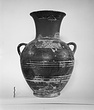
| Burial Amphora. Most of neck, part of shoulder and small pieces of body missing. Substantial ring foot; plump ovoid body; plain flaring rim; small shoulder handles.
Around neck, hatched maeander band, ... Early Geometric. |
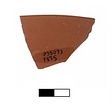
Fragments from bottom of Late Roman C plate. Stamped motif between multiple rouletted circles.
a) Ring foot. Light orange clay with red wash.
b) Another fragment added August 1964 from same place. Part ... 28 April 1932 |
Fragment from center of Late Roman C plate. Stamped motifs, resembling flower calyx, radiating from center.
Light red clay; red wash. From sherds, B 220. Leica, 2-293 ... 28 April 1932 |
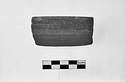
| Rectangular rim fragment. Rounded wall with plain rim, flattened on top.
Orange-red clay; red slip, darkened on outside of rim.
Phocean red slip ware.
Hayes form 1, variant. Catalogued October 1992 ... 1935 |
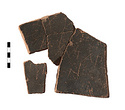
| Fragment probably from a Laconian rain-tile; broken all around.
Incised through the glaze:
Coarse red clay, black glaze on top surface.
ADDENDA Three joining pieces and one non-joining piece added ... 9 May 1939 |
| Single fraqment.
Straight sloping wall with plain rim, slightly beveled.
Brick-red ware, fairly clean; smooth semi-gloss red slip all over (=Africana C1 ware). LRP form 50A early in series.
Context and ... 23-24 February 1937 |
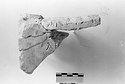
| Inscribed fragments.
From a stele inscribed on two adjacent faces.
Fragment I 4840 a), three lines of the inscription preserved on face A, two on face B.
Fragment I 4840 b), three lines of the inscription ... 28 April 1937 |
| Complete. Much chipped in lower body. Small ring foot; round body; depression at base of each handle. Wide flaring rim.
Graffito on shoulder: Ε
Unglazed pinkish-buff clay. Well. Leica, 94-14-7(6) ... 1 June 1965 |
| Complete stele. Minor chips on face and piece from rear missing.
Tang for insertion into base preserved. Back rough picked. Some sort of wear along upper half of right side.
Letters generally well preserved ... 220/19 B.C. |
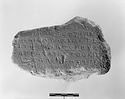
| Inscribed fragment.
Inscribed face only preserved.
Seven lines of the inscription preserved.
The marble stained dark gray.
Hymettian marble.
Now in Epigraphical Museum (joined to E.M. 7493) Found in wall ... 7 June 1939 ... Hesperia 30 (1961), pp. 219-220, no. 16, pl. 46 ... Agora XVI, no. 248, p. 345. |
Inscribed fragments.
Fragment Τ 13 a), the left side and the top preserved. The surface partially pitted with small holes.
Ten lines of the inscription preserved.
Fragment Ν 456 b), the left side and ... Ca. 434 B.C. |
|
|