|
|
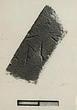
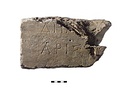
Left to right. Γάες
If this is a genitive of Gaia, as Blegen suggested, it is surprising. Ge and its forms are normal in Attic epigraphy, while Gaia is poetic. Votive dump. Γάες |
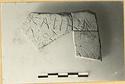
| Joins P 17950. Small wall fragment of plain pot.
Inscribed outside. Red gravelly fill under wall B, ostrakon fill. 8330 Leica ... 20 October 1949 ... Agora XXV, no. 370, pp. 15, 71. |
| From the wall of a large plain amphora?
Incised outside:
Pale greenish buff clay.
Joins P 20412. Red gravelly fill with kalikia. 4976 Leica ... 10 June 1947 ... Agora XXV, no. 370, pp. 15, 71. |
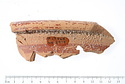
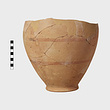
| Mended from many small fragments. Rim piece of a semi-glazed krater, badly broken.
Incised inside:
Red glaze inside, on rim, and for band outside. Finished Red gravelly ostrakon fill under ΝΘ-Ξ wall ... 13 June 1947 ... Agora XXV, no. 372, pp. 15, 71. |
Base preserved.
Graffito on bottom. Complete after purchase.
Clay: fine buff; black glaze. Assembly Place - filling of Period III. Σατύρο(υ) ... 1932 |
Ring foot. A sharp angle at junction of floor and wall. Broad projecting rim, flat on top and with a vertical outer face. Reserved: the resting surface, a zone around the wall. the top and the vertical ... Ca. 450 B.C. |
| The writing end broken away; the eraser end slightly curved. Rectangular rockcut shaft (no. 435). Leica, XXIV-47 ... August-September 1932 |
Handles, foot, stem, and three-quarters of upper bodymissing.
Thin stem. Pointed lower body with scraped groove below handle attachment. Two antithetical dolphins preserved (probably originally four), ... 290-275 |
One-fourth of upper wall missing.
Scraped groove in resting surface; concave underside. Tapering stem. Scraped groove at junction of body and stem and below handle attachment. Lip very thin, as in cup-kantharos ... 290-275 |
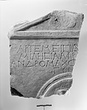
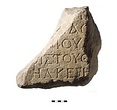
| Inscribed fragment.
Upper left portion of a grave stele.
Part of pedimental top, circular medallion at center, and round picked back preserved.
Remains of iron dowel in left side.
Four lines of the inscription ... 28 January 1938 |
| Inscribed fragment.
Inscribed face only preserved.
Five lines of the inscription preserved.
Pentelic marble. Found in the wall of the modern house 638/21, over the east end of the South Stoa II. Leica ... 20 December 1935 |
Vertical section of handle and over half of body, foot, and underside restored.
Low, flaring foot; flat resting surface; well-formed, slightly convex underside. Lower body very high and nearly straight ... Context of 150-110 |
Flat underside, reserved. Graffito on underside: Δ.
In the latest stages of the shape, the bowls are dipped, e.g. P 10572 B 15:1 Hesperia, XVIII, 1949, pl. 93, 71; P 786 I-J 18:1 and P 17889 N 21:9 ... 430-410 B.C. |
| Mouth and handles broken off and a hole in the shoulder. Flaring ring foot.
Painted on the shoulder in black:
Red clay with grits, unglazed. Smeared inside with a black coating (resin?). Well. Leica, ... 27 April 1936 ... Agora XXI, no. Hc 15, p. 71, pl. 39. |
| Obverse : standing Hermes, with money bags and caduceus.
Reverse : standing Serapis, partly draped, right arm outstretched.
Cf. IL 211 for type. Cistern A. in zip lock bag in conservation
with gloves ... 23 May 1935 |
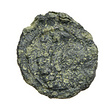
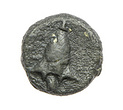
| Obverse: helmet.
Reverse: plain. House A, room 2: upper brownish fill. Leica ... 28 March 1939 |
| Inscribed fragment.
The left side preserved; otherwise broken.
The start of two lines of the inscription preserved.
Hymettian marble. Found in the wall of the modern house 638/12, over the central part ... 6 December 1935 |
One handle and part of the other, half of rim and body, and all of foot restored.
Molded rim. Vestigial masks at base of handles. Neck: ivy garland running right. Main stem white and undulating; large ... 120-110 |
Half of upper body and parts of handles and lower body restored.
Scraped groove in resting surface; concave underside. Small, delicate foot with high, thin stem. Pointed lower body with scraped groove ... 285-275 |
| Mended from many pieces and preserved to level of greatest diameter. Ring foot. Wide glazed bands on foot and around body at intervals.
Pinkish-buff clay. Finished Well, early Geometric. 6987 Leica, ... 25 October-3 November 1947 |
|
|