|
|
P 134 andThree non-joining wall fragments, P 5110 a with roots of one handle. Glaze flaked in many places; fired brown on much of inside. P.H. of P 5110 a) 0.185; P.W. 0.29; max. dim. P 134: 0.184, P 5110 ... Third quarter of the 5th century B.C. |
| About one-fourth preserved. Bowl with flat floor, false ring foot. Everted rim with deep groove on top. On floor, planta form potter's stamp, illegible.
Rather hard, reddish cinnamon clay; dull reddish ... (1967) ... Agora XXXII, no. 342, fig. 12, pl. 14. |
Platter With Offset Rim.
About one-third preserved; foot missing. Mended in antiq-uity; one lead clamp and holes for two more preserved.
Horizontal floor with groove and ridge edge. Offset rim with molded ... 1st-century context |
| The fragment is from near the edge of the lid; the vertical flange which fitted into the box, and the projecting horizontal flange, have broken away but can be traced. The surface of the fragment is very ... 10 March 1932 |
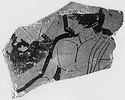
Bowl fragment. Max. dim. 0.032; est. diam. of tondo 0.14. H. A. Thompson, Hesperia 28, 1959, pl. 22:a, c.
I, around tondo, stopped-maeander pattern with cross-squares. A, nude man or youth (from the waist ... Ca. 490-480 B.C. |
Mended from many fragments, with missing pieces restored in plaster and painted, notable among them the left horizontal handle and part of the wall below it. Glaze fired greenish around left handle; abraded ... Ca. 430 B.C. |
| Only a fragment from the top and side is preserved.
The side wall is almost vertical; the rim is broad and flat, rising slightly toward the middle. Around the filling hole it terminates in a depressed ... 1933 ... Hesperia 3 (1934), no. A 46 ... Agora IV, no. 342, p. 78, pls. 12, 39. |
Eight non-joining wall fragments, a and b with rim and strengthened with plaster. Band on inside at rim, a narrower one 0.068 below rim. Glaze fired red on inside, slightly misfired below figures on outside ... Ca. 460-450 B.C. |
| Broad handle, curving down close.
Fairly fine red clay with distinct lighter surface layer (with an inner break line) and gray core; light slip as on the Knidian handles.
Impression from an enghraved ... 6 March 1933 |
| Intact, except chips from foot. Shape very much as P 24665, no groove at rim.
Same fabric as P 24665; discoloration.
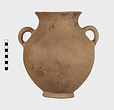
Cf. Agora XII, no. 1601. Αμφοροειδές, ευρύστομο αγγείο. Σχεδόν ακέραιο. Well in Stoa ... 9 March 1955 |
| Small piece of rim and wall missing. Substantial torus ring foot; heavy fabric, the walls rounding in slightly to the rim, which is flattened and slopes gently outwards; stubby U-handle.
Carefuly made ... May-June 1954 |
| Inscribed fragment.
Inscribed face and left side preserved.
Preamble of decree.
Traces of seven lines of the inscription preserved.
Pentelic marble. Found in disturbed Byzantine context west of the late ... 3rd. century B.C ... Hesperia 29 (1960), p. 10, no. 12, pl. 2 ... Agora XVI, no. 243, p. 342. |
| Late Roman C bowl. Mended from seven pieces. Bits of rim, sides and bottom missing; restored in plaster. Ring foot; flaring sides (angular) with downturned rim with two ridges on upper surface.
Red clay; ... 22 April 1933 |
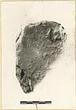
| Flat pyramidal. Pierced near top.
Pinkish buff clay. Well. 725 Leica, LXVIII-55 ... May 1952 |
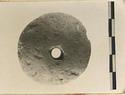
| Half of one side chipped away.
Double convex, pierced through center.
Pinkish buff clay. Well. 725 Leica, LXVIII-55 ... May 1952 |
| Shaped like irregular slice from loaf, with rounded, flat bottom, broken off sides.
Sandstone (?). Well. 725 Leica, LXVIII-55 ... May 1952 |
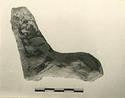
| Torso and neck only of horse; head and legs missing.
Pinkish-buff clay; remains of thick black glaze on neck and body. Well, box 18. Leica, LXVIII-28 ... 20 May 1952 |
| Circular, thick, flat. Perhaps cut from wall of pithos. A large, impressed herringbone pattern covers the whole of one surface.
Coarse red clay with many impurities. Well. 725 Leica, LXVIII-55 ... May 1952 |
| Loaf-shaped with flat bottom; one side chipped off.
An irregular, scratched square both on the top and on the bottom, each at the center of the preserved surface.
Poor grade white marble. Well. 725 Leica, ... May 1952 |
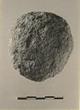
| Irregular spherical.
A fine conglomerate, with quartzy-like inclusions, both black and colorless. Well. 725 Leica, LXVIII-55 ... May 1952 |
|
|