|
|
Both handles and bottom restored.
Low rim, flanged inside; the edge flattened and slightly projecting. Unpierced spout with profiled rim; small knobs to either side ... Context ca. 375-325 B.C. |
One handle and one-fourth of body missing.
Small foot; flat resting surface; nippled underside. Low, wide, slightly flaring neck set off from body by glazed groove. Rim inclined above molding, which is ... Ca. 150 |
Handle missing.
Low ring foot; vertical ribbing, narrowly spaced, joined with arcs at the top, alternately. Groove at junction of foot and wall. Double handle with shouldering. In the space below the ... 450-425 B.C. |
Triton?
Head, left arm, right forearm, left wing, most of right wing, lower back, spout, and chalice missing.
Well-muscled male torso with wings growing from shoulders.
On preserved section of right ... 200-175 |
| Fragments missing from rim and floor. High ring foot, grooved beneath, separated from plate by broad reserved band. Shallow floor, plain rim, lightly moulded beneath.
Firm black glaze, somewhat mottled ... April-May 1936 |
Fourteen non-joining fragments, b with start of handle; e, f, m of handles; d of foot. The rest are wall fragments. Only a -- c, g -- i preserve figured decoration. Narrow reserved band on inside of b ... Ca. 430-420 B.C. |
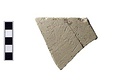
| Two joining body fragments, broken on all sides.
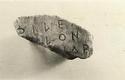
Inscribed letters on exterior, partially preserving name and patronymic of Xanthippos:
Whitish coarse clay, unglazed. Crushed bedrock layer under southern ... 20 June 2000 |
| Four pieces of twisted rope with two or three small bits.
Notes on 17 November 1981: Longest piece remaining: P.L. 0.068, Diam. 0.012, fourteen pieces total. Container 16. Well. Leica ... 20 May 1949 |
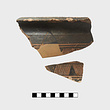
| Fragment from rim and wall. Deep concave rim, slightly inset from body wall; thickened projecting lip, flat on the upper surface and tilted downward. Glazed inside and out to reserved band on upper side ... 1934 |
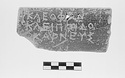
| Inscribed fragment.
Inscribed face only preserved.
Five lines of the inscription preserved; stoichedon.
Pentelic marble.
ADDENDA With IG I2, no. 130.
Transferred to the Epigraphical Museum on 11th. March ... 5th. century B.C. |
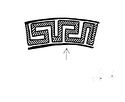
| Two large fragments and three sherds from lip preserve about one-half of body. Profile complete except for tip. Completely restored in plaster. Body zones, from top: zigzag, dogtooth, maeander (key and ... 15 June 1967 ... Hesperia 37 (1968), p. 89, no. 12, fig. 3, pl. 22 ... Agora XXXVI, no. T15-12, pp. 141-142, fig. 2.80. |
| Left side only remains.
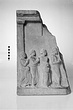
Three men, a woman, a boy and a girl, all draped, move in a procession to the right. In the wall above, a rectangular panel with the lower part of a horse's head in relief, and ... 24 April 1937 |
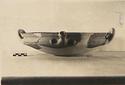
| The bottom and much of one side missing. Restored in plaster. Horizontal rolled handles set below the rim; rim flanged inside to receive lid. A spout to one side between handles; wall not pierced at spout ... April-May 1936 |
| Inscribed fragment.
Broken on all sides.
Three lines of the inscription preserved and traces of a fourth above; stoichedon.
Pentelic marble.
ADDENDA With EM 10235.
Transferred to the Epigraphical Museum ... 5th. century B.C. |
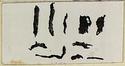
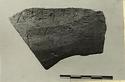
| Fragment of a cover tile preserving one corner. The ostrakon is broken at the lower left corner. Incised on glazed side.
Thin dull glaze, black to red. In earth thrown up from around the Hieron. Leica, ... 28 December 1966 ... Hesperia 37 (1968), p. 120, no. 6, pl. 34 ... Agora XXV, no. 603, pp. 11-12, 90. |
| Two joining fragments from a plain amphora. Cut along east wall of East Building ca. 13.50m. to 17.50m. from the south end, over cobbled surface. 2259 Leica ... 23 June 1967 ... Hesperia 37 (1968), p. 117, pl. 34 ... Agora XXV, no. 9, pp. 10-12, 32, fig. 1. |
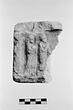
| Top, bottom, left side and back preserved. Broken away at right.
Within a plain frame are two draped standing figures, facing right: in front, a man, behind him, a woman.
Pentelic marble. Demolition of ... 8 February 1935 |
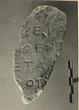
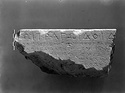
| Inscribed fragment.
Inscribed face, left face, and rough picked back preserved.
Treasure record from Eleusis.
Seven lines of the inscription preserved; stoichedon.
Left edge worn away so first letters ... 5th. century B.C. |
| Inscribed fragment.
Part of top surface preserved.
Narrow smooth band at edge, then toothed chisel to ca. 0.05m.; then rough picked; otherwise broken all around.
Seven lines of the inscription preserved ... 28 May 1937 |
| Fragment from plain amphora.
Cf. P 27678. Cut along east wall of East Building ca. 13.50m. to 17.50m. from the south end, over cobbled surface. 2259 Leica ... 23 June 1967 ... Hesperia 37 (1968), p. 118, no. 4, pl. 34 ... Agora XXV, no. 100, pp. 11-12, 43, fig. 5. |
|
|