|
|
| Well at 99/ΜΕ.
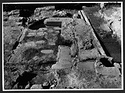
Just outside of SE corner of Fountain House. This well was used in at least two periods; the marble well curb of the second period, certainly Byzantine, was found in place. The fill was ... 5 May 1952
5-14 July 1952 ... Well at 99/ΜΕ.
Just outside of SE corner of Fountain House. |
Pit at 58/ΛΖ ... 5th c ... Agora XXI, p. 99. |
Coins:
15 March 1934 #6 ... 6th-7th c. A.D ... Agora XXI, p. 99. |
Well at 75/Ε. Dumped debris of Herulian destruction, including much material from the first half of the 3rd c ... 3rd c. A.D ... Agora VI, p. 99 ... Agora XXI, p. 99. |
| Dumped filling mostly of 3rd c. A.D., but dumped as late as 5th century. Nbp. 143: The fill in this cistern was of three kinds: to within .60m. of the floor plain broken bedrock with no sherds; then a ... 10-17 February 1937 ... Agora XXI, p. 99. |
NW corner of Civic Offices, lowest layer above Roman road metal[classical floor, see nbp. 1907]. Coins:
12 May 1950 #1-#10 ... Mid 3rd. c. A.D ... Agora VI, p. 99. |
Well in branch of Aqueduct (ca. 13/ΚΔ) 3rd c. A.D. - 5th c. A.D ... 3rd c. A.D ... Agora VI, p. 99. |
Filling between tongue walls to north of main apse in Late Roman complex, equals "Coroplasts' Dump" overlying Odeion south side.
Containers Ο 17-Ο 20 are from "debris of burnt building" [i.e. Odeion ... 267-ca. 350 A.D ... Agora VI, p. 99. |
Appears to be use filling from 3rd c. A.D., pre-Herulian into 4th c. or later. Lined with tiles. Coins:
6 May 1937 #1-#2 (disintegrated) ... Early 3rd-early 6th c ... Agora XXI, p. 99. |
| Construction filling of well N 20:3 which was dug through this cistern; a few later sherds at upper levels may result from late repairs to well tiling. Coins:
6 April 1938 #14-#15
8 April 1938 #4 Some ... Second half 1st c. A.D ... Agora XXI, p. 99. |
East-West Street (63-64/ΙΣΤ, etc.)
Packing in line of ancient east-west street along Areopagus north slopes.
Lower fills, predominantly late 6th-early 5th c. B.C.
Middle fills, last quarter of the 5th ... Various levels and dates ... Agora XXI, p. 99. |
Pit in ancient road, ca. 73/ΜΣΤ The filling of this pit contained quantities of coarse pottery, principally fragmentary amphoras, but including also some glazed and semi-glazed pieces and fragments of ... Ca. 350-325 B.C ... Agora XXI, p. 99. |
Filling over bedrock. Coins:
26 May 1938 #7-#10
27 May 1938 #1
28 May 1938 #1 ... 1st-early 2nd c. A.D ... Agora VI, p. 99. |
Coins:
19 May 1938 #1 (illegible)
20 May 1938 #3-#5, #12-#20 (Dump) ... 4th-6th c. A.D ... Agora XXI, p. 99. |
Burned filling over area of NW Temple (apparently Herulian destruction debris) = Trench I, 18-22/ΛΑ-ΜΣΤ and northwest trench, center at 15-19/ΛΣΤ-Μ Coins:
28 March 1933 #25-#28
29 March 1933 #16-#21
30 ... 28-30 March 1933
5-6 April 1933 ... Agora VI, p. 99. |
The pottery of the first six meters (containers 1-3 of 117 containers total) contains a good deal of unglazed early Byzantine along with very late Roman. Below this begins a great mass of Roman pottery ... 4th-6th c. A.D. POU ... Agora VI, p. 99 ... Agora XXI, p. 99. |
Well at 71/ΛΒ (diameter ca. 1.10m) near the east wall of the entrance porch.
Narrows toward bottom, collapsed at top. Six footholds preserved at south, three at north, spaced at ca. 0.50m. Uniform fill ... Late 8th in early 4th c. B.C ... Agora XXI, p. 99. |
4th century sandy fill west of Peribolos of the Twelve Gods, with animal bones, metal waste and much pottery. Estimated Grid ... 350-325 B.C ... Hesperia Suppl. 8 (1949), p. 99. |
Upper fill (top to around 4.50m.) was in a pit of large dimensions above the preserved well shaft. From the bottom and shaft proper no catalogued pottery. No tiling in place in well but fragments of tiles ... 3rd-4th c. A.D ... Agora VI, p. 99. |
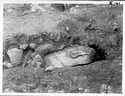
| Dorothy Burr Thompson ... Circular cutting. Grave 24 in notebook. In some records as Grave IV bis. Baby's bones: discarded. No offerings. Negs. KK 99, KK 100, X-61 ... LH III/EPG (date uncertain) ... Negs. KK 99, KK 100, X-61 |
|
|