|
|
Boy's head right, his right arm outstretched; behind it a large mound-like object (?).
No relief contour.
Glaze inside brown; dull and uneven.
The fragment seems to come from near the shoulder. Trench ... 12 December 1930 ... PNP 52 ... PNP 52 |
Head and base are missing.
A youth stands in an easy attitude, an oinochoe in his right hand his cloak hanging over his extended right forearm. His locks reached to his shoulder.
Clay: Fine, buff, covered ... Early fourth century B.C ... PNT 52 ... PNT 52 |
Sides and bottom chipped. Equal sides; sharp angles.
Stamp on top: Female head to right, hair blowing out behind.
A female head facing right. The features are fine and sharp; the hair blown out behind, ... 1932 ... PNW 52 ... PNW 52 |
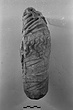
Lead tube with very small hole only partially piercing it. One end widened, and the edges turned inward. Assembly place, filling of Period III ... 1930 ... PNM 52 ... PNM 52 |
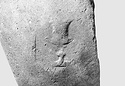
| Stamped with a krater (?).
Inscription: Δ ...
Βuff.
Thasian handle. John Craft, Nb. No. 14. ]αι[ ΔαΪφρων? 228 ... 1939 ... AH 52 ... AH 52 |
Kylix base with black glaze - some red in it. Inscribed on bottom. Oscar Broneer, Nb. No. 4. 178 88-396 ... 31 May 1937 ... AO 52 ... AO 52 |
NM 16168
Flat bottom; shallow, convex lower body.
High slightly concave neck decorated with four goats, couchant and regardant.
Thin brown glaze.
For the goats cf. P. Amandry, Journ. Near East St ... LG II ... H 52 ... H 52 |
| The left side of the head is preserved, broken all round.
The features are heavy, the cheeks and chin bulging; the mouth is bent down at the corner.
Coarse work. Mold made; hollow. Not colored.
Red clay ... 5 August 1931 ... Hesperia 2 (1933), p. 192, figs. 6, 7, no. 52. |
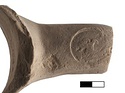
| Typical. Handle rising.
Fine yellowish clay, with small light red core; pinkish cream slip.
Impression doubled; worn. Stp: doubled* Finished Δαμοκράτε[υς]
rose
(framed in O) 438 Leica ... 17 July 1931 ... SS 52 ... SS 52 |
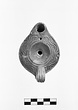
| Wavy lines on rim.
Plain discus, with central filling hole. Handle solid, triple grooved. Nozzle rounded.
On bottom, double concentric grooves, with five stamped circles.
Reddish-brown glaze.
Red clay ... 17 June 1931 ... L 52 ... L 52 |
A small section missing.
Plain thin as a paper, disk.
A single hole for attachment. No decoration. in front of west ledge and ca. 0.30m. below the top Finished Mycenaean chamber tomb; N.W. part of chamber ... 1 June 1939 ... J 52 ... J 52 |
| Apparently a left arm, in tightly wrapped drapery, with another garment, having a fringe resembling locks of hair, worn over the shoulder. On the top of the shoulder rest two long curls.
Pentelic marble ... 1933 ... Η 52 |
| Top part.
All of the lower part of the lamp is missing, save a little near the nozzle.
On rim, debased herringbone, very faint.
On discus, a cross (?), very faint indeed; filling hole between the arms ... 15 March 1933 ... Η' 52 |
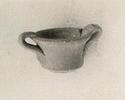
| From a small cup or bowl with nearly straight sides and thin walls, the edge slightly grooved on the outside.
Over part of a festoon, painted in thick buff on the black glaze, the letters:
Clay, fine ... 18 February 1932 ... Α 52 |
| Mended from many fragments which form rather more than half of the body; another fragment does not join. Restored in plaster. In concave flange, two string holes on one side, three on another, in the loose ... 16 April 1932 ... ΣΤ' 52 |
| Small handle; curve piece.
Light cinnamon colored highly micaceous clay.
Rectangular stamp; club.
Early Thasian. Finished Mixed fill. [ Ἀριστοκ]
club
Π̣υ̣λάδης
(retr) Leica ... 12 June 1935 ... Ν' 52 |
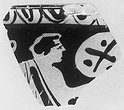
| A single fragment preserves part of the rim, sharply out-turned. Upper part of a draped figure facing right; in field part of a round object decorated with a cross and dots. At the top, ovules.
No relief ... 24 March 1939 ... ΕΕ 52 |
| Head in close fitting helmet. First interpretation: female head.
Broken off at the base of the neck; the surface damaged. below the level 63.30m. Below the level 63.30m., together with late Roman sherds ... 1 February 1934 ... Κ 52 |
| Mended from two pieces.
Human eyes, facing full front. The feathers indicated by incision. The comb pierced by a hole.
Brownish clay. Leica ... 24 February 1934 ... Γ 52 |
|
|