|
|
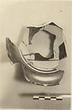
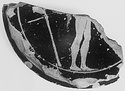
| Much missing from rim and floor. Plain rim; torus foot; handles set well down. Nude youth left bending with outstretched arms; halteres in his hands? In front of him a goal post? Wide exergue; plain reserved ... April-June 1936 |
| Fragment of floor with some of foot, a very low small ring with bevelled sides.
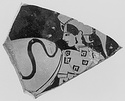
Head and torso of warrior, left, seen from behind, and part of the shield, held on the extended left arm. Ornamented corselet ... December 1953 |
| Small fragment from floor, with part of heavy molded ring foot. Upper part of female figure front, head to left; peplos, sakkos. No relief contours.
Pinkish-buff clay. Provenience unknown. Leica ... (1953) |
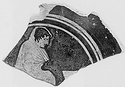
| Ring foot moulded above; inside reserved, with black band. Of the medallion is preserved the head of a youth, left, within a double reserved band. No relief contour. Well. Leica ... 10 March 1937 |
| Two joining sherds preserve part of floor and much of low ring foot.
Satyr running right, holding a thyrsos in his right hand. The head of the thyrsos is drawn over the maeander border.
Partial relief ... 17 April 1954 |
| Very low ring foot. On inside, part of a nude youth left, his right arm extended in front of him along the shaft of a spear. Glazed circles inside the reserved foot. Disturbed early (6th.-5th. c.) fill ... 30 April-1 May 1936 |
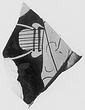
| Some of floor and about half foot preserved. Small low ring foot.
Part of body and kithara of a komast, left.
Relief contour.
Space inside foot reserved, except outer edge. Pit in bedrock; Stoa colonnade ... 6 May 1954 |
| Section of heavy ring foot and floor preserved. In medallion framed by single line, a youthful satyr, standing right. In field at left, a staff(?) or thyrsos.
Glaze on inner edge and top of ring foot ... 5 April 1949 |
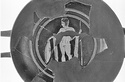
| Seven joining pieces preserve most of foot and floor with part of rim and one handle stump. Moulded ring foot and cushioned bottom. Medallion inside surrounded by two sets of bands. Within it: standing ... 17-24 May 1940 |
| Part of the floor and of the rather high plain ring foot preserved. Within three reserved lines (the two outer close together), a draped youth to right. Before him, part of an altar or stele. Underside ... 14 June 1939 |
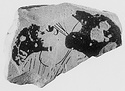
| Part of floor and start of stem; ring at junction. Nude hetaira reclining left, or tilted somewhat more to left, might be restored as dancing to the tune of castanets. She wears a triple fillet in her ... 24 April 1953 |
Pit in bedrock in front of Shop VII (= Pit in Stoa Colonnade in front of Shop VII). It contained a miscellaneous collection of sherds which included one scrap of red-figure ... Ca. 475-460 B.C. |
Fills from construction and reconstruction of a house. "Brown House" = House A (RSY Hesp. 20) (and pit under Layer 4) in the industrial area west of the Areopagus.
Under the original floor of this house ... Second half of the 5th. c. B.C. |
Early cutting beside Great Drain: 103-111/Λ-ΛΓ (= "Deep cutting" Pit at 107/ΛΑ).
Abandonment filling in channel for early drain; the fragment of a red figured bell krater, P 17000, probably to be dated ... Ca. 425-395 B.C. |
Well at 73/Μ on the lower northeast slope of the Areopagus.
Diameter of 0.90m. It seems to have been abandoned because of the very soft stereo that kept falling in from all sides. Many pieces of terracotta ... Ca. 430-420 B.C. |
Fillings in a well on south slope of Kolonos Agoraios. The shaft reached a depth of 20.28m., but produced no use filling. The lower part, from water level at 12.60m. to bottom, provided only mud and gravel ... Ca. 425-400 B.C. |
West Terrace, South End, Layers IV and V. Heavy dumped filling associated with terrace walls at the extreme south end of the excavations in the Areopagus industrial area. The proportion of figured and ... Ca. 420-390 B.C. |
| Well A, early 5th c. B.C. Near the Agora Boundary Stone, northwest corner of Middle Stoa; diameter at top 0.92m, widening to 1.15m and more below. Shaft neatly faced with stones to a depth of 0.70m below ... Ca. 520-480 B.C. |
| Moore, M. B ... American School of Classical Studies at Athens ... This volume presents the inventoried red-figure and white-ground pottery found in the Agora Excavations between 1931 and 1967. Although many of these vases have already been published in various reports ... 1997 |
|
|