|
|
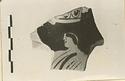
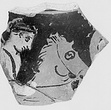
| Neck-shoulder fragment.
Upper part of draped youth to left. Egg pattern above the picture. No relief contour. Neck glazed inside with an unevenly thinned glaze.
Pink clay. Civic Offices, room 2, strosis ... 29 April 1953 |
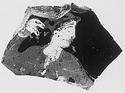
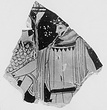
| Fragment from neck and shoulder.
Shoulders, raised hand and head of female figure facing right. Head and hand in applied white; details of features in dilute glaze over the white; details of garment obliterated(?) ... 10 May 1932 |
| From a pelike. The neck glazed inside. A mantle-clad figure looks left, and holds out his right hand. In the field above his hand, a large round object. Along the upper edge of the fragment, a bit of an ... 6 June 1933 |
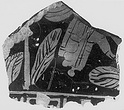
| Broken all around.
Fragment from lower part of scene, with edge of maeander border. Above, a foot with drapery, apparently from a seated figure. In the field, large heavily veined leaves, with white tendrils ... 25 April 1950 |
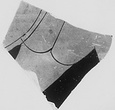
| [Originally identified as column krater(?)]
Wall fragment. Thigh of a figure wearing a chiton in broad pleats (under cuirass?); at left his shield. Relief contour.
Inside, glaze dull and streaky; Level ... 27 April 1957 |
| Pelike neck, both handles and most of the lip broken off. Flaring rim, turned down at the edge, decorated with egg pattern. Egg pattern across tops of panels, front and back. On side A, traces of uncertain ... 19-22 June 1935 |
| Seven joining fragments preserved full circumference of neck and shoulder; lip missing.
A) Female head in Persian headdress, right; horse's head at right, griffin at left.
B) Two cloaked youths facing ... 28 April 1949 |
| Two joining fragments from upper wall of pelike. Heads of horse and rider, right, preserved; added white for flesh. Eros riding horse, woman in front of him. Reserved parts fired dull tan, not red. Thin ... 25-26 July 1946 |
| Two non-joining fragments, the largest mended from five. From a closed pot, amphora or pelike.
a) Parts of two standing figures, left; preserved: Athena (crested helmet, scaled aegis) and Hephaistos (wreath, ... 8 August 1947 |
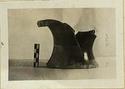
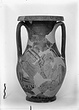
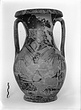
| Mended from many pieces; about one-third of the rim, the upper part of the front, and smaller pieces from the walls missing and restored in plaster. Moulded ring foot; flaring lip with downturned edge ... 1 June 1932 |
| Identical with P 1104. Much mended; fragments from the walls, the base, and the top of one handle restored in plaster. Here the upper parts of the heads of the horse and the first woman are better preserved, ... 1 June 1932 |
4th century sandy fill west of Peribolos of the Twelve Gods, with animal bones, metal waste and much pottery. Estimated Grid ... 350-325 B.C. |
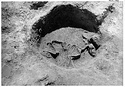
| Dog's Grave, the bones carefully disposed. It contained a small amount of contemporary pottery in the fill, of which some deposited nearby, may have been intended as offerings ... Third quarter of 4th c. B.C. |
Unfinished well, south of the annex to the Poros Building, west of the Areopagus. The shaft was apparently never used as a well. The lower dumped filling contained a quantity of clean red clay, as if from ... Ca. 350-325 B.C. |
A small flask-shaped cistern on the lower southeast slope of Kolonos Agoraios. Lined with hydraulic cement and containing a large quantity of glazed table ware and a fair amount of coarse ware; a homogeneous ... 350-325 B.C. |
| An extensive cistern system on the lower north slope of the Areopagus, south chamber with blind tunnel extending further south (south tunnel); north chamber; drawshaft further north, extends to north tunnel ... Ca. 320-240 B.C. |
| Moore, M. B ... American School of Classical Studies at Athens ... This volume presents the inventoried red-figure and white-ground pottery found in the Agora Excavations between 1931 and 1967. Although many of these vases have already been published in various reports ... 1997 |
|
|