|
|
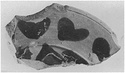
| Small fragment from the floor. Decorated on both sides. Incomprehensible small part of the medallion surrounded by a band filled with dots. From the zone around it part of sphinx right and blob rosettes ... 16, 18 March 1936 |
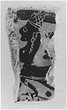
| Two joining fragments preserve part of floor with very low beveled foot ring.
Thighs to ankles of a man running right.
Incised sketch; clay paint in part worn off.
Outside unglazed.
Imitation red figure; ... 12 April 1957 |
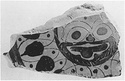
| Center fragment and small part of foot.
Gorgoneion surrounded by band of lotus bud and dots. Short incised strokes on lower jaw. Five concentric glazed circles on underside. West road and drain; east-west ... 1 June 1939 |
| About half the floor and less than half of the rim preserved. Flat foot, reserved below except for a ring at the center. The outward curving rim is black below.
Interior: in the center, a gorgoneion surrounded ... 15 June 1932 |
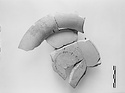
| A single fragment preserves part of the ring foot and flat floor. On the floor, a sphinx left, her polos elaborately incised. Traces of decoration underneath(?).
The glaze fired red. Well, upper fill ... 27 June-5 July 1947 |
| Mended from many pieces; profile complete. At center of floor, gorgoneion. Patterned zones around: tongues, ivy wreath, and again tongues. At the start of the outcurved rim, discontinuous maeander; then ... 3-7 July 1947 |
| From a small plate. Rim piece with bit of flat bottom preserved. Outcurving rim, with a fine groove just inside edge. Inside decoration: on rim, ivy leaves; on floor, head and upper part of wing of Nike ... 19 February 1938 |
| Two large fragments made up of four and three pieces, respectively, give the complete profile of a flat plate with broad out-curved rim which merges below with a thin upright foot. The whole top of the ... August-September 1932 |
| At the northwest foot of Areopagus. Square stone-curbed well with no clear evidence for a period of use; appears to be a single dump ... Ca. 500 B.C. |
| A well in the industrial area of the Areopagus, about 7.00m. west of the West Bath, to a depth of 14.60m. This well was the direct successor to A 17:1, replacing it when it collapsed. The use filling at ... Second quarter 6th. c. |
| A well on the lower slope of the Hill of the Nymphs, (diam. 1.20m -water level -7m), to 7.90m. The scanty use filling at the bottom contained water jars and pitchers as well as the inventoried objects; ... Second quarter of 6th. c. B.C. |
West Road and Drain. (Road, drain and closely related cuts.) Packing in line of ancient road running along the northwest shoulder of the Areopagus. Includes excavation of 1957 titled "Road Area to North", ... Late 6th c. B.C. - Roman |
Destruction debris in Late Roman Buildings on Lower N slope of Areopagus (see summaries under M-Q 17-21).
Over 130 coins came from this filling, of which some 51 survived in a condition to permit accurate ... 6th c. A.D. |
| A cave-in not long after the digging of this shaft destroyed its possible usefulness as a well and thereafter it was used as a dump. Two principle periods of such use were noted, and within these several ... Ca. 575-480 B.C. |
| Moore, M. B. Philippides, M. Z. P ... American School of Classical Studies at Athens ... This volume is the first of the Athenian Agora reports to deal specifically with figured wares; it is concerned with the black-figured pottery found in the excavations in the Athenian Agora between 1931 ... 1986 |
|
|