|
|
Filling associated with construction of Poros Building. A small amount of fragmentary pottery found in the clay filling of the original floor; perhaps deposited as late as ca. 425-400 B.C. Cf. 18:4 and ... Ca. 475-450 B.C. or later. |
Deposit in a cutting in bedrock on Kolonos Agoraios. Sherds in container Lot ΠΘ 4a ... Probably 4th c. B.C. |
Hole in bedrock; small amount of debris filling ... Last quarter 5th c. B.C. |
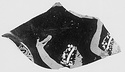
| From a bell krater. The outward curve toward the lip preserved at the top, and part of the handle attachment, with egg and dot around, at the left. Two youths, dancing, left, looking back right; each with ... 26-27 March 1937 |
Tiled well cleared only to a depth of 6.60m. where fallen tiles and broken bedrock made further work impossible. So far as dug, a dumped filling as late as the 6th c. A.D. Coins:
16 May 1949 #2
18 May ... As late as 6th c. A.D. |
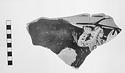
| Fragment from the wall of a chous; thin red wash inside. Preserved is part of a table, with a large loaf(?) on it, and part of a pitcher held out from the right.
Brown drawing for details. Pottery Dump ... 15 June 1949 |
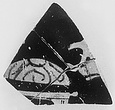
| a) Mended from two pieces, gives part of the scene: Amazon, to right; shield in her left hand, spear in right; also part of olive wreath on the rim; and a handle root.
b) Mended from four pieces, gives ... 7-8 April 1948 |
Pit with marble chips (disturbed); working chips of the Hephaisteion construction. A few vases apparently contemporary with the building of the temple ... 5th c. B.C. to ca. 450 but disturbed. |
Pit 4 in Grave area (= Cistern). Not completely cleared. Filling probably late Hellenistic, though with some earlier material ... Hellenistic |
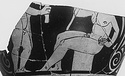
| Both handles, much of the body and all of the rim missing except one small non-joining fragment. The better preserved side shows at left a male figure with a cloak hung from his left arm or shoulder. He ... 15 June 1949 |
Lower filling mostly of second half of 4th c. B. C. and earlier, but perhaps dumped in 3rd c. B.C. Upper filling mixed to Roman (4th c. A.D.). Pottery in container (9-22-58) is mostly second half of 4th ... Ca. 375-325 B.C. with late-3rd-century disturbance |
Pit 2 in Grave area. Small deposit in a pit; a fragment of a red-figured nuptial lebes recalls the early Kerch style of the second quarter of the 4th c.; the deposit as a whole runs somewhat later ... Ca. 375-315 B.C. |
| Pyre /Burial (?) disturbed, in the area of the Poros Building west of the Areopagus. In northeast corner of room 4 west.
Concentration of artifacts, tiny slivers of bone, and burning in a layer of fill ... Early 4th c. B.C. |
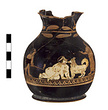
| Back of neck and handle missing; and scraps. Around the neck, olive wreath; ground line, egg and dot. The scene shows three children at play, with a dog; at left a nude boy, right, leaning forward, taking ... 15 June 1949 |
Cistern with mixed dumped filling uniform throughout cistern and two short blind channels. Coins:
16 May 1939 #6-#7
17 May 1939 #1 ... 6th-1st c. B.C. |
| Sacrificial pyre in Poros Building, NW Room (RSY= Pyre 1).
Against east wall of room 5 west. artifacts, bone, carbon and ash in pit in floor sequence. the pyre lay below a floor covered with marble dust, ... Middle of 4th c. B.C. |
A rubbish pit at the foot of the northwest slope of the Areopagus. Black figured, plain glazed vases and several lamps. A pair of lekythoi recall both in make and in style the products of the Haimon Painter ... Ca. 480-475 B.C. |
Same filling as Theseion Street Deposit D 7:2 but separate list.
Perhaps also P 7904. Area disturbed by Turkish (50-56/ΜΓ-ΜΣΤ).
This is 3-4 m. west of Hephaisteion, and the hole was probably filled at ... Ca. 500-470 B.C. |
| Hole at 57/ΛΣΤ = Pottery Dump at 57/ΛΣΤ. May well have accumulated on the spot where it was found, its fragmentary state being attributable to the later rubble wall laid over it.
Cf. also P 19982 (ΟΟ ... Ca. 400-375 B.C. |
Construction filling of the Poros Building west of the Areopagus. Patch of stony fill beneath the courtyard. Accumulation of the second quarter of the 5th c., deposited in the last quarter ... Ca. 475-450 B.C. and later |
Deposit of fine table ware and lekythoi, both black-figured and red; the plain wares closely resemble those from the well H 6:5 ... 470-450 B.C. |
Stuccoed pit, 2m x 2.50 m, rock-cut. Coins:
26 March 1937 #1 (not a coin) ... Ca. 400-350 B.C. |
Cistern at 65/ΚΗ (and Channel). Cistern in the northwest room of the annex to the Poros Building west of the Areopagus. Part of the same system as D 17:4 and D 17:5, the chambers connected by long tunnels ... 300-250 B.C. |
Cistern (diameter 0.90m) with two channels; the fill of the cistern proper, below the scant upper (Byzantine) deposit, appears to have been dumped all at the same time, to 325-275 B.C. Notebook says "all ... 325-275 B.C. |
Cistern at 70/ΚΕ and channels. Part of same system as D 17:3 and D 17:5. It was set against a corner of the lowest foundation block. Thus one is forced to assume that enough of the wall remained at least ... Ca. 200-150 B.C. |
Construction and upper fills. Well at 116/ΣΤ, cut less than one meter from a shallower and older well at 115/ΣΤ [D 15:1]. ... a fall of loose fill occurred from the earlier into the later well ...
Filling ... 2nd c. A.D. plus 6th c. A.D. |
Fillings below the courtyard floor of the Poros Enclosure west of the Areopagus. The lowest layer, over bedrock, is of the archaic period and may have accumulated on the spot before the start of building ... First half of 5th c. B.C. |
An unfinished well in the northwest room of the Poros Building, west of the Areopagus. Dumped filling. Chips from marble-working, variety of plain and figured wares ... Ca. 400-385 B.C. |
Square pit in bedrock southwest of the Hephaisteion. Many marble chips from the construction of the temple of Hephaestus were found here together with a large quantity of pottery and other objects ... Ca. 450 B.C.
Ca. 390-380 B.C. |
A very homogeneous dumped filling and no period of use. Apparently a failure as a well.
T 263-T 289 resorted and reduced August 1967. Cf. BI 157 "from behind the curbing of the well by Stoa pier 3." Estimated ... Ca. 470-460 B.C. |
Packing under cobblestones 7 or 8 meters west of the Temple of Hephaistos. A similar filling found in a small hole in bedrock three or four meters north of the Temple. The high quality of the pottery from ... Ca. 500-440 B.C. |
Built against the south wall of the annex to the Poros Building
west of the Areopagus. At the west the upper layer of marble chips carried against it, the lowest were cut by it.
Part of same system as ... 225-100 B.C. |
Part of the cistern system 44/ΙΓ - 46/ΙΑ - 42/Θ. The filling of the 46/ΙΑ cistern shaft, with the exception of a little Roman at the top, was the same as the bottom fill of 44/ΙΓ - late Hellenistic, running ... Late 2nd-early 1st c. B.C. |
Well at 115/ΣΤ (all the 5th c. fills of 116/ΣΤ). The lower part of the shaft contained a heavy deposit of pottery and other objects of the late archaic period, both coarse and finer wares; probably a post-Persian ... Ca. 500-480 B.C.-Roman |
A small flask-shaped cistern on the lower southeast slope of Kolonos Agoraios. Lined with hydraulic cement and containing a large quantity of glazed table ware and a fair amount of coarse ware; a homogeneous ... 350-325 B.C. |
Part of the cistern system 44/ΙΓ - 46/ΙΑ - 42/Θ.
Objects with context as "cistern 44ΙΓ, mouth of 46/ΙΑ" are listed with D 12:2.
The following objects are from "earth", i.e. no context layer:
SS 5334, ... Late Hellenistic-Early Roman |
Pit and well at eastern edge of Kolonos Agoraios with uniform fill.
Diameter 1.90m; straight round shaft ... Late 8th-first half 7th c. B.C. |
| Sparkes, B. A. Tallcott, L ... American School of Classical Studies at Athens ... This massive (two-part) volume focuses on pottery produced between 600 and 300 B.C. with Sparkes discussing the black glaze and Talcott the domestic (household and kitchen) wares of the period. Over 2,040 ... 1970 |
|
|