|
|
Filling associated with construction of Poros Building. A small amount of fragmentary pottery found in the clay filling of the original floor; perhaps deposited as late as ca. 425-400 B.C. Cf. 18:4 and ... Ca. 475-450 B.C. or later. |
(now O 9:1) Asterisk: O 8:6* |
Deposit in a cutting in bedrock on Kolonos Agoraios. Sherds in container Lot ΠΘ 4a ... Probably 4th c. B.C. |
Pocket in wall of Turkish bothros. The uninventoried material includes along with earlier pieces, the fragment of a bolsal very close to those from the well R 13:4 ... 450-425 B.C. |
Grave 2.
Shallow cutting, 1.00x0.47m, in bedrock; possibly a child's burial, but no skeletal remains preserved ... Late 5th c. B.C. |
Hole in bedrock; small amount of debris filling ... Last quarter 5th c. B.C. |
Hole at 65/ΚΔ; small cutting in bedrock with scanty pottery ... 450-400 B.C. |
Pit in SE corner of room at 14-19/ΙΖ-ΚΑ ... 4th century B.C. |
A circular cutting in bedrock ... Late 6th-early 5th c. B.C. |
Grave XXVII in notebook = RSY Grave 8.
Possibly a child's grave ... Ca. middle of the 6th. c. B.C. |
Pocket in Bedrock, martyr south of 29/ΜΕ (formerly O 8:6) ... 500-480 B.C. |
Rectangular pit over bedrock in north part of E. Building. Broken jars and household basins with a few black glazed and black-figured fragments (uninventoried). The figured pieces indicate the lower limit ... Late 6th-ca. 480 B.C. |
| Sacrificial pyre, disturbed; a small pyxis (P 14864) is close to that from B 18:4. First half of 4th. c. B.C., perhaps first quarter.
West of House C. Pottery and cinders in pit in stratum. The pyre was ... First half 4th. c. B.C. |
Scanty debris filling in a square pit with 4th. c. sherds at bottom. Notebook says 36-38/ΝΑ-ΝΒ and T 81 ... 1st. qtr. 4th. c. B.C. |
Rectangular pit (in Trench IX); dumped filling of late 5th. c. B.C. with some disturbance as late as Early Roman. P 18559 and P 18510 from above this pit ... 5th c. B.C. |
Shallow rectangular pit in bedrock at 44/Η. It contained a very small quantity of pottery, mostly coarse but including a few black glazed pieces, one stamped. Agora XII, p. 396.
No container, pottery ... 450-400 B.C. |
Disturbed burial set into a cutting in hardpan. No lot ... 2nd half of 5th c. B.C. |
Grave (?) under wall 4. Infant burial(?); a kados, P 16747, lying sideways with a tall cylindrical stand, P 16748, set over it as a cover; the upper parts of the pots cut away ... Late 6th. c. B.C. |
Pocket of pottery to south of grave at 36/ΛΔ; uncertain context. Terracotta figurines resembling those from the Coroplast's Dump (S 19:3) No containers (cf. O 18:2).
T 2468, T 2476, ST 412 from Hellenistic ... 350-320 B.C. |
The almost complete red figure hydria set into this cutting suggests the possibility of a 5th c. burial put into a much earlier grave cutting; however, the remainder of the filling appears thoroughly disturbed ... 450-425 B.C- Late Roman disturbance |
Patch of burned filling at 66-67/ΚΘ-Λ (or Λ-ΛΑ) Coin
18 May 1938 #10 P 34428 added from Lot Ω 102 ... Early 5 c. B.C. (?) |
Flask-shaped cistern (1959) (Cistern under Room 4 in NE corner of Section). Upper filling soft silt with a little pottery. Lower filling hard silt, almost no pottery.
1.35m in diameter at the floor with ... End of the 4th c. B.C. |
Hephaisteion Garden; fill beside wall. Loose filling encountered in rescue excavation to examine wall found during construction of public toilet in Theseion Park, outside Agora area. SIR 1991
Originally ... Second half of 4th c. B.C. |
Pits in area 96-100/ΝΕ-ΝΘ (lower east slopes of Hill of the Nymphs, near extreme west edge of excavated area).
Shallow pit in bedrock against N. face of wall. dMax. depth 0.20m.d.
Many fills in areas ... Ca. 325-300 B.C. |
Tiled well cleared only to a depth of 6.60m. where fallen tiles and broken bedrock made further work impossible. So far as dug, a dumped filling as late as the 6th c. A.D. Coins:
16 May 1949 #2
18 May ... As late as 6th c. A.D. |
Patch of early fill, disturbed. 20/9/1962: Tin 145 is checked and is chiefly late archaic, but some of the coarse ware is late 5th with 4th c. B.C., and a few bits are 4th c. A.D ... Late 6th.-early 5th c. B.C. |
| Disturbed pyre containing only a pyxis and a chytridion.
No notebook account of excavation exists. The pyre may have been located at the edge of an ancient road. There is no record of bone or burning ... 350-325 B.C. (?) |
| Pocket, identified as sacrificial pyre by SIR. Possibly disturbed. Outside south wall of building. Concentration of pottery in a small pocket below a "Hellenistic" fill. There is no mention of bone or ... First quarter 4th c. B.C. |
Pithos in NW corner (room) of Poros Building. Marble chips ... Mid-4th c.? |
Shallow pit in bedrock. NB fragment found in gravel to south of pit (ΟΟ 399=P18633) ... Second quarter 5th c. B.C. |
Small pocket between the tumbled wall of large conglomerate blocks and Drain 2 ... 4th c. B.C. |
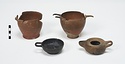
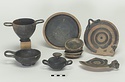
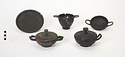
| A compact group of four complete vases and a lamp, found on a house floor; possibly the remains of a sacrificial pyre but without evidence of burning or the characteristic votive vases.
Layer II, "nest ... 425-400 B.C. |
| Pit with traces of burning ... Probably 3rd qtr. 5th c. B.C. |
No independently datable objects. Coins:
17 February 1932 #29
18 February 1932 #4 ... 325-300 B.C. |
Civic Offices, North Pit, Room 1. Filling mixed to Hellenistic; some archaic material ... Prehistoric- 6th c. B.C.- Hellenistic. |
Martyr at Δ6. Top strosis (Byzantine-Turkish) discarded.
Strosis 2, late Hellenistic (Lot ΔΕ 21)
Strosis 3, early Hellenistic (Lot ΔΕ 22)
Strosis 4, to mid-4th c. B.C. (Lot ΔΕ 23)
Nothing catalogued from ... To mid-4th c. B.C. |
Refuse pit in rock by heavy wall on West Street ... Ca. 500-480 B.C. |
| Pyre 1 in Central House, Room XI, strosis 3. Sacrificial pyre with characteristic small vases amid carbonized twigs and bone.
Near north side of courtyard. This pit was cut slightly into strosis 3 (lot ... 1st quarter 4th c. B.C. |
Filling around rubble wall (35/ΚΕ). It contained a mass of pottery, most of it uninventoried ... Ca. 425-400 B.C. |
| Crevice in Rock (Grave?) at 70/ΝΣΤ (below modern surface accumulation).
Identified as a sacrificial pyre, with characteristic banded plates and saucers, by SIR ... 4th c. B.C./300-250 B.C. |
Deposit associated with early walls West of the Stoa of Attalos ... Late 5th c. B.C. (?)- early 4th c. B.C. |
Two narrow trenches at right angles to each other.
Small deposit in bedrock cutting Good black glaze ware ... 430-420 B.C. |
Pit with marble chips (disturbed); working chips of the Hephaisteion construction. A few vases apparently contemporary with the building of the temple ... 5th c. B.C. to ca. 450 but disturbed. |
Pit 4 in Grave area (= Cistern). Not completely cleared. Filling probably late Hellenistic, though with some earlier material ... Hellenistic |
| Grave XVI in notebook = RSY Grave 3.
Bones of a young child found inside. Discarded? ... 6th. c. B.C. |
Perhaps originally a grave cutting ... Ca. 390-380 B.C. |
House N, room 6=House T: Pit with Kalikia in Room 2W. Roughly rectangular pit, length 7.10m., possibly dug to obtain clay for flooring in nearby houses ... Ca. 500-480 B.C. |
Rodney S. Young ... Grave 17 in notebook. No offerings.
Amphora containing skeleton of small child was laid on its side in pit. RSY
Lot Β 304 Fill over Grave 17 ... Early 6th century B.C (?) |
Rectangular cutting, not entirely preserved, west of underground drain. Contained good black glazed pottery, some stamped, and a little coarse ware, along with bits of bone and part of a skull ... Third quarter 5th c. B.C. |
Pits in area 96-100/ΝΕ-ΝΘ (lower east slopes of Hill of the Nymphs, near extreme west edge of excavated area).
Scanty debris filling in a pit. Many fills in areas A 19 and A 20 similar in character to ... 325-300 B.C. |
Deposit of black glazed table ware found with a mass of bones, iron waste and burning. Coins (from above Hellenistic/associated floor):
7 April 1948 #10-#11 ... 375-325 B.C. |
House N, Room 4, Pit through layers 5-6. Debris filling, mixed context. Estimated Grid ... Late 4th. c. B.C. into early 3rd c. B.C. |
Small deposit including red figured fragments ... Second and third quarters of 4th c. B.C. |
Cutting in bedrock (Panathenaic Way Cut II, Cutting C1); loose gravelly filling over bedrock including a number of terracotta figurines. Lot ΠΑ 61? P 26458 is probably a slip. One fragment noted as from ... 4th c. B.C. |
Pit at 48/ΚΕ; circular cutting in bedrock (diameter ca. 1m) ... Ca. 500-470 B.C. (?) |
| Grave 4 in notebook: urn burial. Lower part of a storage jar (P 15407) containing the bones of a small child along with a black glazed kantharos (P 15409) and a banded pelike (P 15408) ... 325-300 B.C. |
Pit in Bedrock South of Large Monument Base, just West of the Stoa of Attalos ... First half of 6th c. B.C. |
Cistern chamber in the area of the southeast Temple, the mouth cut back in antiquity ... Late 4th - early 3rd c. B.C. |
Sacrificial Pit VI in notebook = RSY Grave 18 See also B 21:23 ... Ca. 525-500 B.C. |
Pocket in bedrock, 50/Λ (= Trench, 50-54/Λ), measuring 4.00x0.60m, 0.60-0.90m deep; possibly cutting for wall foundation Coins:
22 April 1932 #1 ... 330-300 B.C. |
Deposit at 42/ΙΕ beside rubble wall under modern cellar wall ... 5th c. B.C. |
Narrow trench in bedrock. Cf. Section Σ, p. 4358 (nb. XXII) same trench, same filling.
EV notes that the cutting probably.. to the "narrow cutting in bedrock". The filling seemed to be ca. 425-420 B.C ... Third Quarter to Last Quarter of 5th c. B.C. |
Fifth century Pit E of Stoa Room 11 with coarse pottery and a few black-glazed, some with stamping and red-figured pieces ... Ca. 450-425 B.C. |
| Identified as Pyre by SIR.
Debris filling of the middle of the 4th c. B.C. including the remains of a sacrificial pyre.
Objects dispersed in red-clay fill uncovered in removal of modern staircase. A broken ... 4th c. B.C. disturbed |
A fair-sized pit in bedrock in Stoa Terrace opposite Pier 18, which contained a good deal of pottery mostly coarse. A little additional material as late as second quarter 4th. c. B.C ... Ca. 425-400 B.C. |
A strosis into which were set the foundations of house of 7th c. B.C. to SE of Tholos (=Building A and Trench W, layers h + i) ... 8th-7th c. B.C. |
Small deposit of undisturbed filling in pocket in bedrock at 85/ΛΖ ... Second Half of the 6th c. B.C. |
| Grave V in notebook = RSY Grave 5. PD 731-c, Ptg. 244 ... Second quarter of the 6th. c. B.C. |
Pocket in bedrock 35/Ε. The filling consisting chiefly of coarse ware and roof tiles; some of the material Archaic, but the deposit as late as the mid-5th c. B.C ... Ca. 500-450 B.C. |
The West Chamber of a double cistern lying between the northeast corner of the Theseion and the Annex to the Stoa of Zeus Eleftherios. ... Both chambers went out of use as water containers simultaneously ... 225-165 B.C. |
Scanty debris filling in a pit. The wishbone-handled bowl (P 16753) is of the middle of the third quarter of the 5th. c. century, as are also two red figured fragments, P 25820 and P 25821; the deposit ... Ca. 450-400 B.C. |
Lower filling mostly of second half of 4th c. B. C. and earlier, but perhaps dumped in 3rd c. B.C. Upper filling mixed to Roman (4th c. A.D.). Pottery in container (9-22-58) is mostly second half of 4th ... Ca. 375-325 B.C. with late-3rd-century disturbance |
| Artifacts, burnt bone, ash, cinders and charcoal in pit in bedrock. The pyre lay directly under mosaic floor A. the deposit is not badly disturbed, however, and it is possible that it was laid immediately ... Early second quarter of 4th c. B.C. |
Debris filling in a pit cut in bedrock at W side of House H, Room 10 ... Ca. 425-400 B.C. |
Small Pit or Well at 25/ΚΑ with a small quantity of fine and coarse household pottery, much of it whole, or nearly so ... Ca. 450-425 B.C. |
Cutting in stereo. Early 4th c. fill with some Hellenistic-Early Roman disturbance ... Ca. 400-375 B.C. |
Pit 2 in Grave area. Small deposit in a pit; a fragment of a red-figured nuptial lebes recalls the early Kerch style of the second quarter of the 4th c.; the deposit as a whole runs somewhat later ... Ca. 375-315 B.C. |
Well at 32/ΣΤ ... Late 6th c. B.C. |
Scanty dumped filling in an abandoned well cutting ... Ca. 425-420 B.C. |
"South Triangle" abandonment filling over Brown House (House A) in the industrial area. Layers 1-3 and layer 4, to floor of second period. As late as the 3rd. c. B.C. but composed largely of earlier material ... 3rd c. B.C. and earlier |
| Pyre /Burial (?) disturbed, in the area of the Poros Building west of the Areopagus. In northeast corner of room 4 west.
Concentration of artifacts, tiny slivers of bone, and burning in a layer of fill ... Early 4th c. B.C. |
| Pyre in House T (= House D), Room 2 (5th c.) and fill east of pyre.
Earlier than the other pyres of this house.
Pottery, slivers of burnt bone, and heavy deposit of carbonized material and cinders in ... Ca. 420-410 B.C. |
Rectangular shaft neighboring the well D 17:12. Dug only to a depth of 4.40m. and provided with two galleries or channels extending from it. Apparently never intended as a well. Refilled with the dug bedrock ... 4th c. B.C. |
Pit at 57/ΚΑ; small pit on the lower north slope of the Areopagus, measuring 1.05x0.80mx0.80m deep. There were traces of burning and a few bones in it, since none of them are recognizably human it is probably ... 480 - 470 B.C. |
Pit in bedrock in front of Shop VII (= Pit in Stoa Colonnade in front of Shop VII). It contained a miscellaneous collection of sherds which included one scrap of red-figure ... Ca. 475-460 B.C. |
| Roasting pits associated with the archaic buildings which preceded the Tholos ... Ca. 500-470 B.C. |
Rodney S. Young ... Grave 1 in notebook. Slightly disturbed by the digging of Pit A.
A large oil jar/amphora lay on its side with a flat stone stopping its mouth. The three small vases offered at the burial were found, together ... Ca. 600 B.C. |
Crescent-shaped cutting in bedrock at 47/ΙΓ; on the north slope of the Areopagus, slightly to the west of the dromos of the Mycenaean Chamber Tomb.
Dimensions of cutting : max. diameter ca. 2.50m.; depth ... Ca. 500-450 B.C.
400-350 B.C. |
Mixed filling in a well cut rectangular pit. Debris of the second half of the 5th. c., deposited as late as the second quarter of the 4th. c. B.C ... 4th c. B.C. and earlier |
Cistern with mixed dumped filling uniform throughout cistern and two short blind channels. Coins:
16 May 1939 #6-#7
17 May 1939 #1 ... 6th-1st c. B.C. |
Well at 112/Ν.
Shallow well with a short period of use. The scattering of fragments in the upper dumped filling is consistently earlier. Lot Τ 12 (all sherds saved) and Lot Τ 13a (Dirt Pile) ... 520-500 B.C. |
Well in Stoa Terrace opposite Pier 2.
Diameter 1.10m. Well cut with steps on both sides. No water. was probably not much used, although part of a well head was found at 4.50m Estimated Grid ... Into 600-575 B.C. |
Filling inside N room of Temple of Apollo, including directly under the foundations of the N room ... Ca. 350 B.C. and earlier |
| Grave 3 in notebook. Outside Archaic cemetery, inhumation burial. Deposit list says black glaze pithos (P 8922) containing the bones of a child and four small vases. The pithos lay on its side with the ... Last quarter of 6th century B.C. |
Cistern System #1e: Shaft at 11/ΞΑ.
Agora XXIX: "Well (not cistern shaft, as in Agora XII) ... Communicates with water system through small hole (see C 8:1) probably fortuitously. Single fill, mostly of ... 350-300 B.C. |
Well at 123/ΝΑ.
At the bottom a few water jars; above , a dumped filling with a small amount of pottery; at the top supplementary fill with scattered sherds.
POU, ca. 500 B.C.
Dumped filling, of ca. 500 ... 6th c. B.C. |
Drain Trench at 62/ΜΗ.
The presence of a number of fairly well preserved vases of good quality suggested to the excavator the possibility that the cutting might once have contained a burial. No skeletal ... 325-300 B.C. |
Filling in a sizeable pit. The objects, along with the dimensions of the cutting from which they came, might suggest offerings in a disturbed grave but there was no evidence of skeletal remains ... Ca. 430-415 B.C. |
A well (diameter 1m) in the industrial area west of the Areopagus, in the area later occupied by House C. Water level 1.50-2.m Dumped filling of broken bedrock with considerable fragmentary pottery in ... Ca. 500-480 B.C. |
|
|