|
|
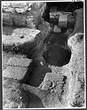
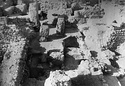
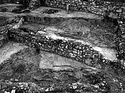
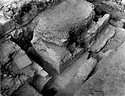
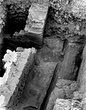
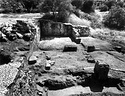
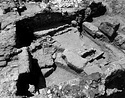
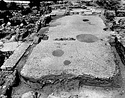
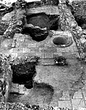
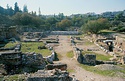
| Southeast corner of the Aiakeion after removal of the Hellenistic fill. Front foundation of the South Stoa II in lower left ... south 3424 Horizontal (normal) ... 29 Jul 1960 |
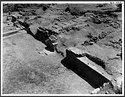
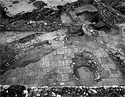
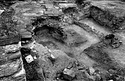
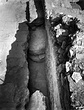
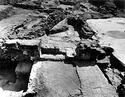
| West side of the building. Modern masonry supports remains of the aqueduct (marked "XX") ... northeast 3436 Horizontal (normal) ... 29 Jul 1960 |
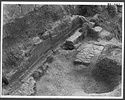
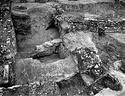
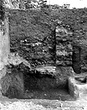
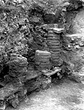
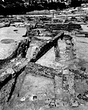
| Poros Aqueduct at the southwest corner of the "Heliaia" (now identified as the Aiakeion). Foundation for south wall of the "Heliaia" in middle right ... southwest 3447 Horizontal (normal) ... 29 Jul 1960 |
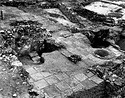
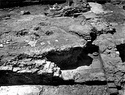
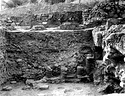
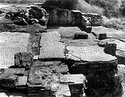
| Late Roman Fortification Wall overlying the foundations of the Propylon. Arrows mark the corners of the Propylon. A) Fragment (I 4720m) from the Bouleutic list of 304/3; B) Dedicatory statue base, I 4850; ... I 4850 and I 4713 were found in section ΘΘ. (SD) east 227 Horizontal (normal) ... 6 Jun 1959 |
Containers 2, 3 ... Late Hellenistic? |
Containers 4, 5, 6 and channel ... Ca. 225-150 B.C. POU |
Built against the south wall of the annex to the Poros Building
west of the Areopagus. At the west the upper layer of marble chips carried against it, the lowest were cut by it.
Part of same system as ... 225-100 B.C. |
Containers 1-5. Coins:
8 April 1949 #17-#20 ... 150-100 B.C. |
Containers 6-9. Coins:
9 April 1949 #1-#6 ... 225-150 B.C.? |
| Hole at 57/ΛΣΤ = Pottery Dump at 57/ΛΣΤ. May well have accumulated on the spot where it was found, its fragmentary state being attributable to the later rubble wall laid over it.
Cf. also P 19982 (ΟΟ ... Ca. 400-375 B.C. |
| Pyre /Burial (?) disturbed, in the area of the Poros Building west of the Areopagus. In northeast corner of room 4 west.
Concentration of artifacts, tiny slivers of bone, and burning in a layer of fill ... Early 4th c. B.C. |
| Sacrificial pyre in Poros Building, NW Room (RSY= Pyre 1).
Against east wall of room 5 west. artifacts, bone, carbon and ash in pit in floor sequence. the pyre lay below a floor covered with marble dust, ... Middle of 4th c. B.C. |
An unfinished well in the northwest room of the Poros Building, west of the Areopagus. Dumped filling. Chips from marble-working, variety of plain and figured wares ... Ca. 400-385 B.C. |
Well under Poros Building Drain at 62/ΛΣΤ, west of the Areopagus. Digging abandoned at 6.10m due to a collapse of the soft bedrock at the west. Small amount of supplementary filling was added in the upper ... Ca. 520-480 B.C. |
Upper fill early Roman. Lower fill latest Hellenistic.
No house walls clearly associated with it, and apparently no attempt made to assign it to any particular house. Subdivisions:
.1=Upper fill
.2=Lower ... Late Hellenistic-Early Roman |
Containers 1-3. Coins:
27 September 1947 #1-#2 ... Early Roman |
Containers 6-12 ... Latest Hellenistic |
Unfinished well, south of the annex to the Poros Building, west of the Areopagus. The shaft was apparently never used as a well. The lower dumped filling contained a quantity of clean red clay, as if from ... Ca. 350-325 B.C. |
| Pocket with burning at 60/ΚΗ. "Is this perhaps a disturbed pyre burial." [Nbp. 2928].
Identified as pyre by SIR.
Near north end of corridor, beside its west wall. Concentration of artifacts, tiny scraps ... 4th c. B.C. |
| Disturbed Pyre at 59/ΚΗ (ΚΖ), in the area of the Poros Building west of the Areopagus.
Against east wall of room 5 west. concentration of artifacts, ash, carbon and a few bones in stratum, no pit discerned ... 3rd c. B.C. |
Rectangular shaft neighboring the well D 17:12. Dug only to a depth of 4.40m. and provided with two galleries or channels extending from it. Apparently never intended as a well. Refilled with the dug bedrock ... 4th c. B.C. |
Pithos in NW corner (room) of Poros Building. Marble chips ... Mid-4th c.? |
Shallow pit in bedrock. NB fragment found in gravel to south of pit (ΟΟ 399=P18633) ... Second quarter 5th c. B.C. |
Drain in corridor of Poros Building. Deposit is from the period of use of the drain. Cf. also containers 140 and 602 ... Late 5th-early 4th c. B.C. |
Late Roman, perhaps as late as 7th c., but excavator noted small amount of material made close dating impossible throughout. Nbpp. 2448-2449: The fill of this well throughout is mixed and there are numerous ... Early to Late Roman |
Casting pit near SE corner of Poros Building, Room C 3. Combined with D 18:4 ... 1st c. B.C.-1st c. A.D. |
Unfinished well in corridor of Poros Building ... Third quarter 5th c. B.C. |
Stratified well. Coins:
22 July 1947 #1 Subdivisions:
.1=top to -5.20m.
.2=5.20-7.80m.
.3=7.80-10.30m ... Second half 1st-early 3rd c. A.D. |
First half of 5th c. B.C. |
Displaced curbing stone had fallen into top of shaft; fill with and around it is presumably second half of 2nd c. A.D. Below tumbled filling at top, shaft was empty to 10.80m. Tiles were missing to ca ... Late 1st-early 2nd c. |
A rubbish pit at the foot of the northwest slope of the Areopagus. Black figured, plain glazed vases and several lamps. A pair of lekythoi recall both in make and in style the products of the Haimon Painter ... Ca. 480-475 B.C. |
Cistern at 65/ΚΗ (and Channel). Cistern in the northwest room of the annex to the Poros Building west of the Areopagus. Part of the same system as D 17:4 and D 17:5, the chambers connected by long tunnels ... 300-250 B.C. |
Cistern at 70/ΚΕ and channels. Part of same system as D 17:3 and D 17:5. It was set against a corner of the lowest foundation block. Thus one is forced to assume that enough of the wall remained at least ... Ca. 200-150 B.C. |
Container 1 ... Ca. 150 B.C. |
| Pottery dumb beside wall of the Poros Building. Deposit D 17:6 ... north Horizontal (normal) ... 14 Jun 1949 |
| South central area, showing pit with pottery dumb at lower left. Deposit D 17:6 ... north Horizontal (normal) ... 14 Jun 1949 |
| Southeast corner ... west 4282 Horizontal (normal) ... June 1968 |
| Room A3 at beginning of season ... east 4217 Horizontal (normal) ... June 1968 |
| The southeast area at beginning of season ... southwest 4215 Horizontal (normal) ... June 1968 |
| The southeast area of the bath ... east 4216 Horizontal (normal) ... June 1968 |
| Room A4. Ancient bedrock cutting and large poros block under floor ... northeast 4214 Horizontal (normal) ... 18 Jun 1968 |
| Stratification of destruction fill at southeast corner of south hypocaust area ... south 4289 Horizontal (normal) ... 18 Jun 1968 |
| Room A6. Northeast corner after exposing hypocaust floor ... west 4232 Horizontal (normal) ... 22 Jul 1968 |
| Latrine in northwest corner ... southeast 4248 Horizontal (normal) ... 4 Jul 1968 |
| South area of the bath. Pillaging trench along south face of Room A3 ... west 4283 Horizontal (normal) ... 22 Jul 1968 |
| Hypocaust columns in tepidarium (Room A) ... 4295 Horizontal (normal) ... 23 May 1968 |
| Hypocaust floor in Room A ... east 4293 Horizontal (normal) ... 23 May 1968 |
| Room A3. Fire chamber and passage to hypocaust room ... northwest 4298 Horizontal (normal) ... 24 Jul 1968 |
| Room A1 with the west end of Room A3 in foreground. Mosaic hall at right ... south 4315 Horizontal (normal) ... 23 Jul 1968 |
| Room A1 with late walls crossing over the room. Mosaic hall at left ... north 4313 Horizontal (normal) ... 23 Jul 1968 |
| Lower rooms to west of bath proper, with exedra of mosaic hall in foreground ... south 4331 Horizontal (normal) ... 23 Jul 1968 |
| Rooms to west of bath proper ... south 4333 Horizontal (normal) ... 23 Jul 1968 |
| Entrance to Hellenistic Bath complex ... northwest 4260 Horizontal (normal) ... 25 Jul 1968 |
| Mosaic hall (Room A2) ... north 4329 Horizontal (normal) ... 23 Jul 1968 |
| Room A3 at beginning of season ... west 4287 Horizontal (normal) ... June 1968 |
| Civic, Possibly Commercial Unknown Limestone Poor, foundations and lines of walls ... Mid 5th B.C. |
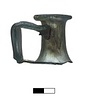
| Broken at top and back. Palmette with volutes and tendrils.
Gritty red clay; traces of white stucco. Signature along lower edge in raised letters: ΗΡΑΚΛΕΙΔΟΥ.
Cf. A 1347 (ΟΟ 469). In late wall over D 1 ... 18 March 1948 |
| Small piece, broken all around, from a thin nearly flat tile.
Inside covered with thin black glaze wash; outside unglazed. On outside, circular stamp with anchor.
Gritty light yellowish buff clay. Well ... May-June 1949 |
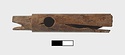
| One end broken; lengthwise cracks and chips.
Preserved end has rabbet to take another section over it. One large hole.
Bone stained brown. Cistern. Container no. 2. Leica, 83-385 PD 1242 ... 20 April 1949 |
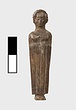
| Intact.
Standing draped female figure. Hole in bottom for attachment.
No visible arms unless they are conceived as held close to the sides, and folded across the front, concealed by and holding up the ... 3 June 1949 |
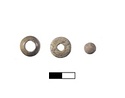
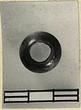
| Globular bead with very large perforation; possibly intended for use around a shaft of pin or the like rather than as a bead.
Bone well polished or worn; stained brown. Pocket with burning.
4th c. B.C ... 4 June 1949 |
| Circular disk pierced in center. Above marble chips. A pocket with burning at 60/ΚΗ.
4th c. B.C. 2929 Leica ... 8 June 1949 |
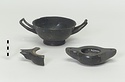
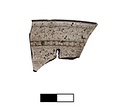
| Two non-joining fragments one from base and one (mended from two) from side wall; the latter preserves part of the lip.
Wide-mouthed round bodied open cup or bowl, the sides decorated with raised ribs ... 14 June 1939 |
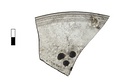
| Plain rim fragment of shallow bowl.
Two shallow grooves on outside of rim; cluster of dots in relief on side.
Mold made (?) Light green glaze; dots blue (?) Dirt fill.
Late Roman. Leica, XXXIII-24 PD 505 ... 2 May 1947 |
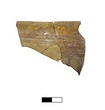
| Fragment preserving part of a broad projecting rim with down-turned outer edge.
A groove at inner and outer edge of rim.
Opaque bluish white glass. Late Roman fill. 868 Leica, XXXIII-26 PD 505, PD 2023-14 ... 18 June 1947 |
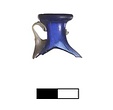
| A single fragment preserves the neck, the flaring rounded rim, and one handle, with the upper attachment of the other, of a miniature amphora.
Dark blue glass; the handles white glass. For contaxt see ... 2 July 1947 |
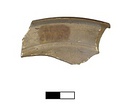
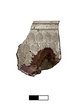
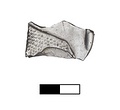
| From rim and wall of a fairly large bowl, moulded.
Bowl with plain slightly out-turned rim. Two grooves around the rim. On the wall a scale pattern formed of oval depressions.
Colorless glass. Agora sample ... 9 July 1947 |
| Mended from four pieces; profile preserved to inside foot ring.
Ring foot; nearly flat bottom, upturned to form a very low wall; broad flat insloping rim, lightly grooved near inner and outer edges.
Nearly ... July 1947 |
| Small piece from the curving wall of a vase.
Part of a wing (?) and the end of a straight band, added in a second layer of glass. Small dots on the wing.
Thin colorless glass. On pebble mosaic floor. Container ... 11 July 1947 |
| Fragment from plain rim of open bowl.
On inside lip, bounded by two grooves, with notched ridge below lower one. Smaller sharper groove lower down.
Moulded glass. For context see Hesp. 20 (1951), p. 183 ... 22 April 1948 |
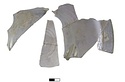
| Fragment a): from vertical rim with ridges inside and out.
Fragment b): from flat bottom curving without break into side wall.
Pontil. Bubbles and spirals. Rim polished after folding.
Light blue glass; ... 30 June 1947 |
| Fragment from thin wall of vessel.
Broken all around.
Oval on both inside and outside, but outside larger.
Place for attachment of handle (?)
On inside blue-green, on outside yellow. Found with coins ... 1 April 1949 |
| Two fragments from a very small very thin-walled vase, mould-blown, with a pattern in low relief. Small horizontal handle (this common mould-blown type, usually has two handles, occasionally one, Stern, ... 20 April 1949 |
| Two joining rim fragments, and non-joining bottom.
Ring foot; pinched in sides, slightly flaring lip.
Thin glaze, yellow green tinge. For context see Hesp. 20 (1951), p. 277. Well, lower fill.
1st c. A.D ... 13 June 1949 |
| Three joining rim fragments and several pieces from bottom. No base.
Short neck, round mouth with flaring lip, handle with projecting ends, from lip to shoulder. Bottom slightly concave.
Blue green glass ... 13 June 1949 |
| Narrow neck with flat lip; angular strap handle, and part of horizontal shoulder preserved.
Greenish blue glass. East-west Street, road fill 4.
2nd-3rd c. A.D. 3490 Leica ... 13 October 1949 |
| Broken into five pieces and very fragmentary.
Inscribed. From the "dump". Store in ziplock polyethylene bag and in area with 40% r.h. or lower.
Wear cotton or latex gloves when handling. Do not bang around ... 25 October 1947 |
| Hollow hub; apparently uninscribed. 5 meters N.E. of N.E. corner poros Building.
Beside late Roman walls.
Fill at least as late as 3rd c. A.D. Leica ... 31 March 1949 |
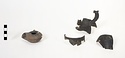
| One nozzle broken off in two pieces, but complete except for small chip.
Globular body on thin ring foot. Central filling hole with short neck and flat projecting rim, grooved on the upper surface.
Three ... 8 April 1949 |
| Complete except for chip from head.
Large-headed hook (if right angle in shaft is original); otherwise a nail.
Head flat. Shaft rectangular in section, tapering to a point, now bent. N.W. room, Poros Building, ... 7 June 1949 |
| Right half of a dikast ticket.
No trace of reuse and no symbol at right end. Punched dots at ends of hastas of letters.
Last letters of name and of demotic preserved. Ca. 3 metres north of Poros Building, ... 2 November 1949 |
| Squat truncated pyramid.
The stub of a projecting pin (for handle or attachment ?) on the bottom. M. Farnsworth reports that although the material is bronze, it appears to contain more lead than is usual ... 15 May 1939 |
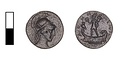
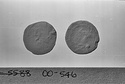
| Athens ... Χάλκινο Αθηνών 2ου αιώνα μ.Χ. Coin no. 8. Casts. Bust of Athena r., wearing Corinthian helmet. ΑΘΗΝ-ΑΙΝ
Themistokles, in military dress and holding trophy with l. hand and wreath with upraised r., standing ... Ca. 120's-140's or later A.D. |
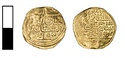
| Miṣr ... Murād III ... Coin no. 11. GCM 1862 BIS. Turkish fill. C 483 ... 1574-1595 A.D. |
| Histiaia ... BMC 138.
[(D 17:5)]
Histiaia.
Obv. Female head right, wearing ivy wreath with hair in knot behind.
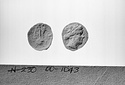
Rev. Α Ε on either side of tripod. Coin no. 2. Cistern, container 7-8 (dump). Head of Maenad r., wearing ... ca. 2nd--1st century B.C. |
Obv. Head of Athena right in Corinthian helmet.
Rev. Owl standing half left in olive wreath; inscription illegible. Coin no. 8. With ashes below disturbed pyre? 2146, 2321, 3286 ... 297-255 B.C. or 339-288 B.C. |
| Lycian League ... Troxell (under 974), p. 191, no. 169; RPC I, 3314.
[Masikytes mint]
[Ob. Head of Artemis to right
Re. MA Stag standing to right] Coin no. 1. Well. [λ-Y] Head of Artemis r., bow and quiver at shoulder ... late 30's--early 20's B.C. |
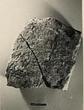
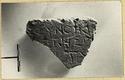
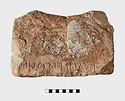
| Inscribed fragment.
Inscribed face only preserved; mended from two pieces
Shallow scratched letters in uneven lines; lower part of face rough picked; upper part coarsely dressed with tooth chisel.
Hymettian ... 17 June 1939 |
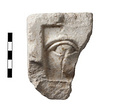
| Inscribed fragment of plaque.
Broken at right and bottom.
In sunken panel, of which bottom edge is preserved, an eye carved in relief.
Inscribed along the top on the raised frame of the panel.
Almost certainly ... 221/0 B.C. |
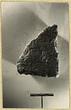
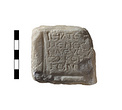
| Inscribed fragment.
Rough edges all around, but right side and back may represent original surface of stone as used.
Letters roughly cut on poor surface.
Blue limestone. Found in Byzantine context east ... 4 April 1947 |
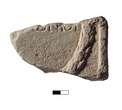
| Inscribed fragment.
Inscribed face and original top preserved.
Parts of three lines of the inscription preserved.
Whitish limestone. Found in Byzantine context east of the Great Drain, in the industrial ... 16 April 1947 |
| Inscribed fragment.
Broken at right and back.
Part of small rectangular base with rectangular cutting, rough picked in top. Left side smooth finished; bottom deeply picked. Shallow groove as frame for ... 24 April 1947 |
| Inscribed fragment of a plaque.
Preserves part of inscribed face, right side and rough picked back.
Part of one line of the inscription preserved, within a wreath.
White crystalline marble. Found in late ... 3 May 1947 |
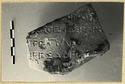
| Inscribed fragment.
Inscribed face only preserved.
Parts of five lines of the inscription preserved.
Hymettian marble. Finished Found in early Byzantine context, east of the Great Drain, in the industrial ... 13 May 1947 |
| Inscribed fragment of grave stele.
Upper left half of stele with pediment top; broken at bottom and right, and acroterion at left broken off. Rough picked back.
Two lines of the inscription preserved ... 15 May 1947 |
| Inscribed fragment of Herm of Zeno.
Fragment from the sloping upper part of a portrait herm; left side and inscribed face only preserved.
Herm of Zeno, son of Mnaseas, the Stoic philosopher.
One line of ... 2nd. century A.D. |
| Inscribed fragment.
Letters inscribed on a partially smoothed down broken surface; back worn smooth; worn breaks at sides and top, in crude pediment form, may be contemporary with inscription; broken at ... 1st. century B.C. |
|
|