|
|
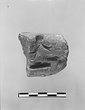
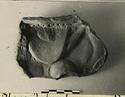
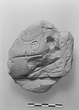
| First interpretation: Mold signed fragment.
Broken at left and chipped along outer edge at top.
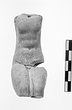
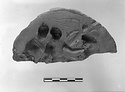
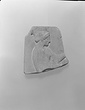
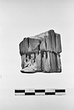
Preserved is a male figure, bearded and partly draped, reclining on a couch and playing the double flutes, ... 27 March 1939 |
| Sloping surface at bottom where front part of stand or base is broken away.
Hermaphroditus see ostendens.
Head missing.
Buff clay, white sizing.
ADDENDA Cf. Agora XI, p. 173.
Compare with T 1808. North ... 7 October 1949 |
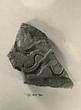
| Flat back and one original edge preserved of mold for a large plaque.
Back legs and tail of a lion walking right.
Coarse brown clay with red bits in it. South Cut A, packing below bath drain, above earlier ... 4 November 1949 |
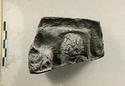
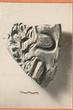
| Fragment from mold for upper left corner of high relief; depressed frame.
Relief widens towards bottom of fragment.
In the positive, upper front part of head in profile left; above it a thyrsos, horizontally, ... 1949 |
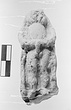
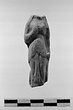
| Nude male figure.
Mended from six fragments. Head and arms missing; with holes for attachment; lower legs missing, and large part from left side.
Traces of white.
Buff clay.
ADENDA Cf. Delos IV, pp. 26 ... 1949 |
| Four pieces of twisted rope with two or three small bits.
Notes on 17 November 1981: Longest piece remaining: P.L. 0.068, Diam. 0.012, fourteen pieces total. Container 16. Well. Leica ... 20 May 1949 |
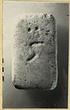
| Plain rectangular block, with a letter and two dots on one side.
Island marble.
Red fill; late Roman. 99 Leica ... 22 April 1947 |
| Joining fragments preserve upper part of neck and of both handles, all of rim.
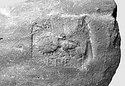
Stamp on one handle; caduceus(?).
Early Thasian. Finished Well; containers 12-13; 4th century B.C. [---]
caduceus? Leica ... 17 May 1949 |
| Small fragment from near toe of unguentarium or amphoriskos.
Light red brown clay; traces of matt red streaked on surface.
One end of a rectangular stamp preserved. Dark Age fill; Byzantine disturbance ... 19 March 1948 |
| Broken off below.
An impression made by pressing a heavy lump of clay against some circular object, presumably a mirror-cover.
The upper part of the scene is preserved; three figures and a hovering Eros ... 3 May 1939 |
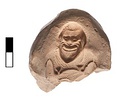
| The upper part of a mold for a bearded figure with mask-like head, wearing a speckled garment (Papposilenus).
He is bending forward and clasping some object (wine-skin ?).
Careful work.
Fine pinkish clay ... Publication: before 350 B.C. |
| Feet and right arm are broken off.
Pot-bellied figure in a short dress.
Traces of red and white paint.
Buff clay.
ADDENDA: Solid. Clay worn and uncrusted. Well. Late 2nd-early 1st c. B.C. 1890 Leica, ... 27 May 1939 |
| Moulded corner fragment, perhaps from an altar.
Leaf band in relief along edge. Top (or bottom) plain.
Hearts of leaves painted alternately red and black with reserved slits down centers; a red and a black ... 22 June 1939 |
| One edge of mold preserved.
Upper part of female figure (?). Sandy late Roman fill. 109 Leica ... 23 April 1947 |
| From one side of a heavy mould, apparently from a plaque of shallow relief, with the curving rim of the mold preserved. Byzantine fill at S.E. corner of section. Leica ... 30 April 1947 |
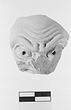
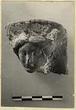
| Mold for bearded head (Pan?)with shaggy hair.
Chip missing at right.
Green-buff clay.
Cf. Fuchs (1963), Mahdia, pl. 53. ΜΣΤ-ΜΖ*
C 17 Great Drain; gravel below elliptical drain tiles. 411 Leica ... 8 May 1947 |
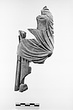
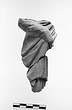
| Drapery for one side of a small standing female figure, preserved about from shoulder to mid-calf (?).
Part of one side preserved.
Plain surface at the right.
From a mold for a relief (?).
Cf. T 3935 ... 23 June 1947 |
| Fragment from a thin flat circular plaque; preserved is the upper part of a lotus flower ornament in low relief, within a raised band. Above (around) the band, a series of triangular projections.
Apparently ... 8 July 1947 |
| Several joining fragments preserve the lower part of a figurine showing a draped figure seated in a large chair or throne. The left hand rests on the arm of the throne; the drapery falls straight to the ... 11 July 1947 |
| Rectangular altar, hollowed at the top; base and crowning mouldings in two degrees. A boukranion in relief on the front; a round hole at the back. Volutes at the top in front.
Small fragments missing ... 14 March 1947 |
| The hair is drawn up into a bow-knot on the top of the head (or is this actually a bow?), and is gathered at the back in a plain projecting .
Earrings. Hair indicated by straight and crosswise grooves ... 15 July 1947 |
| The hair piled high.
Gouged style.
Broken across the neck; the back of the head broken away about on the line of the mould.
No color.
Micaceous red clay. Late Roman destruction fill. Leica ... 14 July 1947 |
| Elongated head with high bald brow; trace of hair, or a wreath at the top. Small pointed ears, somewhat exaggerated features.
Broken off below the chin, and the back missing. Surface chipped on forehead ... 15 July 1947 |
| Fragment preserving upper part of face.
Beetling brows; nose and mouth askew; pierced eyes.
Considerable remains of white, with red over.
Smooth blond-buff clay. N.-S. Trench VI; Late Roman fill. 510 Leica, ... 21 July 1947 |
| In fairly high relief, the upper part of a female figure, right, her head slightly bent, her arms outstretched from the elbows (the hands missing). She wears a thin chiton which covers her arms to the ... 19 September 1947 |
| Lower part broken off. Surface inside somewhat cracked.
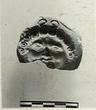
Mold for relief Gorgon head, with snail-shell curls around the face, and two snaky loops rising from the hair at the center above.
Pinkish clay ... 24 April 1940 |
| Edge of large Medusa mask with short curling individual locks of hair plus parts of two curling snakes preserved.
Outer piece, roughly triangular; broken on two edges.
Cf. T 2920, T 2925. On foundation ... 6 April 1949 |
| Fragment from mold for large antefix (?).
A little of the lower part of the face preserved, with tongue, row of teeth and jowls.
Broken all around and at back.
Firm pink clay, fairly fine.
Cf. T 2918, ... 1 April 1949 |
| Part of male thigh.
Metal impression.
Slightly micaceous cinnamon clay.
ADDENDA T 2924 consists of two fragments (a,b) but they were not from the same mould. They were catalogued on one card, but now ... 19 April 1949 |
Preserved is a leg in low relief, and two paws.
Metal impession.
Slightly micaceous cinnamon clay.
ADDENDA T 2924 consists of two fragments (a,b) but they were not from the same mould. They were catalogued ... 19 April 1949 |
| Nude male figure, seated right, on the stepped base of a herm, leaning against the pillar, and looking back left. His cloak beneath him; left arm on bent left knee, right arm at side, the hand holding ... 19 April 1949 |
| The right hand held up to breast. High girt chiton with long overfold.
Back plain.
Solid figurine, head and feet broken off.
Reddish-buff clay. Clay fill about level of Poros Building floor; fourth century ... 21 May 1949 |
| Uncertain subject.
Heavy fabric, reddish-brown at back, light cream on surface.
Flat back; broken all around.
Architectural (?). In trench through marble chip floor, House F, Room 4. Leica ... 1 June 1949 |
| Female head, a polos and veil crowing the softly waved hair.
Broken below the chin and along the right side. Nose chipped; open behind.
Considerable remains of white.
Grayish clay. Washed down by last ... 10 June 1949 |
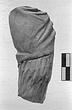
| Part of a standing female figure on a large scale.
Much of the front preserved from knee to shoulders.
The figure wears chiton and himation, the cloak wrapped close around her body to the hips and covering ... 14 April 1949 |
| Lower part of standing draped female figure, about to knees.
The feet project below the chiton; the edge of the himation is preserved above, with a heavy fold hanging at the left side.
Pinkish-buff clay ... 14 April 1949 |
| Small fragment of a figurine similar to T 2953 (ΠΠ 797) and from the same mould.
The right foot and leg to the knee preserved, draped. The knee slightly bent. Area west of Street, Room 3, and Roman House ... 14 April 1949 |
| From the lower part of a standing figure with light inner and heavy over drapery; the left foot preserved.
Similar in scale, style and fabric to T 2953-5 (ΠΠ 797-8), but a different mould, and with the ... 14 April 1949 |
| Part of the right side of a draped standing female figure.
Scale, fabric and style similar to T 2952 (ΠΠ 796).
The cloak is wrapped close around the upper body, covering the right arm; the right hand holds ... 14 April 1949 |
| Right leg and slightly bent knee of a standing figure, perhaps Papposilenos.
Above a cloak; from the knee downward the leg irregularly grooved to represent shaggy trousers or pelt.
Traces of burning.
Hard ... 14 April 1949 |
| Original edge preserved at top.
Left side of a cow head. Delicate modeling of mouth, eye area, and muscles around jawline.
Perhaps a Rhyton? N.W. of building D 1; layer a; early Roman fill. 1145 Leica ... 19 March 1948 |
| Mold for the left side of a mask, apparently a female face; hair rolled back from face, eyebrows exaggerated.
Two finished edges preserved.
ADDENDA Cf. T 2439; close type. Well; near bottom, container ... 4 Oct 1947 |
| Mold for the mid-part of a standing male figure, probably an actor.
One edge preserved; the other chipped away.
Broken off top and bottom.
ADDENDA Cf. Hesperia 20 (1951), p. 274. This filling is associated ... 1 August 1947 |
| The right shoulder of a large draped figure; drapery over shoulder.
The arm broken off below. House H, Room 10, Brown fill, mixed Hellenistic; 4th. to 2nd. B.C. 5545, 5568, 5582 Leica, 80-9-29 ... 22-24 July 1947 |
| Broken across the top, about at the knee, and at one side.
A fall of heavier drapery at the side.
Extremely fine engraved lines and carefully stepped chiton-hem. House H, Room 12, loose brown fill; 4th ... 4 August 1947 |
| Part of a draped figure, perhaps a thigh with drapery over it.
Buff slip, white paint.
Blond clay; pinkish surface. House N, Room 12, loose brown fill; 4th. to 2nd. B.C. 5889, 5899, 5911 Leica, 80-9-26 ... 4 August 1947 |
| Part of bottom, with edge projecting below, and of the right side preserved.
On the front, the leg of a table and part of a long bench under it.
Attachment hole through the plaque, under the bench.
Broken ... 13 August 1947 |
| Fragment a), part of the body of a large standing draped figure, the drapery drawn tight in rather shallow diagonal folds.
One edge preserved.
Fragment b), a second fragment appears to belong, and gives ... 11-12 August 1947 |
| Rectangular stamp; line at top and bottom; symbol (fire-ball or thyrsos?) at centre. Par: for name cf Pridik 1917, Pl IV, nr 21*Rdg: dev: thyrse?(AB)* Finished Brown silted fill; Byzantine. Θ̣α̣[σίω]ν̣ ... 24 May 1939 |
| Part of rim preserved.
Lower part of rectangular stamp; one line preserved; large letters; retrograde. Cxt: NB p1898: top fill, pottery mixed to LHell; NB p1896:
this part mostly broken tiles, few sherds ... 27 May 1939 |
| Curve fragment.
Rectangular stamp; kantharos(?) and kyathos. Rdg: dev: vase(AB)* Finished Cleaning late brown fill. Θασίων
ladle
device
[ Ἀ]ρι[στο]κλῆς 1733 Leica ... 17 May 1939 |
| Rectangular stamp; dolphin(?). Finished Brown silted fill; Byzantine. unread 1696 Leica ... 19 May 1939 |
| Part of rim preserved.
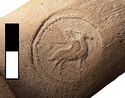
Circular stamp with horse and rider, right, surrounded by a beaded ring. Prof: PD 0845(g)* Well, upper fill; box 5. Dionyssus on ass (in O) 5956 Leica, 94-23-22 PD 845 ... 9 August 1947 |
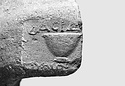
| Rectangular stamp broken off at right; bowl at centre, line above and below. Finished Drain; at level of change from red to green sand. Θασίων̣
vaseIX
Πυθίων̣ [Λυ] 1776 Leica ... 9 June 1939 |
| Narrow neck with mouth and part of rim preserved.
Rectangular stamp with urn. Date: see Ag 12*
Dim: Drim: outer 0.099, inner 0.07 (VG)* Finished Well; container 8. Θασίων | [ Ἀρισ | τοτέλης]
vaseVIII ... Ca. 350-325 B.C. |
| Fragment of handle lower attachment.
Micaceous clay.
Punched mark. Well; first quarter of 4th century B.C. incuse ring 2502 ff. Leica ... 27 May-2 June 1949 |
| Fragment of jar.
Micaceous clay. Stored with άγνωστα. Well; first quarter of 4th century B.C. Ο (incuse) 2502 ff. Leica ... 27 May-2 June 1949 |
| Wide, heavy handle.
Highly micaceous red clay.
Stamp: “alpha”. Hellenistic fill in corner of retaining walls. ΑΔ (Α,Δ lig, inc) 5015 Leica ... 13 June 1947 |
| Rectangular stamp broken at right. Finished Late Roman fill around well. Θασί̣[ων]
vaseIII
Σιμ[αλίωνος | Ἀθη] Leica ... 9 June 1947 |
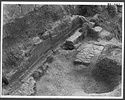
| Southeast corner of the Aiakeion after removal of the Hellenistic fill. Front foundation of the South Stoa II in lower left ... south 3424 Horizontal (normal) ... 29 Jul 1960 |
| West side of the building. Modern masonry supports remains of the aqueduct (marked "XX") ... northeast 3436 Horizontal (normal) ... 29 Jul 1960 |
| Poros Aqueduct at the southwest corner of the "Heliaia" (now identified as the Aiakeion). Foundation for south wall of the "Heliaia" in middle right ... southwest 3447 Horizontal (normal) ... 29 Jul 1960 |
| Late Roman Fortification Wall overlying the foundations of the Propylon. Arrows mark the corners of the Propylon. A) Fragment (I 4720m) from the Bouleutic list of 304/3; B) Dedicatory statue base, I 4850; ... I 4850 and I 4713 were found in section ΘΘ. (SD) east 227 Horizontal (normal) ... 6 Jun 1959 |
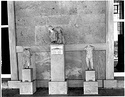
| Installation of the Hephaisteion sculptures, from the left, the Hesperides' group (S 429) Athena (S 1232) and a standing youth, possibly Herakles (S 1313) ... east ... 18 Sep 1958 |
| Hole at 57/ΛΣΤ = Pottery Dump at 57/ΛΣΤ. May well have accumulated on the spot where it was found, its fragmentary state being attributable to the later rubble wall laid over it.
Cf. also P 19982 (ΟΟ ... Ca. 400-375 B.C. |
| Pyre /Burial (?) disturbed, in the area of the Poros Building west of the Areopagus. In northeast corner of room 4 west.
Concentration of artifacts, tiny slivers of bone, and burning in a layer of fill ... Early 4th c. B.C. |
| Sacrificial pyre in Poros Building, NW Room (RSY= Pyre 1).
Against east wall of room 5 west. artifacts, bone, carbon and ash in pit in floor sequence. the pyre lay below a floor covered with marble dust, ... Middle of 4th c. B.C. |
An unfinished well in the northwest room of the Poros Building, west of the Areopagus. Dumped filling. Chips from marble-working, variety of plain and figured wares ... Ca. 400-385 B.C. |
Well under Poros Building Drain at 62/ΛΣΤ, west of the Areopagus. Digging abandoned at 6.10m due to a collapse of the soft bedrock at the west. Small amount of supplementary filling was added in the upper ... Ca. 520-480 B.C. |
Upper fill early Roman. Lower fill latest Hellenistic.
No house walls clearly associated with it, and apparently no attempt made to assign it to any particular house. Subdivisions:
.1=Upper fill
.2=Lower ... Late Hellenistic-Early Roman |
Containers 1-3. Coins:
27 September 1947 #1-#2 ... Early Roman |
Containers 6-12 ... Latest Hellenistic |
Unfinished well, south of the annex to the Poros Building, west of the Areopagus. The shaft was apparently never used as a well. The lower dumped filling contained a quantity of clean red clay, as if from ... Ca. 350-325 B.C. |
| Pocket with burning at 60/ΚΗ. "Is this perhaps a disturbed pyre burial." [Nbp. 2928].
Identified as pyre by SIR.
Near north end of corridor, beside its west wall. Concentration of artifacts, tiny scraps ... 4th c. B.C. |
| Disturbed Pyre at 59/ΚΗ (ΚΖ), in the area of the Poros Building west of the Areopagus.
Against east wall of room 5 west. concentration of artifacts, ash, carbon and a few bones in stratum, no pit discerned ... 3rd c. B.C. |
Rectangular shaft neighboring the well D 17:12. Dug only to a depth of 4.40m. and provided with two galleries or channels extending from it. Apparently never intended as a well. Refilled with the dug bedrock ... 4th c. B.C. |
Pithos in NW corner (room) of Poros Building. Marble chips ... Mid-4th c.? |
Shallow pit in bedrock. NB fragment found in gravel to south of pit (ΟΟ 399=P18633) ... Second quarter 5th c. B.C. |
Drain in corridor of Poros Building. Deposit is from the period of use of the drain. Cf. also containers 140 and 602 ... Late 5th-early 4th c. B.C. |
Casting pit near SE corner of Poros Building, Room C 3. Combined with D 18:4 ... 1st c. B.C.-1st c. A.D. |
Unfinished well in corridor of Poros Building ... Third quarter 5th c. B.C. |
Well on the lower west slope of the Areopagus. Tiled well. The tiles were carefully made and clamped together with lead, two clamps at each joint.
Several fills but apparently all 2nd c. Material in lowest ... Late 2nd to early 1st c. B.C. |
Great Drain fills, including "packing over elliptical tiles" and "gravel fills". The central drain area covered by the sections below; other sections are with other deposits. Coins:
9 May 1947 #2-#5
16 ... 1st c. A.D. |
This is associated with Building A. It had a circular marble well-head with a rectangular well slab beneath. The construction throughout was of well tiles. It produced little to a depth of -8.60m. Between ... 4th c. A.D. |
Pit (Well?) under Building A, Room 2. Coins:
9 May 1949 #1-#2
11 May 1949 #4
12 May 1949 #3 (not a coin, bronze fragment in lotted metal tins ΠΠ 295). Estimated Grid
Remains of coloring matter found with ... Hellenistic-Early Roman |
No objects catalogued ... Late 4th c. B.C. |
Stratified well. Coins:
22 July 1947 #1 Subdivisions:
.1=top to -5.20m.
.2=5.20-7.80m.
.3=7.80-10.30m ... Second half 1st-early 3rd c. A.D. |
First half of 5th c. B.C. |
Near the Poros Enclosure. Diameter 0.76m. water level -1.20m. Plain shaft sunk in the stereo ... 14-22 July 1947 |
Well M: EG, under the south court of the Poros Building.
Hesperia 20 (1951), p. 144 (noted) ... Middle Geometric |
Construction filling of the Poros Building west of the Areopagus. Patch of stony fill beneath the courtyard. Accumulation of the second quarter of the 5th c., deposited in the last quarter ... Ca. 475-450 B.C. and later |
Well, neatly stone-curbed to bottom. Diameter 0.70m. The use filling, from about 3.50m to bottom, consisted chiefly of water-jars with a few small vases and some black-figured fragments.
Upper filling, ... Use filling of ca. 575-550 B.C. |
Second half of 6th c. B.C. |
First half of 5th c. B.C. |
Ostrakon deposit, sand fill in a shallow channel in bedrock at the bottom of the Great Drain in the valley between the Areopagus and the Hill of Nymphs.
This group of ostraka may well come from a single ... Ca. 490-480 B.C. |
|
|