|
|
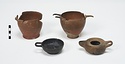
| A compact group of four complete vases and a lamp, found on a house floor; possibly the remains of a sacrificial pyre but without evidence of burning or the characteristic votive vases.
Layer II, "nest ... 425-400 B.C. |
G-H 11-12 was probably extended to G-I and is hereafter G-I 11-12. Asterisk: G-H 11-12* |
North and South Rectangular Stereo-cut Rubbish Pits. These two adjacent rock-cut pits, of uncertain original purpose, were filled with deposits of rubbish evidently contemporary and probably dumped simultaneously, ... Second half of 5th c. B.C. |
| Artifacts, burnt bone, ash, cinders and charcoal in pit in bedrock. The pyre lay directly under mosaic floor A. the deposit is not badly disturbed, however, and it is possible that it was laid immediately ... Early second quarter of 4th c. B.C. |
Hephaisteion Garden; fill beside wall. Loose filling encountered in rescue excavation to examine wall found during construction of public toilet in Theseion Park, outside Agora area. SIR 1991
Originally ... Second half of 4th c. B.C. |
Well at west side of Theseion Plataea, partly cleared to a depth of ca. 5.30m. Dumped filling, apparently the debris from a sculptor's workshop, as indicated by both the quantity of marble chips in the ... Second quarter 4th. c. B.C. |
Deposit of fine table ware and lekythoi, both black-figured and red; the plain wares closely resemble those from the well H 6:5 ... 470-450 B.C. |
First half of 5th c. B.C. |
Well at 20/ΙΔ.
No POU fill. Bottom packed with sherds, including roof-tile fragments. Above this, were six meters with a "fair quantity" of sherds; then the top meter and a half contained a great quantity ... Ca. 420-390 B.C. |
Fillings below the courtyard floor of the Poros Enclosure west of the Areopagus. The lowest layer, over bedrock, is of the archaic period and may have accumulated on the spot before the start of building ... First half of 5th c. B.C. |
A small flask-shaped cistern on the lower southeast slope of Kolonos Agoraios. Lined with hydraulic cement and containing a large quantity of glazed table ware and a fair amount of coarse ware; a homogeneous ... 350-325 B.C. |
A very homogeneous dumped filling and no period of use. Apparently a failure as a well.
T 263-T 289 resorted and reduced August 1967. Cf. BI 157 "from behind the curbing of the well by Stoa pier 3." Estimated ... Ca. 470-460 B.C. |
West Terrace, South End, Layers IV and V. Heavy dumped filling associated with terrace walls at the extreme south end of the excavations in the Areopagus industrial area. The proportion of figured and ... Ca. 420-390 B.C. |
A well on the NW slope of the Areopagus; unfinished well-shaft dug to a depth of only 3.05m., and refilled with broken pottery and other debris. The shaft clearly was begun with the intention of digging ... Ca. 520-480 B.C. |
Well at 21/Ε (beneath Library of Pantainos).
The clearing of the well was abandoned because of a cave-in of the rock walls. Heavy dumped filling, the proportion of fine black table ware high ... Ca. 440-425 B.C. |
Well in house R of industrial area west of the Areopagus. This well, originally tiled, was abandoned and filled at the time of the conversion of the house into a stone-cutters' workshop.
Tiled well but ... Ca. 425-400 B.C. |
It is a considerable deposit including both figured and plain wares, the red-figure consistently of the second quarter of the 4th c. Estimated Grid ... Ca 375-340 B.C. |
Heavy deposit of good black and plain wares ... 450-425 B.C |
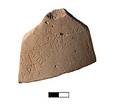
| Pit (6x10) in the valley between the Areopagus and the Hill of the Nymphs. Large cutting in bedrock with 540 ostraka, mainly of the late eighties of the 5th. c. B. C. Much pottery, principally of the early ... Ca. 500-450 B.C. |
Filling behind retaining wall of Stoa of Zeus. The remains of unfired clay adhering to the interior of various pieces make it probable that the material in this filling is a mass of debris from the floor ... Ca. 435-425 B.C. |
Bottle-shaped cistern with dumped fillings on NW slopes of Areopagus; appears not to have been finished in antiquity: the walls and floor show no traces of stucco.
Lower filling, ca. 375-340 B.C.
Upper ... Ca. 375-275 B.C. |
Found in 13/06/1935.
Dumped filling in an unfinished well originally dug only to a depth of 5.50m. Probably a post-Persian cleanup, perhaps in one of the public buildings near the SW corner of the square ... Ca. 520-490 B.C. |
Dumped filling in a well on the west slope of the Areopagus (apparently separate, no mends between them, but differing little in date) the bottom filling apparently thrown in towards the beginning of the ... Ca. 425-400 B.C. and earlier |
| This filling is the largest deposit of its time found in the Agora. It may be compared with H 6:5 and with N 7:3.
Dug in soft bedrock to a depth of 11.40m; footholds cut on opposite sides of the shaft ... Ca. 490-450 B.C. |
A well on Kolonos Agoraios. The upper dumped filling, a heavy deposit of pottery, was separated from the lower filling of similar character by several meters of plain mud. No use filling. Coins:
8 April ... Ca. 375-325 B.C. with disturbance of 250-225 B.C. |
Well (stone-curbed shaft) near middle of Tholos which served the prior building.
Period of Use dated to ca. 500-480(?) B.C., Upper fill dated to ca. 480-470 B.C. or soon after in Agora XXX (a gradual ... Ca. 500-480 B.C. |
Tiled well, ca. 30m south of the Tholos. Associated with Building D. Hellenistic Group A with Late Roman fill in upper 3.00m. Objects A 245 and P 4597 are from fill on floor around well-head, contemporary ... 325-260 B.C. |
Estimated Grid ... 325-260 B.C. |
Cistern with considerable dumped fill at the north foot of Kolonos Agoraios. It may have been abandoned ca. 295-295 B.C.; it will have been filled by 280 B.C.
Multiple vessels share same stamps, and painted ... Ca. 325-250 B.C. |
Estimated Grid ... Ca. 510-480 B.C. |
| Well A, early 5th c. B.C. Near the Agora Boundary Stone, northwest corner of Middle Stoa; diameter at top 0.92m, widening to 1.15m and more below. Shaft neatly faced with stones to a depth of 0.70m below ... Ca. 520-480 B.C. |
| A cave-in not long after the digging of this shaft destroyed its possible usefulness as a well and thereafter it was used as a dump. Two principle periods of such use were noted, and within these several ... Ca. 575-480 B.C. |
| Well below Stoa Gutter opposite Pier 1.
Heavy dumped filling remarkable among Agora well-deposits both for the high quality and the good conditions of pottery of all sorts.
It represents the stock of a ... Ca. 520-490 B.C. |
|
|