|
|
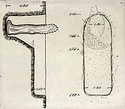
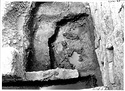
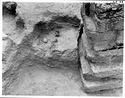
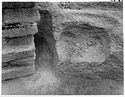
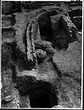
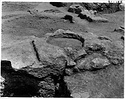
Basin in rock at NW corner of Church of St. Athanasius. Walls lined with small stones and bricks and covered with plaster or mortar.
Dimensions length 1.99, width 0.37, depth 0.77. Coins:
1 April 1939 ... 3rd c. A.D. |
Investigations within the Stoa of Zeus, the north part, various levels.
Notebook references: Stoa Trench E Layers IV and V, Stoa Pits A, B and C, and Layers I and II of area between back wall and retaining ... 5th c. B.C. |
Filling behind retaining wall of Stoa of Zeus. The remains of unfired clay adhering to the interior of various pieces make it probable that the material in this filling is a mass of debris from the floor ... Ca. 435-425 B.C. |
Undisturbed filling inside foundations of small Rectangular Building = Temple of Zeus and Athena. Household pottery, both fine and coarse, and other objects, together with working chips from the construction ... Ca. 375-350 B.C. |
Filling inside N room of Temple of Apollo, including directly under the foundations of the N room ... Ca. 350 B.C. and earlier |
| Pit (f) in bedrock used for casting archaic bronze statue for the first Temple of Apollo Patroos (Hesperia 6 (1937), pp. 82-84) ... 6th c. B.C. |
| Pit and drain at SE corner of Apollo Temple. Antedates building of Apollo Temple which was assigned to a date 'late in the third quarter' ... 3rd quarter 4th c. B.C. |
Lower fill:
See Deposit G-I 11-12, where the finds are again listed.
Dug as Tholos Trench A, Layer VI, no finds.
Dug as Tholos Trench C, Layer IV+Va, A 756, A 757, P 10507.
Dug as Tholos Trench N, Layer ... 6th c. B.C. |
A strosis into which were set the foundations of house of 7th c. B.C. to SE of Tholos (=Building A and Trench W, layers h + i) ... 8th-7th c. B.C. |
Horos terrace trench Layer III, under line of tiles. Coins:
19 March 1953 #16-#17 ... 2nd c. A.D. |
Ostrakon Pit (Horos Terrace Trench). Oval pit cut into bedrock. Packed filling of stones, coarse sherds and roof tiles; among these a few fragments of finer vases and 22 ostraka, probably from the ostracaphoria ... Ca. 490-480 B.C. and later |
From kiln in house of 7th c. B.C. (=Building A), to southeast of Tholos. Tholos Trench U, furnace ... 675-625 B.C. |
Pit in Tholos Trench V (below Layer e).
In plan it would seem to have been oval, though its east end is c/../ by the south wall of the North Archaic Home. Its N-S width is 1.25m, its E-W length is 1.40m ... 7th-early 6th c. B.C. |
Pocket in cobble paving in road west of Fountain House ... 1st c. A.D. |
| C.G. Thomas ... Geometric grave. Bones discarded.
Tomb located about 2m west/west-southwest of the EG1 child inhumation, beneath the restored line of a hypothetical wall connecting the western "apse' and the south wall ... Middle Geometric II |
Exploratory Pits to West of Bema Coins:
31 July 1958 #1-#5 ... To early 2nd century |
Square Peristyle (Square Building) Constructions fill + other (square peristyle area); fragmentary and with some earlier material but in the main, where undisturbed, a homogenous deposit. Coins:
26 May ... Βefore 300 B.C. |
Well of Christian Lamp; west of Stoa terrace wall near north end. Pottery spread out June 1952. A big amphora was made up (ΣΑ 1780), but nothing else went together. Fill appeared o be all of one period ... Late 5th-early 6th century A.D. |
Tiled Well in Square Building Foundations, equipped with evenly spaced hand-holds, with a good supply of water. There was no period of use represented and the dumped fill consisted mostly of chunks of ... Third quarter of 4th c. B.C. |
Dumped debris filling east of East Building, badly shattered. There is a small amount of disturbance from the filling immediately above, but the bulk of the pottery is consistent, and very close to that ... Ca. 470-460 B.C. |
Filling over drain from East Room of Archaic Fountain House. Lot T 16, fill e.
Τ 1567 (SS 11587) and Τ 1734 (P 22538) from upper disturbed fill (p. 2448) ... Late 5th. into 4th c. B.C. |
| Eugene Vanderpool Homer A. Thompson ... Mycenaean Grave to W. of "Court Room" below Stoa Terrace with "Ballot Box" (Grave XXIX).
Unusual type, conforming neither to our pit nor to our cist graves, and consisted of two parts. The outer part was ... Mycenaean III A-B |
Stoa Construction Fills (n.b. for all Stoa and pre-Stoa fills later than construction filling of Square Peristyle see P-R 6-12)
Over 100 stamped amphora handles in fill. No long-petal bowls, but one fragment ... Before ca. 150 B.C. |
Pit in bedrock at SE corner of cut at N end of Stoa Terrace.
Small irregular pit, extending under Stoa foundations, containing a number of black-figured pieces ... Late 6th c. B.C. |
Dromos of a Mycenaean Tomb at N end of Stoa Terrace (Burial 3). No remains. Perhaps to be associated with dromos of a Mycenaean chamber tomb (?) observed in this area (XIV, p. 2707).
Tomb found when workmen ... Myc. III A |
Soft Trench behind Stoa Stylobate, opposite Piers 21 and 22, along W face of Shop front wall. Herulian destruction debris at the north end of the Stoa of Attalos. Coins:
20 February 1954 #1-#2
22 February ... Late 3rd c. A.D. |
Mycenaean Grave below Stoa stylobate opposite pier 21, about 0.75m below the bottom of the Stoa conglomerate foundations. Although only the south side and the west end could be certainly fixed, the dimensions ... Myc. III A-early IIIB |
Mycenaean Grave inside NW corner of N extension of Stoa.
It was set deeply down, ca. 1.50m below the surface. Excavation revealed a single skeleton, extended, with head to east, and legs bent up at the ... Myc. III B |
Cesspool in N Exhedra ... Turkish |
Filling over Floor of Square Peristyle (beneath Stoa).
122 stamped amphora handles. Many parallels with handles from cistern M 21:1. Latest coin dates ca. 200. latest lamp types 33 A and 34 A. Fragment ... 200 B.C. |
Narrow trench in bedrock. Cf. Section Σ, p. 4358 (nb. XXII) same trench, same filling.
EV notes that the cutting probably.. to the "narrow cutting in bedrock". The filling seemed to be ca. 425-420 B.C ... Third Quarter to Last Quarter of 5th c. B.C. |
In "Ballot Box" ... Late 4th-early 3rd century |
| Mycenaean Tomb to NE of Pier 19 (Burial #1)
Most of the doorway and the dromos had been cut away by the ancient Stoa builders. The dimensions of the chamber were 2.90m wide by 1.60m deep. Unusual features ... Myc. III A:1 |
| Homer A. Thompson ... PG grave to NW of Pier 19 (Grave 4).
It consisted of a rectangular pit, oriented north-south, cut into bedrock. Only the lowest part of the tomb pit was preserved; the upper part was cut away in the Classical ... Earlier-Developed Protogeometric |
| Homer A. Thompson ... PG grave to NW of Stoa Pier 19 (Tomb no. 5 in notebook). In some records as Grave XLII.
It consisted of a rectangular pit, oriented north-south, cut into bedrock. The sides of the pit were lined and the ... Earlier-Developed Protogeometric |
| Homer A. Thompson ... PG grave north of Stoa Pier 19 (Grave 6). In some records as Grave XLIII.
Unlined rectangular pit cut into a shallow depression in bedrock that was formed by the collapse of the roof of Mycenaean Chamber ... Developed Protogeometric |
| Eugene Vanderpool Homer A. Thompson ... Mycenaean Tomb to NW of Pier 19 (Burial 7).
The chamber was roughly square in shape (2.70m wide by 2.10m deep), oriented northeast to southwest across in transverse axis. The entrance was at the northwest ... Myc. II-IIIA:1 |
A fair-sized pit in bedrock in Stoa Terrace opposite Pier 18, which contained a good deal of pottery mostly coarse. A little additional material as late as second quarter 4th. c. B.C ... Ca. 425-400 B.C. |
Eugene Vanderpool Homer A. Thompson ... Mycenaean burial (no offerings) in NW corner of Stoa Terrace (original north end).
" It consisted merely of an adult skeleton lying in an extended position with head to east and the left leg slightly flexed ... Mycenaean or Protogeometric |
Cistern System: Stoa Terrace at Piers 11-12. Probably abandoned at the time of the construction of the Square Peristyle ... 350-325 B.C (?) |
Well in front of Shop 15: Turkish (in line of Valerian Wall) Opened the well again in 1951, without realizing that it was finished. Found nothing in it. (p. 1468) ... 15th-16th c. A.D. |
Trench for foundation of south stylobate of Square Building (between Piers 12-13) ... Late 3rd-early 2nd c. B.C. |
| Mycenaean Grave at SE corner of Pier 12 (Burial 9).
There are no traces of dromos, which must have been located at the north and have been cut away by the trench four the south stylobate of the Square ... Myc. III A:1 |
| Mycenaean Grave to W of Pier 12 (Burial 11).
The northern part of the tomb had been cut away by the foundation trench for the south stylobate of the Square Building that preceded the Stoa, and the dromos, ... Myc. IIB-IIIA:1 |
Well by Stoa Pier 8.
Mouth of well discovered in 1950 (p. 2287).
Dumped filling in the 4th c. B.C. but the bulk of the material of the 5th c. B.C. Fill contained much wood, bones, Mycenaean, Geometric, ... 5th c. B.C. |
| Mycenaean Chamber Tomb SE of Stoa Pier 12 (Burial 8).
Roughly rectangular, measuring 1.70m by 1.40m, and was cut down to within 0.65m. by the construction of the Square Building. A rectangular cutting ... Early Myc. IIIA |
| Mycenaean Chamber Tomb by Stoa Pier 12 (Burial 10).
The entire north side of the chamber had been cut away by Stoa Pier 12 and most of the depth by leveling operations in connection with Square Building, ... Early Myc. IIIA |
Pit in bedrock in front of Shop VII (= Pit in Stoa Colonnade in front of Shop VII). It contained a miscellaneous collection of sherds which included one scrap of red-figure ... Ca. 475-460 B.C. |
Ash and Carbon Dump in Corridor directly behind Room C of Brick Building.
This material comprises what appears to have been a household dump associated with the period of use of the Brick Building, but ... To mid-2nd century |
Well by Stoa Pier 3.
Mouth was discovered in 1950 (p. 2273). Between first and second POU; no joins between the groups, which were separated by nearly sterile fill. No apparent chronological difference ... Mid-2nd c. B.C. |
Mycenaean Grave W. of Circular Building. Measuring 1.40m by 0.55m and it was covered with a few rough stone covering slabs, under which lay the skeleton of an adult with the head to the north and the knees ... Myc. III A2-B |
Destruction fill in octagonal room of Gymnasium and Rooms to North; also basement room F of late Roman Gymnasium ... Late Roman |
| Phaidon Street Cistern: South Chamber.
Connected by tunnel to O 17:5.
Knidian stamped amphora handle; fragments of five long-petal bowls, one made in worn mold. Type 35 A lamp. Coins
9 August 1957 #1-#3 ... Late 2nd c. B.C. |
Investigations in the area of the Odeion: lettered Odeion Trenches not otherwise specified.
The trenches were excavated by layers; these layers could be compared across the area to determine correlation ... 1st c. B.C. |
Well a in west part of Odeion Cavea, probably unfinished. The dumped fill mostly potters' refuse including test pieces.
Well D. Diameter ca. 0.90m ... Early Protogeometric |
| Cistern with dumped filling, second quarter of 4th c. B.C. Also Lot Φ 187bis (selected coarse).
No coins ... Ca. 375-350 B.C. |
| Date of filling early third c. B.C.
Little pottery. Seven stamped amphora handles. Latest coin dates in first third of 3rd c. One small fragment of moldmade bowl of undetermined type. Coins:
12 August ... 310-220 B.C. |
| Stone-curbed Pit (Sacred Pit) to North of Altar of Ares.
An accumulation of votives dating at least from the middle of the 7th. c. B.C. into the early 5th. c. Finds include those from the immediate area ... 7th-5th c. B.C. |
| Mycenaean Chamber Tomb below Middle Stoa Terrace.
The tomb was entered from the west by a stepped dromos, at least 4.20m long by 1.10 to 1.50m. wide, splaying slightly toward the doorway, which was 1.26m ... Myc. IIIA:1 |
Cf. P 3736, from the original "packing behind poros benches". Not from the pit itself it is therefore not listed with this deposit ... 5th c. B.C. |
Cistern system West of Bouleuterion: (see also B: cistern system to West of Tholos). Third Chamber from North. A well was dug through the bottom in Byz. times. Cf. deposit F 9:2. Coins:
3 May 1934 #1 ... 160-140 B.C., with Byz. disturbance
Early 3rd to late 2nd c. B.C. POU |
Investigations in Room to N of Tholos, various layers and periods. ... 470 B.C.-post-Herulian reuse |
| Grave 8 in notebook.
Inhumation in Tholos Cemetery. Length of shaft 1.75m; Width at upper end 0.95m; Depth from cover 0.70m.
One end cut into sloping rock.
Skeleton of a woman, with head southeast. Most ... 750-725 B.C. |
Grave 11 in notebook. Grave disturbed by diggers of pit A.
Only skull and left arm of man's skeleton remained in position, head toward N.E. Cover slabs were piled near head ... Late Geometric |
Grave 12 in notebook. Probably an adult burial ... Late Geometric |
Rodney S. Young ... Grave 15 in notebook.
Skeleton of infant inside the hydria which lay on its side, its mouth stopped by cup; a pitcher stood by the neck of the hydria ... 750-725 B.C. |
North and South Rectangular Stereo-cut Rubbish Pits. These two adjacent rock-cut pits, of uncertain original purpose, were filled with deposits of rubbish evidently contemporary and probably dumped simultaneously, ... Second half of 5th c. B.C. |
Pit in bedrock under W drain of Square Peristyle ... Late 6th-early 5th century |
Deposit associated with early walls West of the Stoa of Attalos ... Late 5th c. B.C. (?)- early 4th c. B.C. |
Pit in Bedrock South of Large Monument Base, just West of the Stoa of Attalos ... First half of 6th c. B.C. |
Narrow trench in bedrock; one section found to NE of Circular Building west of the Stoa of Attalos, another (Q 8:1) beneath the terrace of the Stoa of Attalos opposite Pier 19. A single filling in both ... Ca. 450-425 B.C. and shortly after |
| Mycenaean Chamber Tomb opposite ΣΑ pier 15. It was discovered about 20m to the west of Pier 15 of the Stoa of Attalos and almost in a line and a few meters south of Tomb XX. although the entire upper part ... Myc. II-IIIA/B |
Cistern chamber in the area of the southeast Temple, the mouth cut back in antiquity ... Late 4th - early 3rd c. B.C. |
| Homer A. Thompson ... Child's grave, Geometric.
The bones of a child about one month old had been placed into P. 25787, which was lying on its side. The upper side of the pot was cut away in later times. The mouth was closed ... Late 8th c. B.C. |
Well G, just south of Room D. It was finally filled in the 6th c. A.D. with some attractive sculpture. Its contents suggest that the building was not used for metal work, but was purely domestic containing ... 3rd-6th c. A.D. |
Well L.
Use filling and well-head; abandonment filling chiefly of mud and stones, with a scattering of pottery ... ca. 575-550 B.C.-To early 5th c. B.C. |
Manhole-square pit providing access to aqueduct; the dumped filling includes many fragments of coarse pottery, including 5 stamped amphora handles ... Late 2nd-1st c. B.C. |
Small Mycenaean Chamber Tomb ... Myc. III A:1-2 |
Chamber of water system with one blind tunnel and two cisterns connected by tunnel. Pottery consistent throughout, late Hellenistic. Late 2nd c. B.C.
Ten stamped amphora handles. Most of bowls long-petal ... 100-75 B.C. |
Alison Frantz ... Vases from "Child's Grave" disturbed by the Late Hellenistic cistern. No remains. JP
But see P 27110 ... Late Protogeometric/Early Geometric I |
Grave 3 ... Dark Ages - Byzantine |
Grave 9 ... Dark Ages - Byzantine |
Grave 10 ... Dark Ages - Byzantine |
Grave 11 ... Dark Ages - Byzantine |
Grave 12 ... Dark Ages - Byzantine |
Grave 13 Coin
2 May 1934 #1 (inside with B 167) ... Dark Ages - Byzantine |
Grave 15 ... Dark Ages - Byzantine |
Grave 18 ... Dark Ages - Byzantine |
On and over poros water channel (area of Room XX) ... 450-425 B.C. |
Mycenaean well and grave.
Single burial, that of a middle-aged man, had been made in the mouth of an unproductive well near the southeast corner of the South Square ... Myc. IIIB-C:1 |
Shallow Pit at ca. 6/ΘΗ.
Small finds catalogued as Ω for the 1957 season, with reference to other sections, nbp (ΑΑ). 1462.
No other reference ... 3th c. B.C. ? |
| Pyre in Room 8 of Roman House H. Concentration of artifacts, bone, and flecks of carbon in stratum, no pit discerned. the pyre lay within a red fill apparently contemporary with it, but with some later ... 300-290 B.C. |
Greek House J, under room 8 of Roman House H.
Typical though very fragmentary pyre pottery lay dispersed in a stratum over bedrock with pottery ranging from the 5th to the mid-3rd c.
In same general area ... Early 4th c. B.C.? |
Pit under floor of "Storeroom" south of fish mosaic in Roman House H.
Small peanut-shaped pit ca. 0.50x0.90. No association with architecture. Small group of votive miniatures ... 4th c. B.C. ? |
Destruction fill in "Storeroom" south of fish mosaic., outside SW corner of Roman House H. In SW corner of room an area of broken jars. heavy deposit (ca. 0.45m thick) of destruction fill over whole room ... 3rd c. A.D. |
Well in Room 5 of Roman House H.
Under cement border of andron of Greek House G. Diameter 1.10m, cut through bedrock. water at ca. 3.55m. Hand or foot holes along one side.
0-7.25m crushed bedrock fill ... 5th c. B.C. |
Construction fill below floor of Brick Building.
Areas involved:
a) Western portion of Room A: packing below floor.
b) Room B: packing below floor of northern,larger room.
c) Fill over water channel in ... First quarter 2nd century, before its end |
Floor of Mudbrick Building.
The material from this deposit comprises what was found on the floor of the Brick Building, as opposed to the fallen brick fill Coins:
24 February 1936 #1-#3 SS 11078-SS 11079 ... To ca. 165 B.C. |
Destruction Layer, Brick Building.
It represents material from the layer of fallen brick covering the floor and wall socles of the Brick Building and therefore marking the destruction of the structure ... To ca. 165 |
Late Roman fills on line of Dromos xx ... Late Roman |
|
|