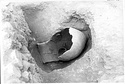
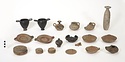
|
|
The deposit notebook lists S 1439 here, but the following information on that card indicates that D 18:4 could be considered with D 18:3 and not as a separate deposit.
"Excavation of pit, which partly ... The deposit notebook lists S 1439 here, but the following information on that card indicates that D 18:4 could be considered with D 18:3 and not as a separate deposit.
"Excavation of pit, which partly underlies later cross wall, has not been finished. ... Further, Hesperia 46 (1977), p. 375 lists S 1439 with deposit D 18:3[p.f. Oct 2006] |
Cistern at 70/ΚΕ and channels. Part of same system as D 17:3 and D 17:5. It was set against a corner of the lowest foundation block. Thus one is forced to assume that enough of the wall remained at least ... Ca. 200-150 B.C ... Part of same system as D 17:3 and D 17:5. ... Thus one is forced to assume that enough of the wall remained at least to preserve its line. After Sulla many of the blocks at the east and were pulled out, the north wall of court F was placed on the western foundations, but at a slightly different angle, and the wall as such ceased to exist.
|
House C, Room 4 (Pottery dump of stamnos wall and fill below floor). Coins:
1 July 1947 #13
2 July 1947 #1
Coins from House IV:
14 May 1947 #1-#2
19 May 1947 #6-#7
20 May 1947 #32 ... First half 3rd c. B.C. |
| Pocket with burning at 60/ΚΗ. "Is this perhaps a disturbed pyre burial." [Nbp. 2928].
Identified as pyre by SIR.
Near north end of corridor, beside its west wall. Concentration of artifacts, tiny scraps ... 4th c. B.C. |
Abandoned digging at 6.25m. due to water level. Tile well could be associated with a bit of late Roman wall to the south, with floor level about one meter above that of pebble floor. Well tiles were not ... 14-22 April 1948 |
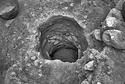
| Hole at 57/ΛΣΤ = Pottery Dump at 57/ΛΣΤ. May well have accumulated on the spot where it was found, its fragmentary state being attributable to the later rubble wall laid over it.
Cf. also P 19982 (ΟΟ ... Ca. 400-375 B.C. |
| Sacrificial pyre in Poros Building, NW Room (RSY= Pyre 1).
Against east wall of room 5 west. artifacts, bone, carbon and ash in pit in floor sequence. the pyre lay below a floor covered with marble dust, ... Middle of 4th c. B.C. |
| Laura Gawlinski ... Bronze foundry north of bridge on Piraeus street, east of Great Drain.
Keyhole-shaped bronze casting pit, cut into bedrock.
2016: Continuation of the excavation of a rectangular pit with foundry debris, ... Late 6th-early 5th c. B.C.
(Late Archaic/ Early Classical) ... Pit cut into bedrock at west and north; fill continues beneath later wall (“Wall A”) at east. ... Seven standing mudbricks line the bedrock wall at south, surrounding a ceramic stand, hand-formed on a cut bedrock base. ... Old grid: ΟΟ:58/Ε
The grid is often marked incorrectly as D/14,15-16/2,3 in older documents. |
Well at 115/ΣΤ (all the 5th c. fills of 116/ΣΤ). The lower part of the shaft contained a heavy deposit of pottery and other objects of the late archaic period, both coarse and finer wares; probably a post-Persian ... Ca. 500-480 B.C.-Roman ... A Roman well at 116/ΣΤ (D 15:2) was subsequently dug beside it, and later the party wall between the two broke at two points, allowing some of the filling from D 15:1 to fall into the deeper shaft of D 15:2; there is thus no stratification.
... Deposit Lists file has the 5th c. objects from this deposit listed together with those fallen in from D 15:2. |
Built against the south wall of the annex to the Poros Building
west of the Areopagus. At the west the upper layer of marble chips carried against it, the lowest were cut by it.
Part of same system as ... 225-100 B.C ... Built against the south wall of the annex to the Poros Building
west of the Areopagus. ... Part of same system as D 17:3 and D 17:4.
|
| Disturbed Pyre at 59/ΚΗ (ΚΖ), in the area of the Poros Building west of the Areopagus.
Against east wall of room 5 west. concentration of artifacts, ash, carbon and a few bones in stratum, no pit discerned ... 3rd c. B.C. |
| Pyre in cut in E-W street, layer 7 (Pyre 14). North edge of Piraeus street, west of the Great Drain Bridge, in the area west of Areopagus.
RSY-Pyre.
Pottery, a little burnt bone, and patches of charcoal ... 250-240 B.C. |
West Road and Drain. (Road, drain and closely related cuts.) Packing in line of ancient road running along the northwest shoulder of the Areopagus. Includes excavation of 1957 titled "Road Area to North", ... Late 6th c. B.C. - Roman |
Two chambers connected by a tunnel, all filled at the same time, but with slight Hellenistic disturbance. Chamber A, to west at 14/ΛΗ, B to east at 14-15/ΛΒ on grid for section RR.
Cistern system ca. 20.00m ... Ca. 325-275 B.C. |
Anne McCabe ... Pithos D, adjacent to Pithos A at the NE, is built of stone and broken tile, beehive-shaped, unlined, with no floor. The wall of Pithos D appears to have been cut by the construction of the mortar wall ... 4-6 July 2007
31 July 2007 ... The wall of Pithos D appears to have been cut by the construction of the mortar wall of Pithos A, and both vessels were damaged by the modern basement. Loose brown earth was removed from the highest preserved level of Pithos D (Lot 518) until the bottom of the lowest course of masonry of the vessel wall was visible. ... The damaged upper courses of the wall of Pithos D were dismantled from 53.911m. |
| "Room D" is the triangular area at L/15,16-2/10,12, NW of Wall 1, in E corner of basement of No.3. Hastings Street, bounded by the NE and SE walls of basement).
Bell-shaped vessel built of horizontally-laid ... 10th-11th c. A.D ... "Room D" is the triangular area at L/15,16-2/10,12, NW of Wall 1, in E corner of basement of No.3. |
| Disturbed pyre dispersed in fill of Room 5, House D.
Pyre pots in very fragmentary condition were noticed by Barbara Tsakirgis in later analysis of pottery that had been excavated in 1938; no mention of ... 14 June 1938 ... Disturbed pyre dispersed in fill of Room 5, House D.
Pyre pots in very fragmentary condition were noticed by Barbara Tsakirgis in later analysis of pottery that had been excavated in 1938; no mention of them was made at the time of excavation.
The fill in which they were found lies partly over the continuation of the eastern wall of the house. |
| RSY Grave 51.
The grave lay on the slope of the Areopagus in Roman house O, just east of the line where the hillside is scarped for the foundation of the west wall of the house.
Cutting:the pit cut in ... Archaic period/6th or 7th c. |
Two pebble floors of Roman date, broken into at the SE and north, covered a 6x5m trench in ΕΛ, bounded by the unexcavated east trench and a wall from Byzantine Building D (Wall A). Under these pebble floors ... 220 - 150 B.C ... Two pebble floors of Roman date, broken into at the SE and north, covered a 6x5m trench in ΕΛ, bounded by the unexcavated east trench and a wall from Byzantine Building D (Wall A). |
Material from trenches:
a) 1.00-7.00m. from East End of Stoa.
b) 18.40-21.40m. from East End of Stoa.
c) 46.60-48-60m. from East End of Stoa.
d) 51.00-53.00m. from East End of Stoa.
e) 79.00-81.00m. from ... 2nd c. B.C ... Material from trenches:
a) 1.00-7.00m. from East End of Stoa.
b) 18.40-21.40m. from East End of Stoa.
c) 46.60-48-60m. from East End of Stoa.
d) 51.00-53.00m. from East End of Stoa.
e) 79.00-81.00m. from East End of Stoa.
Includes drain trench in front of back wall of Stoa (some disturbed, some undisturbed fill), soft fill above stone drain, fill from within stone drain, channel behind stylobate. |
Laura Gawlinski ... Pebble floors of Roman date covered the northern half of a 6x6m square trench in ΕΛ, bounded to the west by the post-Herulian Wall and to the east by a wall from Byzantine Building D (Wall A) to the east ... Hellenistic/ 220-150 B.C ... Pebble floors of Roman date covered the northern half of a 6x6m square trench in ΕΛ, bounded to the west by the post-Herulian Wall and to the east by a wall from Byzantine Building D (Wall A) to the east. |
Investigations within the Stoa of Zeus, the north part, various levels.
Notebook references: Stoa Trench E Layers IV and V, Stoa Pits A, B and C, and Layers I and II of area between back wall and retaining ... 5th c. B.C ... Notebook references: Stoa Trench E Layers IV and V, Stoa Pits A, B and C, and Layers I and II of area between back wall and retaining wall of Stoa. Also in Trench E the footing trench of Pier V, all layers; also Trench D, Pier III, all layers; also trench F, layers III and IV. |
Investigations in the Hellenistic Metroon, various levels. Stoa Pits A, B, C, D, E, F, H and I (various layers).
Locations include:
SW corner of Primitive Bouleuterion; from contemporary filling alongside ... 8th-6th c. B.C ... Stoa Pits A, B, C, D, E, F, H and I (various layers).
Locations include:
SW corner of Primitive Bouleuterion; from contemporary filling alongside its south wall.
Footing trench of the Primitive Bouleuterion and from filling accumulated during the period of use of the Primitive Bouleuterion.
|
| Pyre in House D, Room 4 (RSY=Pyre 4) in the industrial area west of the Areopagus.
Notebook refers to House N.
Pottery belongs late in third quarter of the 4th. c. BC. Pyre burned near beginning of last ... 350-300 B.C ... Pyre in House D, Room 4 (RSY=Pyre 4) in the industrial area west of the Areopagus.
... The pyre pit was dug through layer 1 and into layer 2, both of which overlay the foundation of the wall between rooms 3 and 4. |
Construction fill below floor of Brick Building.
Areas involved:
a) Western portion of Room A: packing below floor.
b) Room B: packing below floor of northern,larger room.
c) Fill over water channel in ... First quarter 2nd century, before its end ... Areas involved:
a) Western portion of Room A: packing below floor.
b) Room B: packing below floor of northern,larger room.
c) Fill over water channel in smaller, southern room B; channel discovered by builders of Brick Building,rebuilt by them and covered over.
d) Foundation trench of earlier building beneath Brick Building, filled and covered by builders of Brick Building.
e) "Apparently from below floor of building" (nb.p. 1282).
... Lot 20 "Ash, Carbon and Slag Fill, against the west face of dividing wall between Rooms A and B" of 1936 excavations including P 19790, SS 5379 and coin ΣΑ-16. It was believed to antedate the construction of the building since the wall of the building seemed to cut it. |
| Mycenaean Chamber Tomb occupies a considerable part of the western half of section ΕΕ; lies about half way up the north slope of the Areopagus towards its eastern end, just below the highest point of the ... Myc. III A:1 ... Its outer or northern end was blocked by a neatly made dry wall of rough field stones. This wall was 1.40m thick and ran right up to the roof of the passage. ... Group of objects:
a) on the east bench, a little north of its center (BI 511, P 15234-15239)
b) on the floor in the northeast corner of the chamber just to the left of the door (B 704, P 15358-15359)
c) on the floor of the chamber, about 0.40m from the south wall, near its mid-point (B 705, BI 513, BI 514, BI 530
d) on the floor in the northwest part of the chamber, at the foot of the bench about midway between the grave and the north wall of the chamber (J 64, J 65, J 68) |
| Dorothy Burr Thompson ... Child's Grave (E.L. Smithson: Grave XXVIII: G).
Cf. Container Lot ΣΤ 165 (fill over geometric grave).
Neat, rectangular, unlined trench, cut into bedrock to a preserved depth of 0.20m,below the level ... Early Geometric I ... The tomb was located in the area between pits A and D, and was just over 2m to the east of the preserved west wall of the Geometric House. |
|
|