|
|
Deposit at 42/ΙΕ beside rubble wall under modern cellar wall ... 5th c. B.C ... Deposit beside Rubble Wall |
Pocket behind heavy Roman retaining wall ... 4th c. B.C ... Pocket behind heavy Roman retaining wall. |
Above well at 48/ΙΕ (J 15:1) ... Early Roman ... Pit with Wall |
Pocket in bedrock behind stepped retaining wall ... 7th c. B.C ... Pocket in bedrock behind stepped retaining wall. |
Dug as Tholos Trench V, Room E, burnt filling of plundered wall trench of S wall of court. See also lot Ζ 484 ... Late 6th c. B.C ... Dug as Tholos Trench V, Room E, burnt filling of plundered wall trench of S wall of court. |
Refuse pit in rock by heavy wall on West Street ... Ca. 500-480 B.C ... Refuse pit in rock by heavy wall on West Street. |
Found during removal of late Roman wall in area Ι/11. No container ... 28 June 1967 ... Lamp Deposit beside Roman Wall |
Coin Hoard found at LRF wall as it runs over the paved court of the Klepsydra, North Slope ... 6-16 June 1937 ... Coin Hoard found at LRF wall as it runs over the paved court of the Klepsydra, North Slope. |
Rectangular cutting at 58-60/ΚΘ-Λ, probably a plundered wall trench ... 350-290 B.C ... Rectangular cutting at 58-60/ΚΘ-Λ, probably a plundered wall trench. |
Hephaisteion Garden; fill beside wall. Loose filling encountered in rescue excavation to examine wall found during construction of public toilet in Theseion Park, outside Agora area. SIR 1991
Originally ... Second half of 4th c. B.C ... Hephaisteion Garden; fill beside wall. Loose filling encountered in rescue excavation to examine wall found during construction of public toilet in Theseion Park, outside Agora area. |
| Marcie Handler ... The Pyre was revealed in a layer of 4th c. fill in the north end of Room 6, just south of Wall 8. Room 6 is defined by the street wall (Wall A) on the west, Wall 7 on the east, Wall 9 on the south (preserved ... 4th c. B.C ... The Pyre was revealed in a layer of 4th c. fill in the north end of Room 6, just south of Wall 8. Room 6 is defined by the street wall (Wall A) on the west, Wall 7 on the east, Wall 9 on the south (preserved only as a stub on the east side of the area), and possibly Wall 8 or Wall 6 on the north.
2.5 meters SW of the pyre, a patch of floor surface at J/10-1/20 at 52.188 masl. was found. |
Found while cleaning wall running east-west over 57. Contained late glazed pottery ... Byzantine ... Found while cleaning wall running east-west over 57. |
Small pocket between the tumbled wall of large conglomerate blocks and Drain 2 ... 4th c. B.C ... Small pocket between the tumbled wall of large conglomerate blocks and Drain 2. |
| Kernos Pit #1 under Valerian Wall. P 30173-P 30174 added on May 7, 1973 ... 4th c. B.C ... Kernos Pit #1 under Valerian Wall. |
Filling around rubble wall (35/ΚΕ). It contained a mass of pottery, most of it uninventoried ... Ca. 425-400 B.C ... Filling around rubble wall (35/ΚΕ). It contained a mass of pottery, most of it uninventoried. |
Filling in the footing trench of the late Roman Fortification.
Includes Layer 1 and Layer 2 of Library Colonnade opposite Room 2. "Note: both these layers are fill thrown into V.W. footing trench." (nb.p ... End 3rd. c. A.D ... Coins:
23 March 1933 #16-#19
24 March 1933 #4-#5(below layer of bricks 1.00m. east of
Ven. wall 24/ΙΗ)
26 April 1933 #1-#5
1 May 1933 #5-#8 (yellow fill against Venetian wall 36/ΙΑ)
27 May 1939 #6-#7
13 June 1939 #3 |
Filling behind retaining wall of Stoa of Zeus. The remains of unfired clay adhering to the interior of various pieces make it probable that the material in this filling is a mass of debris from the floor ... Ca. 435-425 B.C ... Trial Pit behind Stoa Retaining Wall |
Stoa of Attalos (Shop VI), between poros orthostates of front wall. No deposit list ... Stoa of Attalos (Shop VI), between poros orthostates of front wall. |
Late Roman Building to W of N end of Stoa (from its wall and below floor) Coins:
July 12 1950 #1-#4 ... 11-12 July 1950 ... Late Roman Building to W of N end of Stoa (from its wall and below floor) |
Mycenaean Tomb under Valerian wall (Burial 12).
It was impossible to fix the limits of the tomb in any direction, since at the north and south it was cut by the wall, an operations could not be extended ... Myc. III B ... Chamber Tomb under Valerian Wall, Burial 12 |
Well at 56/ΚΖ, just south of the south wall of the northern Late Roman Building ... Second half of 2nd c. - early 3rd c. A.D ... Well at 56/ΚΖ, just south of the south wall of the northern Late Roman Building |
Classical Pit under Rubble Wall of Predecessor of Square Building and above Geometric Well (Q 8:9) ... Classical Pit under Rubble Wall of Predecessor of Square Building and above Geometric Well (Q 8:9) |
Well at 40/Λ, in the "plataia" ca. 600m north of the terrace wall and ca. 10m east of the Valerian wall. Top diameter of 1.00m, bottomm diameter 0.95m
The shallowness of the shaft, and the fallen condition ... 550-500 B.C ... Well at 40/Λ, in the "plataia" ca. 600m north of the terrace wall and ca. 10m east of the Valerian wall. Top diameter of 1.00m, bottomm diameter 0.95m
The shallowness of the shaft, and the fallen condition of the rock wall suggested that the well was abandoned and filled immediately, before completion. |
Clearing bedrock on line of early (Archaic) peribolos wall, east of entrance on the south side, west end. Uncatalogued material: 50 sherds, 83 fragments. of plemochoai.
Classical Ware : lekythos; plemochoai ... Early 2nd c. B.C ... Clearing bedrock on line of early (Archaic) peribolos wall, east of entrance on the south side, west end. |
Destruction debris in L.R. water basin, 6th-7th c. A.D, set against back wall of South Stoa II ... 6th c. or 7th c. A.D ... A.D, set against back wall of South Stoa II. |
Pit along house wall foundations to south = footing trench. Uncertain context, possibly no later than ca. 425 B.C ... 450-400 B.C ... Pit along house wall foundations to south = footing trench. |
Valerian Wall, undisturbed contents: Lower stretch.
Not on concordance, not on cardex neither. No info. Asterisk: R 15-16* ... Valerian Wall, undisturbed contents: Lower stretch.
|
Valerian Wall, undisturbed contents: Upper stretch.
Not on concordance, not on cardex neither. Asterisk: S 16-17* (no info) ... Valerian Wall, undisturbed contents: Upper stretch.
|
| Marcie Handler ... It was situated in the NW corner of Room 3 in the Classical Commercial Building, just S of Wall 11, the cross-wall that divides Room 3 from Room 4 to the north. The pyre pots were found surrounded by ... Late 4th c. B.C ... It was situated in the NW corner of Room 3 in the Classical Commercial Building, just S of Wall 11, the cross-wall that divides Room 3 from Room 4 to the north. ... The pyre deposit continued up to the north face of late Roman Wall C, suggesting that these lower courses of Wall C were packed into a narrow trench instead of built up within a wider foundation trench. |
| Pyre against north face of polygonal wall, Room 2, Classical Building II. No floor preserved above, but the pyre is below floor level 51.820masl, preserved just to the east and above patchy floor with ... Ca. 275-260 B.C ... Pyre against North Face of Polygonal Wall, Room 2 |
Material from trenches:
a) 1.00-7.00m. from East End of Stoa.
b) 18.40-21.40m. from East End of Stoa.
c) 46.60-48-60m. from East End of Stoa.
d) 51.00-53.00m. from East End of Stoa.
e) 79.00-81.00m. from ... 2nd c. B.C ... Drain and drain channels/trenches at Stoa back wall |
Fill against back wall foundations of Royal Stoa I/6,9-4/8,14. Dug separately, these many fills contain material which joined horizontally and vertically all along back wall of Royal Stoa. Fill seems to ... 2nd/3rd quarters of 5th c.-420s ... Fill against back wall foundations of Royal Stoa I/6,9-4/8,14. Dug separately, these many fills contain material which joined horizontally and vertically all along back wall of Royal Stoa. |
The deposit notebook lists S 1439 here, but the following information on that card indicates that D 18:4 could be considered with D 18:3 and not as a separate deposit.
"Excavation of pit, which partly ... Casting pit on line of Poros Building S. wall. |
Small pit north of Wall C (appr. 0.50 E-W x 0.35m N-S). Coins:
11 August 1994 #1125-#1127 ... 3rd c. B.C ... Small pit north of Wall C (appr. 0.50 E-W x 0.35m N-S). |
Filling over and behind blocks of E. wall of Great Drain at 10-15/Α-Γ. Coins:
10 May 1954 #1-#2 ... 3rd c. B.C ... Filling over and behind blocks of E. wall of Great Drain at 10-15/Α-Γ. |
| Marcie Handler ... The contents of this Hellenistic cistern shaft were excavated in a series of layers: the preserved top of the shaft, six layers in the shaft and the fill within the tunnel. At the bottom of the shaft on ... POU: Mid-3rd c. BC
Dumped fill: after 225 BC ... Excavations | 2007 | Trenches | Handler | Room M | East of Wall 7 | Cistern J 1:7 |
Fillings behind retaining wall and in road.
SW Building, rooms 3, north, south. Coins:
13 March 1934 #1, #2
14 March 1934 #37
15 March 1934 #37-#38
24 March 1934 #31 ... 6th c. B.C. and earlier ... Fillings behind retaining wall and in road.
SW Building, rooms 3, north, south. |
| Marcie Handler ... A deposit of six amphorae and one micaceous water jar was excavated between 20 June and 6 July 2005 in the area north of Wall K. The neck and one handle of one of the amphorae (BZ 1213) had been poking ... Ca. 1st c. A.D ... A deposit of six amphorae and one micaceous water jar was excavated between 20 June and 6 July 2005 in the area north of Wall K. The neck and one handle of one of the amphorae (BZ 1213) had been poking out of the surrounding fill since the end of the 2001 season. |
Pocket in bedrock, 50/Λ (= Trench, 50-54/Λ), measuring 4.00x0.60m, 0.60-0.90m deep; possibly cutting for wall foundation Coins:
22 April 1932 #1 ... 330-300 B.C ... Pocket in bedrock, 50/Λ (= Trench, 50-54/Λ), measuring 4.00x0.60m, 0.60-0.90m deep; possibly cutting for wall foundation |
| Burned Deposit. A thick deposit of ash, cinders and pottery fragments extending alongside wall of cemetery. Character of pottery like the pyre of F 12:2 ... Late Geometric ... A thick deposit of ash, cinders and pottery fragments extending alongside wall of cemetery. Character of pottery like the pyre of F 12:2. |
A shallow tiled well or reservoir set inside the South Stoa against its back wall. Its location in relation to the wall of the Stoa, and the fact that a lead pipe set through the latest floor of the Stoa ... 5th - 6th c. A.D ... A shallow tiled well or reservoir set inside the South Stoa against its back wall. Its location in relation to the wall of the Stoa, and the fact that a lead pipe set through the latest floor of the Stoa leads to it, shows that it was built while the Stoa was still in use, that is before 267 A.D. |
Also noted as 32-33/Μ. The N wall collapsed. A very shallow deposit of ancient fill over its stuccoed floor. Coins:
10 May 1939 #3-#4 ... Hellenistic, 4th-early 3rd, Roman, 4th c. A.D ... Also noted as 32-33/Μ. The N wall collapsed. A very shallow deposit of ancient fill over its stuccoed floor. |
Lower fill may be original. Part of North side cut away by modern bothros wall. Fragments of Pilgrim Jug of Grey Ware, related to Turkish Grey Ware? ... 12th or 13th c. A.D ... Part of North side cut away by modern bothros wall. |
Byzantine Well at 66/ΛΑ.
Semi-curbed well at the west wall of the Byzantine room.
From the mouth of the well, a few brown glazed sherds ... Byzantine ... Semi-curbed well at the west wall of the Byzantine room.
|
Deposit alongside Greek House I, perhaps giving the construction date of the second phase. Deposit list title it as : outside of east wall of Roman House H ... Last quarter of the 4th c. B.C ... Deposit list title it as : outside of east wall of Roman House H. |
Located just north of the stepped retaining wall between the Great Drain and the Poros Monument (Propylon).
Short period of use; dumped filling above, mostly cemetery debris ... Early Protogeometric ... Located just north of the stepped retaining wall between the Great Drain and the Poros Monument (Propylon).
|
Red sandy earth at inner corner of heavy late wall at 12/ΛΖ.
A. Walker coin deposit. Coins:
27 March 1934 #1-#12
28 March 1934 #1-#2 ... 2nd-3rd c. A.D ... Red sandy earth at inner corner of heavy late wall at 12/ΛΖ.
A. Walker coin deposit. |
House K: Brown fill (publ. House U). Filling between terrace wall and house wall at the extreme west end of the Areopagus; a brown gravelly filling of early Roman date found here undisturbed but occurring ... Early Roman ... Filling between terrace wall and house wall at the extreme west end of the Areopagus; a brown gravelly filling of early Roman date found here undisturbed but occurring also throughout this general vicinity, sometimes with later intrusions. |
Pocket in wall of Turkish bothros. The uninventoried material includes along with earlier pieces, the fragment of a bolsal very close to those from the well R 13:4 ... 450-425 B.C ... Pocket in wall of Turkish bothros. |
| The remains of a pyre disturbed by the construction of Wall 106. The compact, light brown soil contained some ash and bone and 5 nearly complete pots or saucers ... First half 3rd. c. B.C ... The remains of a pyre disturbed by the construction of Wall 106. The compact, light brown soil contained some ash and bone and 5 nearly complete pots or saucers. |
Well in front of Shop 15: Turkish (in line of Valerian Wall) Opened the well again in 1951, without realizing that it was finished. Found nothing in it. (p. 1468) ... 15th-16th c. A.D ... Well in front of Shop 15: Turkish (in line of Valerian Wall) |
Well E (diameter 1.10-1.20m) just outside the northwest corner of the southwest Fountain House.
Dug initially as a pit (J 15:2) partially covered by an early Roman wall ... Early 7th c. B.C ... Dug initially as a pit (J 15:2) partially covered by an early Roman wall. |
Rectangular pit at 54/ΛΓ.
The pit's plan is irregular; its measurements approximately 2.00x1.10x1.15m. The wall foundations run a little over a meter deep at 53/ΛΓ-ΛΕ, consist of irregularly shaped and ... Ca. 450-425 B.C ... On top of these rest two good sized poros blocks which once supported the first blocks of the house wall. The south wall of the pit is built of slightly smaller stones and clay (no poros blocks), and bonds with the west wall. The east wall is one large (2.00x1.14x0.22m) poros slab. ... The north wall, of which only a few stones were left, would have been like the south wall.
|
Ash and Carbon Dump in Corridor directly behind Room C of Brick Building.
This material comprises what appears to have been a household dump associated with the period of use of the Brick Building, but ... To mid-2nd century ... The dump is located in the corridor between the back wall of the Brick Building and the retaining wall behind the building , immediately east of the line of the dividing wall between Rooms B and C [City Grid: Q/18-11/2] |
Brian Martens ... This deep stratum (ca. 030m) is delayed Persian destruction cleanup deposited in the 470s B.C. it contains about one generation's worth of pottery, almost exclusively dating between about 500-470 B.C ... 29 June-19 July 2017
12–15 July 2022 ... The stratum abutted E-W polygonal Wall 8 and was laid down for Post-Persian renovations of the building. ... The deposit joins fill taken in 2013 that runs under the scarp of Wall G.
Addendum 2022: The collapse of Wall G’ allowed further work on deposit J 1:18 in the 2022 season. |
Plaster dump at Q/2,5-6/7,9.
Layer 5 in "Wall Painted Room" of Roman House ε. Layer resting on bedrock and covered partially by good strosis (55.26m.). Fill was red with mudbricks, tiles, much plaster ... Late 1st-early 2nd c. A.D ... Layer 5 in "Wall Painted Room" of Roman House ε. ... The plaster fragments were restored into a large panel exhibited on the inner wall of the Upper Colonnade. |
| A closely compacted group of 431 bronze coins found at ca. 52.50m., against the east brick wall. No sign of a container. Others dribbled down against the channel wall in a restricted area to as deep as ... Late Roman ... A closely compacted group of 431 bronze coins found at ca. 52.50m., against the east brick wall. No sign of a container. Others dribbled down against the channel wall in a restricted area to as deep as 52.07. |
| Terracotta deposit in SW corner of Room K and E of Roman Wall L. Roman layer of red, compact earth.
Baskets 50,52,54. Coins:
18 July 2002 #1282
19 July 2003 #1295 ... 4th c. A.D ... Terracotta deposit in SW corner of Room K and E of Roman Wall L. Roman layer of red, compact earth.
|
Mudbrick Pithos at N/8-6/3.
Constructed in conical shape of mudbricks, including the floor. Top cut by modern basement wall. Diameter at floor 1.45m Coin
30 May 1930 #113 ... Byzantine ... Top cut by modern basement wall. Diameter at floor 1.45m |
Earlier well northwest of well U 19:2 and cut by it, unexcavated; sherds and hydria gathered from party wall. Uncatalogued material: 26 sherds. Deposit created by Margie Miles, 1 inventoried object ... Late Geometric ... Earlier well northwest of well U 19:2 and cut by it, unexcavated; sherds and hydria gathered from party wall. |
Firm fill over bedrock on east edge of section, north of the early (Archaic) peribolos wall. Uncatalogued material: 10 sherds, 30 fragments of plemochoai. Deposit created by Margie Miles, 4 inventoried ... 3rd quarter 4th c. B.C ... Firm fill over bedrock on east edge of section, north of the early (Archaic) peribolos wall. |
P.H. 1.98m; greatest diameter 1.70; wall thickness 0.20. The walls are of rubble set in clay, and the bottom is flat. Pottery was coarse Byzantine sherds but discarded except for one graffito ... 25 May 1956 ... P.H. 1.98m; greatest diameter 1.70; wall thickness 0.20. |
Fill around the upper block of the southwest corner of the early (Archaic) peribolos wall, south of the Propylon, and hard fill at the side of a trench for a modern wall.
Uncatalogued material: 181 sherds ... 2nd c. B.C ... Fill Around the Upper Block of the Southwest Corner of the Early (Archaic) Peribolos Wall |
Burnt Layer inside retaining wall of Middle Stoa Terrace (Θ) and NW Corner of Middle Stoa, burnt debris inside terrace retaining wall (Ζ). Coins Ζ: Coins Θ:
1 June 1951 ... Mid-3rd c. A.D ... Burnt Layer inside retaining wall of Middle Stoa Terrace (Θ) and NW Corner of Middle Stoa, burnt debris inside terrace retaining wall (Ζ). |
Grave in south peristyle of Hephaisteion. Grave LXV in notebook. Coins:
13 March 1939 #24
14 March 1939 #8 (Vandal, not kept?) Notebook says: wall of LXIV rests on bones.
Neg. KK 396 ... 13-14 March 1939
16 March 1939 ... Notebook says: wall of LXIV rests on bones.
|
Grave (?) under wall 4. Infant burial(?); a kados, P 16747, lying sideways with a tall cylindrical stand, P 16748, set over it as a cover; the upper parts of the pots cut away ... Late 6th. c. B.C ... Grave (?) under wall 4. Infant burial(?) |
Geometric Well under Rubble Wall of Predecessor.
Classical pit above a Geometric well with a small amount of pottery from the late 6th to the middle of the 4th c. B.C. Estimated Grid ... Late 8th century B.C ... Geometric Well under Rubble Wall of Predecessor.
|
Cistern at 70/ΚΕ and channels. Part of same system as D 17:3 and D 17:5. It was set against a corner of the lowest foundation block. Thus one is forced to assume that enough of the wall remained at least ... Ca. 200-150 B.C ... Thus one is forced to assume that enough of the wall remained at least to preserve its line. After Sulla many of the blocks at the east and were pulled out, the north wall of court F was placed on the western foundations, but at a slightly different angle, and the wall as such ceased to exist.
|
| Marcie Handler ... Fill within the drain from the basin on the west side of Roman Room B through Wall A.
After we removed the fill within the basin on the west side of Roman Room B (BZ XXVII p. 5325), we began excavating ... Late Roman ... Fill within the drain from the basin on the west side of Roman Room B through Wall A.
After we removed the fill within the basin on the west side of Roman Room B (BZ XXVII p. 5325), we began excavating in the cutting on the east face of a conglomerate block that is part of Wall A. ... The cutting is probably a drain that carried water from the basin through Wall A and onto the North-South Road. |
Anne McCabe ... Pithos D, adjacent to Pithos A at the NE, is built of stone and broken tile, beehive-shaped, unlined, with no floor. The wall of Pithos D appears to have been cut by the construction of the mortar wall ... 4-6 July 2007
31 July 2007 ... Pithos D, adjacent to Pithos A at the NE, is built of stone and broken tile, beehive-shaped, unlined, with no floor. The wall of Pithos D appears to have been cut by the construction of the mortar wall of Pithos A, and both vessels were damaged by the modern basement. Loose brown earth was removed from the highest preserved level of Pithos D (Lot 518) until the bottom of the lowest course of masonry of the vessel wall was visible. The fill contained brown-glazed pottery and a few sherds of sgraffito ware. ... The damaged upper courses of the wall of Pithos D were dismantled from 53.911m. |
| Pyre in layer 2a in Room 9 SE of Greek House δ. Sand, gravel, ashes, iron nails, carbon, some bones partially cut away by foundation trench of SYPE wall.
Coin
1 July 1971 #459 ... 260-200 B.C ... Sand, gravel, ashes, iron nails, carbon, some bones partially cut away by foundation trench of SYPE wall.
Coin
1 July 1971 #459 |
Amphora dump at P/2,3-6/6,8.
Layer "8b" in Room 6 of Greek House δ.
Trench cut into lower levels next to west wall of Room 6. Fragments of amphorai, tiles.
No coins ... Early Hellenistic ... Trench cut into lower levels next to west wall of Room 6. |
Pocket on the line of the early (Archaic) peribolos wall at entrance on the south side. Uncatalogued material: 215 sherds, 186 + frags. plemochoai and 4 objects.
Classical Ware : black glaze; mug; rilled-rim ... 3rd quarter 4th c. B.C ... Pocket on the Line of the Early (Archaic) Peribolos Wall at Entrance, on the South Side |
42-50/Ζ-ΙΑ: below uppermost Byz. Floor at level of top of railroad retaining wall (cf. also 50/Ι: from packing of floor). Coins:
24 March 1936 #18-#22
26 March 1936 #9-#10 ... Early Byzantine ... Floor at level of top of railroad retaining wall (cf. also 50/Ι: from packing of floor). |
Well at 71/ΛΒ (diameter ca. 1.10m) near the east wall of the entrance porch.
Narrows toward bottom, collapsed at top. Six footholds preserved at south, three at north, spaced at ca. 0.50m. Uniform fill ... Late 8th in early 4th c. B.C ... Well at 71/ΛΒ (diameter ca. 1.10m) near the east wall of the entrance porch.
|
Well L: PG, ELS. Includes a displaced grave (K 12:2 bis). The pottery appears less consistent than that in the pit at 70/ΜΕ. Depth of well 6.25m. below the top of wall B. PD 2780 ... Protogeometric ... Depth of well 6.25m. below the top of wall B. |
| "Koumanoudes' Well.
Tile-lined well (diam. 0.85m) at SE corner of courtyard of Roman House E, at top built wall of stones and mortar, bedrock at bottom. Coin
7 August 1971 #495-#500
13 August 1971 #507 ... 28 July-6 August 1971 ... Tile-lined well (diam. 0.85m) at SE corner of courtyard of Roman House E, at top built wall of stones and mortar, bedrock at bottom. |
| David Scahill ... Protogeometric/Early Geometric well under floors in Room 1, Classical Building II, on north side of south ashlar wall. See J 3:9 for the burial within this well.
Cf. Hesperia Suppl. 50 (2018), p. 106, ... 27 June 2001
17 July 2002 ... Protogeometric/Early Geometric well under floors in Room 1, Classical Building II, on north side of south ashlar wall. See J 3:9 for the burial within this well.
|
| David Scahill ... Behind northeast corner of Classical Building; east wall C. Below Hellenistic levels and early Classical pit. Chamber cut through bedrock, depth ca. 0.90m., diameter ca. 2m., roughly square in shape, angling ... LH III A:1 ... Behind northeast corner of Classical Building; east wall C. Below Hellenistic levels and early Classical pit. ... Possible dromos cutting in northwest corner, running under wall C.
Loose fill of stones and earth filling tomb with large number of geometric sherds ranging early to late Geometric. ... At the floor of the tomb, bone fragments, broken pottery, two figurines and bronze implements along south wall. Pottery appears to be LH III A:1 with some possibly earlier. |
Hellenistic fill, north of Temple of Ares, on either side of wall running east-west over 50/ΙΓ. Mostly coarse pottery including many stamped amphora handles.
Cf. also nb. P XII, pp. 2297-2298. Coins:
13 ... 275-200 B.C ... Hellenistic fill, north of Temple of Ares, on either side of wall running east-west over 50/ΙΓ. |
Called a Turkish pit, located under a Byzantine wall and filled with an upper level of Byzantine material under which a level of Roman material. Coins:
5 April 1932 #1-#3
6 April 1932 #1-#5
7 April 1932 ... 6-11 April 1932 ... Called a Turkish pit, located under a Byzantine wall and filled with an upper level of Byzantine material under which a level of Roman material. |
House C, Room 4 (Pottery dump of stamnos wall and fill below floor). Coins:
1 July 1947 #13
2 July 1947 #1
Coins from House IV:
14 May 1947 #1-#2
19 May 1947 #6-#7
20 May 1947 #32 ... First half 3rd c. B.C ... House C, Room 4 (Pottery dump of stamnos wall and fill below floor). |
Investigations within the Stoa of Zeus, the north part, various levels.
Notebook references: Stoa Trench E Layers IV and V, Stoa Pits A, B and C, and Layers I and II of area between back wall and retaining ... 5th c. B.C ... Notebook references: Stoa Trench E Layers IV and V, Stoa Pits A, B and C, and Layers I and II of area between back wall and retaining wall of Stoa. |
Laura Gawlinski ... Pebble floors of Roman date covered the northern half of a 6x6m square trench in ΕΛ, bounded to the west by the post-Herulian Wall and to the east by a wall from Byzantine Building D (Wall A) to the east ... Hellenistic/ 220-150 B.C ... Pebble floors of Roman date covered the northern half of a 6x6m square trench in ΕΛ, bounded to the west by the post-Herulian Wall and to the east by a wall from Byzantine Building D (Wall A) to the east. |
Unlined Pit at N/9-6/3,4 partially cut into wall of Mudbrick Pithos (N 6:1). Dimensions 1.20x 2.m.
Soft green-gray with wet sandust consistency. Large number of sea shells, fish and animal bones. No pottery, ... Turkish ... Unlined Pit at N/9-6/3,4 partially cut into wall of Mudbrick Pithos (N 6:1). |
Red Figure Pocket in front of Retaining Wall at 74-77/ΛΖ-ΛΘ.
Pit , a large cutting in bedrock, irregular in outline, reaching a depth of ca. 1m; dumped filling of alternating layers-broken pottery fragments ... Ca. 430-410 B.C ... Red Figure Pocket in front of Retaining Wall at 74-77/ΛΖ-ΛΘ.
|
Double Well by E. Entrance to Square Building (Well A) (formely a O 8:1) Coin
21 April 1951 #1 (disintegrated) Carefull there is two O 8:1, the actual one is a filling around rubble wall at 35/ KE.
Estimated ... 750 to early 7th century B.C ... Carefull there is two O 8:1, the actual one is a filling around rubble wall at 35/ KE.
Estimated Grid |
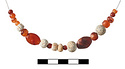
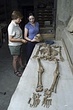
| Brian Martens ... Mycenaean Chamber Tomb J 1:11, located in the area north of Wall K, was partially excavated during the 2014 season. At this point the full western extent of the chamber has not been located because of ... LHIIIA ... Mycenaean Chamber Tomb J 1:11, located in the area north of Wall K, was partially excavated during the 2014 season. ... The skeleton along the southern wall wore a necklace of carnelian and glass-paste beads, which was excavated in situ. ... At the end of season, a strip of fill remained atop the blocking wall.
Cf. Hesperia 87 (2018), p. 663. |
Pit in House N, Room 2 (RSY, House C). Filling thrown in behind the west wall of the Great Drain South at the time of the building of the drain and the extension of House C.
Cf. Hesperia 20 (1951), pp ... Ca. 430-410 B.C ... Filling thrown in behind the west wall of the Great Drain South at the time of the building of the drain and the extension of House C.
|
Late Roman Fills: SE Building, Conglomerate Wall. (see O-Q 18-19)Deposit list under O-Q 18-19 Coins
21 May 1938 #14
23 May 1938 #1-#2
24 May 1938 #2, #3-#4
25 May 1938 #3 Asterisk: O-P 20-21* ... Late Roman Fills: SE Building, Conglomerate Wall. (see O-Q 18-19)Deposit list under O-Q 18-19 |
| John Camp ... Burial north of Roman temple, E. of polygonal wall.
The tomb, as preserved, consisted of the cinerary urn, which stood in an upright position, its upper part damaged by later disturbance. It contained ... Late Helladic IIIC Late-Final Mycenaean/Submycenaean ... Burial north of Roman temple, E. of polygonal wall.
The tomb, as preserved, consisted of the cinerary urn, which stood in an upright position, its upper part damaged by later disturbance. |
| David Scahill ... Burial in Geometric well (J 3:8), in Classical Building II, Room I, next to south ashlar wall. "No grave goods!"
ADDENDA: J. Papadopoulos later associated P 34449 and P 34450 to that grave. (Cf. Agora ... Geometric ... Burial in Geometric well (J 3:8), in Classical Building II, Room I, next to south ashlar wall. |
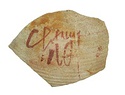
A total of 79 ostraka was recovered from Room 5 of the Classical Building.
More of this deposit was excavated in the 2021 season on the opposite side of the scarp of Wall R, up against the face of Wall ... 500-475 B.C ... More of this deposit was excavated in the 2021 season on the opposite side of the scarp of Wall R, up against the face of Wall 4. |
| Bronze-casting pit and furnace against S apse of Church (106/ΛΕ). Late Roman sherds of the 4th and the 6th c. A.D. were found with fragments of moulds from bronze casting. The west end was destroyed by ... 5th-6th c. A.D ... There is a tile floor set on bedrock and two brick piers of the south wall stand to a height of 1.12 m.; one scrap of the north wall establishes a width of 1.05m. |
Double Well by Entrance to Square Building (Well B)
Wall A (R 9:2) was Late Geometric or transitional well, into one-half of which a bothros had been sunk in Turkish times (16th c. A.D.)-R 9:3.
This bothros ... ca. 17th century A.D ... Double Well by Entrance to Square Building (Well B)
Wall A (R 9:2) was Late Geometric or transitional well, into one-half of which a bothros had been sunk in Turkish times (16th c. ... This bothros was lined on the side of the Geometric well by a wall made of rough stones and pink cement, supported by three small round wooden beams. |
| Anne McCabe ... Adjacent to the SW face of Byzantine Wall 14. The circular cutting, 0.90m in diameter, appeared at 53.504m under a layer of loose rubble (Lot 481). Wall of the well roughly built, consisting at the top ... 11-19 July 2006
24 June-21 July 2009 ... Adjacent to the SW face of Byzantine Wall 14. The circular cutting, 0.90m in diameter, appeared at 53.504m under a layer of loose rubble (Lot 481). Wall of the well roughly built, consisting at the top of several courses of large tiles (placed horizontally) and flat stones, including marble blocks. |
Located in road west of Middle Stoa. It was 4.80m deep. Owing to its shallowness, it was probably kept clean. The southernmost block of the N-S peribolos (?) wall west of the Middle Stoa partly covered ... 200-165 B.C ... The southernmost block of the N-S peribolos (?) wall west of the Middle Stoa partly covered the mouth of the well. |
| Osteotheke. (Group N). Coin
7 May 1938 #7 83/ΜΔ (83-84/ΜΓ-ΜΕ: If I judge from p. 811, this grid would be the concrete retaining wall). Somebody else wrote the following grid on page 878: 83-85/ΜΓ-ΜΣΤ ... Early 7th cent ... 83/ΜΔ (83-84/ΜΓ-ΜΕ: If I judge from p. 811, this grid would be the concrete retaining wall). Somebody else wrote the following grid on page 878: 83-85/ΜΓ-ΜΣΤ possibly of Room 2. |
Irregular depression in bedrock (ca. 7x5m), ca. 2m deep; area south of E-W Late Roman wall. Dumped filling apparently intended to level off the area. Coins:
11 March 1952 #10
12 March 1952 #1-#5
13 March ... Ca. 400-325 B.C ... Irregular depression in bedrock (ca. 7x5m), ca. 2m deep; area south of E-W Late Roman wall. Dumped filling apparently intended to level off the area. |
| Initially uncovered with a diameter of c. 1.05m. Its south side extends under the south wall of the Classical structure and so clearly predates it. The highest preserved portion of the well shaft (at the ... 22 July-9 August 1994
26 June 1995
3-7 July 1995 ... Its south side extends under the south wall of the Classical structure and so clearly predates it. ... It is not clear at exactly what elevation the lining wall originally began, but it seems unlikely that the entire shaft was lined, for the cutting in bedrock for the upper part of the shaft, where it is well preserved on the east side, lies directly above the inner face of the lining wall below. ... Because the south side of the well shaft projects beneath the E-W Classical Wall at J/6,7-2/20, we attempted to leave undug the portion of the well fill that underlies that wall. |
|
|