|
|
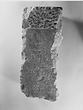
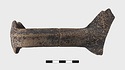
| Inscribed columnar grave monument.
Inrtact.
Inscribed in three lines.
Hymettian marble. Found in the valley, southwest of the Pnyx. Leica ... 1948 ... Found in the valley, southwest of the Pnyx. |
| Inscribed fragment from upper left corner of stele.
Moulding above roughly chipped away. Top flat (?).
Toothed left side. Rough picked back.
Mentions the archon Theophilos.
Twenty lines of the inscription ... 8 November 1939 ... Mentions the archon Theophilos.
... Found near the church of St. Demetrios in the saddle between the Pnyx and Philopappos hills. |
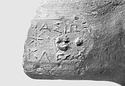
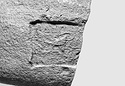
Apparently complete in a single letter: A; np letters to either side. Upside down to vessel.
Single alphas are often found on objects dedicated to Athena, undoubtedly as abbreviations of the goddess' ... Single alphas are often found on objects dedicated to Athena, undoubtedly as abbreviations of the goddess' name (cf., for example, those from the sanctuary of Athena on the acropolis of Sparta: B.S.A. 30, 1928-1930, p. 251, fig. 6, nos. 1-11, 14, 22). ... Schiering, Olympische Forschhungen V, 1964, p. 156, no. 79, and the eleven from the Pnyx, G. ... VII, Small Objects from the Pnyx: I, 1943, p. 29. |
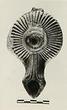
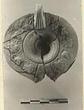
| Handle missing; chips from side.
Watch-shaped body, small discus, top rayed. Long nozzle, triangular at end. Rudimentary unpierced knob at right. Vertical strap-handle.
Signed: "ΑΙΝΕΙΟΥ"; letters in relief, ... 5 February 1940 ... Signed: "ΑΙΝΕΙΟΥ"; letters in relief, incised in the mould.
Dull glaze fired red, much peeled. ... Found by some boys somewhere in the region of the Pnyx and the Hill of the Nymphs. |
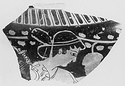
Wall fragment. Glaze slightly pitted. Max. dim. 0.048.
Woman(?) seated to left on a decorated cloak. All that remains of her is her lap. At the right, part of another figure. Relief contour. White: woman ... Probably late 5th or early 4th century B.C ... All that remains of her is her lap. At the right, part of another figure. ... Cf. a bell-krater fragment from the Pnyx, P 214 (Hesperia Suppl. |
Pnyx 110
Clay; fine grained; buff inside; yellow on the surface. East Sanctuary; Clearing North of Terrace Wall ... October 1932 ... Pnyx 110
Clay; fine grained; buff inside; yellow on the surface. |
Clay fine, buff, soft. Head missing. Traces of white slip. Pin hole beneath on level bottom. Not carefully modeled.
Almost identical with Agora T IIII which is from Late 5th century context. From the ... Probably late fifth century B.C ... From the disturbed surface of an exploratory trench on top of the central Pnyx Hill. |
Upper part of Amazon on horseback, in high relief. She wears kurbasia with flaps, chiton and chlamys, and brandishes sword in raised right arm. Thin brown glaze with smears of black inside.
For Amazons ... Early 4th c. B.C ... Similar style and quality to 1185, a fragment from the Pnyx, PN-P 263: Hesperia, Suppl. |
Pnyx 205
Clay; fine; light buff insode, paler outside, slightly micaceous. East Sanctuary; From the Filling behind the Terrace Wall ... October 1932 ... Pnyx 205
Clay; fine; light buff insode, paler outside, slightly micaceous ... East Sanctuary; From the Filling behind the Terrace Wall. |
| Pnyx 12
Clay; bright buff; fine; slightly micaceous. Assembly Place; From the Filling of Period III ... October 1932 ... Pnyx 12
Clay; bright buff; fine; slightly micaceous ... Assembly Place; From the Filling of Period III. |
Pnyx 97
Clay; buff inside, yellow on surface,fine.
The seal apparently was chipped at one end. East Sanctuary; Clearing Coarse of Terrace Wall ... 1932 ... Pnyx 97
Clay; buff inside, yellow on surface,fine.
The seal apparently was chipped at one end. |
Pnyx 189
Clay; buff containing many fine particles of shiny black grit.
The stamp is set vertically on the outside of the nich just below the lip. Assembly Place, Filling of Period III ... November 1932 ... Pnyx 189
Clay; buff containing many fine particles of shiny black grit.
The stamp is set vertically on the outside of the nich just below the lip. |
Pnyx 124
Clay; coarse, deep rust in color, large grains of grit. East Sanctuary; From the Uppermost Filling in the Southern Part of the Area ... October 1932 ... Pnyx 124
Clay; coarse, deep rust in color, large grains of grit ... East Sanctuary; From the Uppermost Filling in the Southern Part of the Area. |
Pnyx 152
Clay; dull buff, creamy on the surface, coarse, containing many grains of brown and white grit but no mica. Assembly Place; Filling of Period III ... October 1932 ... Pnyx 152
Clay; dull buff, creamy on the surface, coarse, containing many grains of brown and white grit but no mica. |
Pnyx 77
Clay; fine, buff inside; yellow on surface. East Sanctuary; Clearing the West end of Terrace Wall ... October 1932 ... Pnyx 77
Clay; fine, buff inside; yellow on surface ... East Sanctuary; Clearing the West end of Terrace Wall. |
Rim fragment with part of ring base. Glaze abraded slightly. Max. dim. 0.06; est. diam. 0.23.
On rim, between two reserved lines, wreath of myrtle.
A similar but slightly more ornate wreath occurs on ... Late 5th century B.C ... Petersburg (Π 1867/68.962) that has the names of Peleus and Thetis inscribed. ... For a simpler version, see P 25 from the Pnyx (Hesperia Suppl. |
Lid fragment with offset brim and incurving rim. Band of glaze on underside. Much of glaze fired red on top side. Max. dim. 0.064; est. diam. 0.13.
Woman (top of head missing) dressed in a chiton, moving ... Second quarter of the 5th century B.C ... Her left arm is also outstretched. At the right, a bit of reserve, but it is not quite clear what it is (another chest with hanging scarf[?] ... For a woman holding both a chest and an alabastron, see the lekanis fragment from the Pnyx, P 120 (Hesperia Suppl. |
Pnyx 122
Clay; course, dull buff, course grains of grit and mica. East Sanctuary; from uppermost filling in the southern part of the area ... October 1932 ... Pnyx 122
Clay; course, dull buff, course grains of grit and mica ... East Sanctuary; from uppermost filling in the southern part of the area. |
| Pnyx 14
Clay; bright buff; containing some grit and fine grains of mice. Assembly Place; From the Filling of Period III ... October 1932 ... Pnyx 14
Clay; bright buff; containing some grit and fine grains of mice ... Assembly Place; From the Filling of Period III. |
Pnyx 247
Clay; dull buff inside and outside; fine grains of grit and mica. East Sanctuary; From the Filling behind Terrace Wall ... October 1932 ... Pnyx 247
Clay; dull buff inside and outside; fine grains of grit and mica ... East Sanctuary; From the Filling behind Terrace Wall. |
Pnyx 127
Clay; buff, containing fine particles of grit and air holes. From Clearing North of the Great Retaining Wall of Period III ... 1931 ... Pnyx 127
Clay; buff, containing fine particles of grit and air holes ... From Clearing North of the Great Retaining Wall of Period III. |
Pnyx 149
Clay; dull buff; coarse; containing some grains of brown grit and a little mica. Assembly Place; From the Filling of Period III ... October 1932 ... Pnyx 149
Clay; dull buff; coarse; containing some grains of brown grit and a little mica ... Assembly Place; From the Filling of Period III. |
Pnyx 203
Clay; soft; pale yellow; air holes and grit particles.
Impressed on the outer face of the handle near its lower point of attachment. [In reference to seal]. East Sanctuary; Clearing to North ... October 1932 ... Pnyx 203
Clay; soft; pale yellow; air holes and grit particles.
Impressed on the outer face of the handle near its lower point of attachment. |
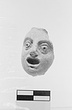
| Face only preserved; exaggerated features with wide open mouth and staring eyes; the eye-balls pierced.
Broken across the neck and at the hair line.
No color.
Pale buff clay.
ADDENDA Mask descendant of ... 24 July 1947 ... Face only preserved; exaggerated features with wide open mouth and staring eyes; the eye-balls pierced.
Broken across the neck and at the hair line.
... AT 31.
Cf Pnyx 75, youth, the same size, later style. |
Wall fragment. Surface pitted in places. Max. dim. 0.161. LIMC V, 1990, p. 129, sub 2922, s.v. Herakles.
Apotheosis of Herakles. The fragment shows the chariot team (heads, necks of right-hand pole and ... First quarter of the 4th century B.C ... In front of and behind them are the shafts of four columns, and in the lower left, an object that is uncertain: conceivably it might be part of Hermes, who may appear in these scenes at the heads of the horses. ... Dilute glaze: drawing on white.
The subject is identified on the analogy of Pnyx P 171 and P 226 (Hesperia Suppl. ... For bit burrs, cf. 96.
By the same hand as 441 and the bell-krater fragment from the Pnyx (P 171: Hesperia Suppl. |
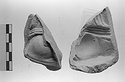
| Fragment of mold from the middle of a padded actor, showing a roll of drapery above the belly.
Mold cut off with string.
Smooth buff clay, very neatly finished behind.
ADDENDA Cf. Pnyx Figs, no. 68. Pit ... 11-12 June 1947 ... Fragment of mold from the middle of a padded actor, showing a roll of drapery above the belly.
... ADDENDA Cf. Pnyx Figs, no. 68. |
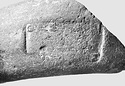
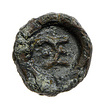
| A: small stamp with ligature or monogram.
B: plain. Entered as coin no. 6, for the day. Aiginitou Street-foot of Pnyx. Fill described as Hellenistic with modern disturbance. 273 Leica ... 12 March 1948 ... Entered as coin no. 6, for the day ... Aiginitou Street-foot of Pnyx. Fill described as Hellenistic with modern disturbance. |
| A: quiver.
B: plain. Entered as coin no. 2, for the day. Aiginitou Street-foot of Pnyx. Fill described as Hellenistic with modern disturbance.
With coins nos. 1-19. 273 Leica ... 12 March 1948 ... Entered as coin no. 2, for the day ... Aiginitou Street-foot of Pnyx. Fill described as Hellenistic with modern disturbance.
|
Broken all around.
Single, pellet-like molding at the top. Broken on all sides. (top ... )
Gray Marble- Hymettian? Brought in from lower hill to south of Pnyx. Ευπορε[ία]
χρηστ[ή]
χαιρ[ε] ... Single, pellet-like molding at the top. Broken on all sides. ... Brought in from lower hill to south of Pnyx. |
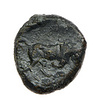
| A: a bull, right.
Disk too small for head to appear.
B: illegible impression. Entered as coin no. 12, for the day. Aiginitou Street-foot of Pnyx. Fill described as Hellenistic with modern disturbance ... 12 March 1948 ... Entered as coin no. 12, for the day ... Aiginitou Street-foot of Pnyx. Fill described as Hellenistic with modern disturbance. |
Wall fragment. Glaze flaked in places. Max. dim. 0.076.
Symposion. At the left, a symposiast (back, part of decorated himation) reclining to right, seen from the back. On the right, part of the back of ... Ca. 420 B.C ... On the right, part of the back of a similar symposiast.
Perhaps in the manner of the Kadmos Painter. The border of the himation is very close to that of the standing female figure on Pnyx P 45 a (Hesperia Suppl. |
| A: two ears of wheat on single stem and letter Π in field above, enclosed in wreath.
B: plain. Entered as coin no. 5, for the day. Aiginitou Street-foot of Pnyx. Fill described as Hellenistic with modern ... 12 March 1948 ... Entered as coin no. 5, for the day ... Aiginitou Street-foot of Pnyx. Fill described as Hellenistic with modern disturbance. |
| Mended from many pieces; nozzle and fragments of body missing.
On rim vine pattern; discus, rays; handle, pierced; three grooves above and below.
Reverse, within a single groove, the signature: "ΠΡΕΙ
... December 1932 ... Reverse, within a single groove, the signature: "ΠΡΕΙ
ΜΟΥ"
Unglazed.
... Pnyx Street. |
| Fragmentary, but profile complete. Ring foot; trefoil mouth.
Owner's inscription scratched on the handle: . Part of a second inscription scratched on the wall:
Dull glaze, black outside, very much chipped; ... 9 April 1954 ... Owner's inscription scratched on the handle: . Part of a second inscription scratched on the wall:
Dull glaze, black outside, very much chipped; red inside.
Cf. Pnyx, Hesperia Suppl. 7 (1943), p. 31. |
| Broken before curve; probably typical.
Coarse reddish-grey clay, yellowish at surface; traces of light slip.
Right end of the impression broken away; incomplete above and below; shallow; worn. Msc: read ... 15 February 1932 ... Right end of the impression broken away; incomplete above and below; shallow; worn ... Msc: read by Pnyx street? seal(VG)* |
| Broken all around; part of handle and dody where handle was attached preserved.
Orange micaceous clay.
Vase.
First example found at the Agora. Msc: first ex found at Agora; for whole amph see Pnyx 1956, ... 1939 ... First example found at the Agora ... Msc: first ex found at Agora; for whole amph see Pnyx 1956,
Pl 60, 2 and 2a* |
| The vertical strap handle from the back, and large chips from the body, missing.
Mold made, with low raised base, somewhat angular body, sunken top and two nozzles at either side of front. Ridge around ... 12 March 1948 ... The vertical strap handle from the back, and large chips from the body, missing.
... Aiginitou-Pnyx Street; fill over modern drain (late Hellenistic-early Roman, with modern disturbance). |
Floor fragment with start of lip, root of one handle, and part of molded ring base. Lip offset on inside. Band and three concentric circles with central dot on underside of floor. Glaze abraded in part ... Probably second quarter of the 4th century B.C ... On outside, part of palmette at handle and at the left, a reserved area that might be part of a woman's head with sakkos, to left, perhaps one of two facing. ... Similar to Pnyx P 24 (Hesperia Suppl. ... Although little remains of the wreath on 1354, it may have been similar to the one on Trieste S. 465, which may be from the Group of Vienna 116 (CVA, Trieste 1 [Italia 43], pl. 6 [1918]:3; for the attribution, see B. |
| Part of neck preserved.
Slightly micaceous reddish clay with light brown slip.
Stamped on rim; bust of emperor with three-branched sceptre in his left hand; broken below; coin type.
Cf. SS 9295 (BB 501) ... 16 June 1939 ... Par: SS 09295, SS 09085 and Pnyx Ptolemian?(VG)*Date: 7c AC by
the coins(VG)* |
A few fragments missing; partially restored.
Broad ring foot, convex to outside; beveled resting surface; pointed underside. Convex-concave wall with two grooves at half height.
Warped. Wide, flat rim ... 225-200 ... Center: star with alternating straight and tapered rays, the latter flanked by smaller, white, tapered rays. ... Shape close to Watzinger 1901, no. 32, p. 82. The distinctive garland of the rim, with its strong diagonal emphasis, is similar to that on the following: Samos IV, no. 277, p. 116, fig. 9, pl. 57 (also on the rim of a plate); Vogeikoff 1994, p. 42, pl. 14:α (plate); H. ... Thompson 1934, p. 402 (reversible lid from the Pnyx); Kopcke 1964, pl. 46:9 (bowl-kantharos); Patsiada 1990, no. 190, p. 195, pl. 77:γ (double cruet); Watzinger 1901, no. 3, p. 68, pl. |
Flesh polished very smooth, hair slightly polished. Back and side broken off.
The face is very long, with large eyes, well-defined upper [eye] lids and eye brows. Deep hole punched in inner corner of each ... 1934 ... Cheeks are rounded and [unreadable]. The forehead is fairly high, and the hair forms into a triangle. ... Directly back of the fillet two small,deep holes are bored in the head, for attachment to a bracket (?). ... Crystalline, but the crystals do not show on the surface. |
| Two non-joining fragments.
a) Preserves the head and shoulders of a woman, right. Behind her, part of a lyre. In the field, vine branch; added red for cluster and leaves. Relief contour.
b) Part of a ... December 1932 ... Two non-joining fragments.
a) Preserves the head and shoulders of a woman, right. ... Tongue pattern at the attachments. Ivy pattern along the sides ... Pnyx Street. |
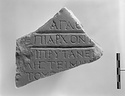
| Inscribed fragment.
Rough picked back preserved; broken at top, bottom, and right; left edge uncertain, chipped at front, but slightly rough curved surface behind may be original, since first letters of ... 28 January 1942 ... First five lines of the inscription preserved.
... Found in hollow west of Pnyx Hill; brought in by former workman. |
| Somewhat twisted handle with slightly arched upper part; worn bit of rim preserved.
Clay bright colored; core only slightly greyish; thin slip(?).
The die from which the boukranion is clear seems to ... 2 May 1933 ... Clay bright colored; core only slightly greyish; thin slip(?).
The die from which the boukranion is clear seems to have been applied over another impression, further down and nearer the neck, of which the boukranion appears, faintly, at right angles to the clear one (nose toward neck of amphora). In each setting, the die slipped a little. The two impressions appear to be from different dies (very similar in appearence). |
|
|