|
|
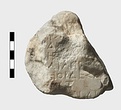
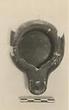
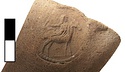
Thick ring at the join of neck. Part of the neck ornament a tiny part of the shoulder ray and upper part of the crest of Athena preserved.
Athena is turned to left. Her crest is outlined with a red band ... Thick ring at the join of neck. ... This kind of ornament is assigned(?) to the Panathenaic of the fifth century (ours is certainly one of its last appearance); a fifth century date is also supported by the use of red (Beazley, Panathenaica p. 454).
End of fifth century. |
Thick ring at the joint of the neck. Very little part of the tongues on the shoulder and of the Athena's crest. Athena is turned to left. The crest is outline with a red band; round it's base, at the point ... Thick ring at the joint of the neck. ... The use of red mineral makes a dating still in the fifth century certain (Beazley, Panathenian p. 454). End of fifth century. |
Wall fragment, glazed inside Right leg and part of peplos of Athena, to left. White for the leg; the lower hemline as well as the drapery folds, incised.
First half of fifth century. LI-48 ... White for the leg; the lower hemline as well as the drapery folds, incised.
First half of fifth century. |
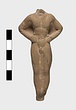
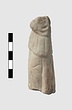
Broken away below the waist.
Pan playing on a syrinx.
Clay: Buff, coarse, covered in front with red paint. Hollow, back unmodelled. From a disturbed area to the south of the retaining wall of the ... Fifth century B.C. |
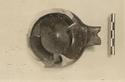
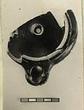
| The lower part of the nozzle and front wall, and part of the bottom.
Signed.
Unglazed.
Buff clay.
Type XXVII of Corinth collection. Well. Upper fill. Second century A.D. construction; at transition from ... May-June 1937 ... The lower part of the nozzle and front wall, and part of the bottom.
... Second century A.D. construction; at transition from Sixth century A.D. to Fifth century B.C. |
Only the lower part of the face remains.
After moulding the nostrils and the corners of the mouth over emphasized by piercing. The size and glaze on the interior suggest that fragment comes from a ... Late fifth century B.C. |
Male phallos attached as spout to the side of a vase. On the inside is a bit of the shoulder of the aryballos?
Clay: Firm, buff. Reddish glaze on the upper part of the outer face and smeared over the ... Early fifth century B.C. |
Upper and lower extremities missing.
Seated figure, legs covered, right elbow knee, shaggy legs, grossly exaggerated membrum virile.
Clay: Fine, buff, coated with no white glaze, pink-red painted applied ... Fifth century B.C. |
Mould for the left side of a ram's head with curling horn. For a rhyton.
Clay reddish, hard. Burned? From a disturbed area to the north of the retaining wall of the Assembly Place III ... Early fifth century B.C. ? |
Male phallos, attached as spout to the side of a vase. On the inside is a ledge for the reception of a lid. Scratched into the clay on the upper part of the outer face: ΚΕΡΚΙΩ.
Clay: Fine, buff, burned ... Early fifth century B.C. |
Broken at top only.
The right side is set at an obtuse angle to the base line.
A draped figure sits to right on a throne with lions feet, holding kin the hand a stick? The peculiar shape suggests the ... Early fifth century B.C. |
There remains only the front of the figure from waist to knee.
A female figure standing, with left knee slightly flexed, wearing a peplos with long overhang.
Clay: Fine, rosy buff, showing traces of ... Late fifth century B.C. |
Mould for a female head. The hair ripples off the forehead.
Fine, buff clay. Assembly Place, filling of Period III ... End of fifth century B.C. |
Mould for the cheek and eye of a cow or bull, probably for a rhyton.
Clay buff, fine, thin fabric. Smoothly finished. Assembly Place, filling of Period III ... Late fifth century B.C. |
Clay fine, buff, soft. Head missing. Traces of white slip. Pin hole beneath on level bottom. Not carefully modeled.
Almost identical with Agora T IIII which is from Late 5th century context. From the ... Probably late fifth century B.C. |
| Head and feet are missing.
Sold; flat behind. Soft, tan clay.
The youth stands erect, resting his hands on his hips, he wears goat pants.
Fine buff clay; remaining traces of white paint, front and back ... Early fifth century B.C. |
Broken away at root of neck. Solid.
A mature female head. The hair is lightly bound in a kerchief and drawn into a pointed mass on the back of the head. A wisp protrudes from the top of this mass and ... Late fifth century B.C. or later. |
| End of nozzle and handle, with much of rim, missing.
Groove around low base underneath.
Black to brownish glaze, somewhat peeled; the resting surface and the groove unglazed.
Type VI (late 5th. century ... 18 May-4 June 1937 ... Black to brownish glaze, somewhat peeled; the resting surface and the groove unglazed.
Type VI (late 5th. century variety) of Corinth collection, type 23A of Agora collection ... Latest Fifth-Fourth century B.C. |
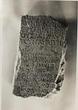
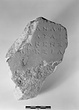
| Inscribed fragment.
The back rough picked; the edges broken.
Sixteen lines of the inscription preserved, with a space between the fifth and sixth.
Pentelic marble. Found in disturbed earth, outside the ... 2nd. century A.D. |
| One nozzle and about half of rim and body missing.
Shape fabric and decoration as the L 4500 (OO 739).
Type IV (early fifth century group) of Corinth collection, type 22B of Agora collection. Stony fill ... 1947 ... Shape fabric and decoration as the L 4500 (OO 739).
Type IV (early fifth century group) of Corinth collection, type 22B of Agora collection. |
| Part of the bottom missing.
Ribbed discus and a relief wreath around the rim; handle semi-pierced with a leaf at its base.
Unglazed.
Buff clay.
Type XXVII of Corinth collection. Well B. Fourth-Fifth century ... May-June 1937 ... Part of the bottom missing.
Ribbed discus and a relief wreath around the rim; handle semi-pierced with a leaf at its base.
... Fourth-Fifth century A.D. |
| Inscribed fragment.
Inscribed face only preserved.
Fifth century financial record; the lettering looks like that of the Erechteion accounts.
Twenty letters remain.
Pentelic marble.
ADDENDA Belongs with ... 5th. century B.C ... Inscribed face only preserved.
Fifth century financial record; the lettering looks like that of the Erechteion accounts.
... November 1954 and returned the same day ... Found in modern context, over the north end of the Middle Stoa. |
| Draped standing female figure preserved from just below shoulders to just above ankles.
Fifth century type with Doric chiton and overfold; belted over the overfold.
Pentelic marble. Finished Bath area, ... 24 April 1948 ... Draped standing female figure preserved from just below shoulders to just above ankles.
Fifth century type with Doric chiton and overfold; belted over the overfold.
|
| Inscribed fragment.
Inscribed face only preserved.
Four lines of the inscription preserved, part of fifth; stoichedon.
Pentelic marble. Finished Found in Byzantine context west of the Panathenaic Way, ... 4th. century B.C. |
Preserved only from waist to knees
The front part of the figure was shaped in a mould and then a solid mass of clay was applied to it's back which part remained unmolded. A female figure clad in a chiton ... Mid fifth century B.C. or later. |
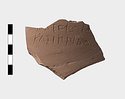
| Fragment from the wall of a large unglazed amphora.
Incised outside. Όστρακο οστρακοφορίας Κλεοφώντος Κλειππίδου. Προέρχεται από το σώμα μεγάλου αμφορέως. Finished Late fifth century fill. 4374 Leica, ... 11 June 1951 ... Fragment from the wall of a large unglazed amphora.
... Late fifth century fill. |
| The horizontal band handle at the back is broken off.
Dull black glaze over all, except under side of low base.
Type IV of Corinth collection, type 21C of Agora collection. Well. Latest Fifth-Fourth century ... 18 May-4 June 1937 ... The horizontal band handle at the back is broken off.
... Latest Fifth-Fourth century B.C. |
| Small fragment of the body, and most of the strap handle at the back missing.
Small lamp; inside glazed; outside unglazed except for nozzle, handle, and bands at the rim. No base; the floor rises to a ... 10-12 June 1947 ... Small fragment of the body, and most of the strap handle at the back missing.
Small lamp; inside glazed; outside unglazed except for nozzle, handle, and bands at the rim. No base; the floor rises to a low point at the center.
Type IV (later fifth century group) of Corinth collection, type 21D of Agora collection. |
| Part of bottom, with edge projecting below, and of the right side preserved.
On the front, the leg of a table and part of a long bench under it.
Attachment hole through the plaque, under the bench.
Broken ... 13 August 1947 ... On the front, the leg of a table and part of a long bench under it.
Attachment hole through the plaque, under the bench.
... House H, Room 14; fifth century fill in grave cutting. |
| Inscribed fragment.
Right side with chisel marks preserved; elsewhere broken.
Face very rough.
Boundary for grave lot.
Four letters remain and traces of fifth.
Pentelic marble. Found in the wall of a modern ... 4th. century B.C. |
| Inscribed fragment.
The right side preserved; elsewhere broken.
"POLETAI" record; sale of confiscated property.
Six lines of the inscription preserved; a space above the first, and between the fifth and ... Early 4th. century B.C. |
| The bottom is missing, and the horizontal band handle at the back broken away.
Good black glaze inside and out.
Type VI (late 5th. century variety) of Corinth collection, type 23A of Agora collection ... 18 May-4 June 1937 ... The bottom is missing, and the horizontal band handle at the back broken away.
... Type VI (late 5th. century variety) of Corinth collection, type 23A of Agora collection.
... Latest Fifth-Fourth century B.C. |
| Three non-joining fragments; one with part of the floor, about two thirds of the rim, and the stamp of the nozzle; a floor fragment and a rim fragment from the back with the stump of the horizontal handle ... 24 April -13 June 1947 ... Three non-joining fragments; one with part of the floor, about two thirds of the rim, and the stamp of the nozzle; a floor fragment and a rim fragment from the back with the stump of the horizontal handle.
The rim glazed, with a reserved band on its top.
... Type IV (early fifth century variety) of Corinth collection, type 21D of Agora collection. |
| One side of rim and wall missing, and chips.
Pierced collar through center of floor; single nozzle encroaching on rim; no handle.
Inside, and rim and nozzle outside, glazed; a reserved band around the ... 23 April 1948 ... Inside, and rim and nozzle outside, glazed; a reserved band around the middle of the rim.
Type IV (early fifth century variety) of Corinth collection, type 22A of Agora collection. |
| Low base and continous convex wall and rim; part of three nozzles preserved.
Black glaze inside and on body most of the way to bottom.
Type IV of Corinth collection, type 21C of Agora collection. Well ... 18 May-4 June 1937 ... Black glaze inside and on body most of the way to bottom.
... Latest Fifth-Fourth century B.C. |
| Inscribed fragment.
Inscribed face only preserved.
Burned and acid-eaten; behind, part of a cutting for an iron dowel.
Four lines of the inscription preserved, trace of fifth.
Pentelic marble.
ADDENDA ... 5th. century B.C. |
| Fragment from left side of inscribed stele.
Broken top, bottom and at right.
Left side dressed smooth, with the back edge beveled to the rough picked back; the front edge much chipped, so that the first ... 5th. century B.C. |
| Inscribed fragment.
Inscribed face and perhaps original back preserved (now worn smooth).
A rectanguslar cutting (for reuse) along left side of inscribed face.
Four lines of the inscription preserved, ... 5th. century B.C. |
| The top preserved; handle and tip of nozzle missing.
Broad down sloping rim, a ring of raised dots and ribs on the top; a large double-spiral lug on either side. On the throat of the nozzle, a large palmette ... June 1937, June 1938 ... The top preserved; handle and tip of nozzle missing.
... On the throat of the nozzle, a large palmette in relief.
... ADDENDA Four fragments of lamps of similar type remain in the tray, three of fifth to fourth century types. |
| Most of the discus, part of side wall, and upper part of handle missing.
Very big lamp; concentric grooves on the bottom, pierced handle. Narrow rim with two grooves.
Lion's paw on preserved edge of discus ... 5-8 June 1937 ... Most of the discus, part of side wall, and upper part of handle missing.
Very big lamp; concentric grooves on the bottom, pierced handle. ... Roman, Fourth (Fifth) century A.D. |
| Inscribed fragment.
Inscribed face, left face, and rough picked back preserved.
Treasure record from Eleusis.
Seven lines of the inscription preserved; stoichedon.
Left edge worn away so first letters ... 5th. century B.C. |
Mended with the missing pieces restored in plaster and painted, notably most of the mouth and handle. Glaze misfired reddish brown on back; abraded on inside of handle at join of neck. H. 0.181; diam ... Late 5th century B.C ... Mended with the missing pieces restored in plaster and painted, notably most of the mouth and handle. ... Mattusch, Greek Bronze Statuary: From the Beginnings through the Fifth Century B.C., Ithaca/London 1988, p. 233, fig. ... The forehead of each is bald. |
| Torso of a draped standing female figure, broken below, the head missing, and the lower arms broken off. Back left plain; vent hole below.
The figure stands with both arms outstretched from the elbow ... 12 May 1951 ... Torso of a draped standing female figure, broken below, the head missing, and the lower arms broken off. Back left plain; vent hole below.
The figure stands with both arms outstretched from the elbow. ... Fill under stones (context of second half of fifth century B.C. |
| Preserved are upper right corner (BE 103) and joining section to lower left (BE 61). Broken diagonally above, at left side, and below.
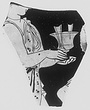
Votive relief with simple fillet and ovolo molding above. Narrow frame ... Late 5th c. B.C. (410-400 B.C. ?) ... In her extended right hand she holds a vase by the foot. The vase compares to late fifth century thurible or incense burners.
White marble with small crystals, probably Pentelic.
Late fifth century B.C. (410-400 B.C. ?).
Similar representations on vases of the early and middle fourth century (cf. |
| Small shallow lamp mended from three pieces; complete except for horizontal band handle at back. The floor rises to a low central cone.
Floor, rim, nozzle and handle glazed; reserved band around rim.
... 26 April 1948 ... Small shallow lamp mended from three pieces; complete except for horizontal band handle at back. The floor rises to a low central cone.
... Type IV (early fifth century variety) of Corinth collection, type 21D of Agora collection. |
| About two-thirds of the rim preserved, with part of the wall; none of the bottom. The larger nozzle broken.
Deep body with convex side wall and grooved rim. One big and one small nozzle, at right angles ... 18 May-4 June 1937 ... About two-thirds of the rim preserved, with part of the wall; none of the bottom. The larger nozzle broken.
... Latest Fifth-Fourth century B.C. |
| Broken away at back, bottom and left.
From top down: ovolo, fillet, beak. One end mitered for inside corner.
Considerably weathered; color gone. Like Theseion anta cap, but larger. Fifth century finish ... 16 July 1946 ... Like Theseion anta cap, but larger. Fifth century finish.
... Assigned to the Temple of Ares.
|
| Horizontal loop handle, nozzle and bottom missing.
Ring foot, deeply grooved underneath; convex body and flat slightly sloping rim with wick hole encroaching a very little on its outer edge.
Black glaze; ... 20 June 1935 ... Black glaze; reserved; a line around the central opening; the handle space, a groove at junction of foot and body; the outer edge of the foot, beneath; and the space inside the ring.
The glaze somewhat worn.
... Well F, early fifth century. |
| A herm used as support for the left arm of la large statue carrying a child.
Upper half of the child is missing as well as the entire statue, whose left arm rests on the head of the herm. The base of ... 2nd c. A.D ... Upper half of the child is missing as well as the entire statue, whose left arm rests on the head of the herm. The base of the herm is somewhat chipped.
... S 2144 (ΣΑ 3253).
Cf. the description of the Herm of Alkamenes in Richter (1929) , Sculpture and Sculptors of the Greeks, p. 236, fig. 628 (p. 182, fig. 673 in the 4th edition 1970): "The style of the herm is evidently archaistic, the formal treatment of the hair and beard being conditioned by its architectonic character, for the rendering of the eyes places it in the second half of the fifth century." |
| Two joining fragments giving part of shoulder and most of the picture.
Two rows of blobs, row of dots between them, on shoulder. On wall, battle scene, onlooker at right. Two rows of dots above.
No added ... January-February 1950 ... Two joining fragments giving part of shoulder and most of the picture.
Two rows of blobs, row of dots between them, on shoulder. ... Ure (1927), Sixth and Fifth Century Pottery from Rhitsona, pl. |
| Two pieces preserving the nozzle and part of rim and wall.
Wall rounded; flat rim; broad nozzle with wick-hole not encroaching on rim.
Black glaze inside and out, except for two reserved bands around top ... 26 September 1947 ... Two pieces preserving the nozzle and part of rim and wall.
... Type IV (later fifth century type) of Corinth collection, type 22B of Agora collection. |
| Inscribed fragments.
List of names; "POLETAI" record.
Fragment Ζ 331 a), inscribed fragment.
Broken on all sides.
Nine lines of the inscription preserved, with a space between the fourth and fifth.
Fragment ... First half of 4th. century B.C. |
| A Tholos eaves tile, fragmentary but complete save for the tip, which has been restored on the evidence of A 864 (Ζ 1540). A triangular rain tile, its sides equipped with heavy flanges below, with light ... 15 February 1938 ... A Tholos eaves tile, fragmentary but complete save for the tip, which has been restored on the evidence of A 864 (Ζ 1540). A triangular rain tile, its sides equipped with heavy flanges below, with light flanges above. The under flanges are channeled toward the lower edge of the tile so as to grip a projection on the cornice. ... Like A 856 (Ζ 1532) ff., in contexts of the late fifth century, and would seem to have been discarded after the building was damaged by fire at that time. |
| Horizontal band handle at back, and end of nozzle missing.
Ring foot; two ridges on the down-sloping top.
Black glaze inside only.
Type V (third Variety) of Corinth collection, type 24A' of Agora collection ... 10 June 1947 ... Ring foot; two ridges on the down-sloping top.
... Green late fifth century fill between drain and wall at west. |
| Nozzle and part of adjoining rim preserved.
Large, rather square ended nozzle, grooved around outer edge of upper surface. The groove ends in round holes where nozzle joins rim.
Black to brownish glaze, ... 22-23 June 1939 ... Large, rather square ended nozzle, grooved around outer edge of upper surface. The groove ends in round holes where nozzle joins rim.
... Deep cutting, sand fill, late fifth century. |
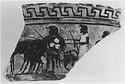
| Rim fragment of volute krater, the outer face of the lip has a maeander, figured scene below: warrior armed with shield, spear, helmet and greaves, walking left beside a four-horse chariot; part of a third ... 9 May 1940 ... Rim fragment of volute krater, the outer face of the lip has a maeander, figured scene below: warrior armed with shield, spear, helmet and greaves, walking left beside a four-horse chariot; part of a third figure following.
... Mixed fifth century and Hellenistic fill over wall B. |
Fragment of domed lid with start of knob, glazed on underside. Max. dim. 0.139.
From the center out: dots; women. At the left, a woman, a maid (upper left front to waist, most of head) moves to right, ... Second quarter of the 4th century B.C. |
| From wall of a small bell krater.
A maenad right, holding a kantharos in her hands. She attends a seated figure of which the right knee and part of short chiton is preserved, probably Dionysos. Short ... 9 June 1951 ... She attends a seated figure of which the right knee and part of short chiton is preserved, probably Dionysos. ... Fifth century fill south of white poros wall. |
| Two joining fragments.
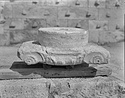
Abacus, fillets, and top of volutes recut to make base for interior support of fourth period of church. Lower part of volutes cut off.
Developed fifth century type egg and dart ... 18 February 1936 ... Developed fifth century type egg and dart. ... ADDENDA Dreruf points out that this capital is identical with another now lying beside the Guard's House below the Nike Temple (Homer A. ... From late reuse in Church of the Vlassarou. |
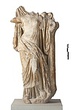
| Missing, the head of Aphrodite, her right arm from above the elbow, her left forearm (doweled on, dowel in place), and fragments of her drapery. The upper right arm was found broken off. The free-hanging ... 12 April 1934 ... Missing, the head of Aphrodite, her right arm from above the elbow, her left forearm (doweled on, dowel in place), and fragments of her drapery. ... The folds of the cloak are chipped across the front, and at the left knee. ... Aphrodite wears a thin clinging chiton, girt with a cord below the breasts and around the shoulders, a simplified version of late fifth to early fourth century costume, similar to that worn by the Themis from Rhamnous. |
| Identical in fabric and from similar, if not same amphora, are part of neck and rim with handle attachment and a toe; rim flares slightly with very sharp lip and is set off from neck by a deep groove ... 15-26 May 1937 ... Coarse micaceous clay, buff to purplish pink, light slip; traces of red color on stamp and near it; inside pot heavily coated with pitch; body just above
the toe is circled by a band of red paint.
... A dotted circle surrounds the whole. The coin-type of Mende in Chalcidice.
Cf. also P 9247 (I 1031); also an amphora of the same shape and fabric, P 2375 (I 599); and a neck, from a third-fifth century context. |
|
|