|
|
Cistern System #1c: Shaft (well) at 25/ΞΑ. Began as a manhole but opened up by early-mid Byzantine as a well ... Late 12th c. A.D ... Shaft |
Rectangular shaft at northwest foot of Areopagus; dumped filling of second half of 4th c. B.C. Pit at 16/Δ-Ε recorded one time as an extension of shaft 17/Δ-Ε (see L 506 and nb.p. 395), but items from ... Ca. 325-275 B.C ... Rectangular Shaft |
Cistern shaft, part of cistern system in Η-Ι 16-17. Filling disturbed to bottom; general run of the pottery is to late Hellenistic, lamps as late as Knidos type. Finds from 60/ΙΘ-62/ΙΘ, 61/ΙΗ. "Some Arretine" ... 5 May 1932
18 June 1932 ... Cistern shaft, part of cistern system in Η-Ι 16-17. |
Rectangular shaft neighboring the well D 17:12. Dug only to a depth of 4.40m. and provided with two galleries or channels extending from it. Apparently never intended as a well. Refilled with the dug bedrock ... 4th c. B.C ... Rectangular shaft neighboring the well D 17:12. |
Coins:
22 February 1936 #4-#13
26 February 1935 #1-#2
27 February 1936 #1-#4
28 February 1936 #3-#5 ... Shaft/Manhole |
| Marcie Handler ... The contents of this Hellenistic cistern shaft were excavated in a series of layers: the preserved top of the shaft, six layers in the shaft and the fill within the tunnel. At the bottom of the shaft on ... POU: Mid-3rd c. BC
Dumped fill: after 225 BC ... Hellenistic Cistern Shaft |
Shaft (= well + caves) at 116-118/ΚΕ-ΚΣΤ Coins:
6 May 1939 #16-#21
8 May 1939 #35-#37
9 May 1939 #1
24 April 1940 #6 ... 2nd. quarter - mid-5th. c. A.D ... Shaft (= well + caves) at 116-118/ΚΕ-ΚΣΤ |
A well on the NW slope of the Areopagus; unfinished well-shaft dug to a depth of only 3.05m., and refilled with broken pottery and other debris. The shaft clearly was begun with the intention of digging ... Ca. 520-480 B.C ... Unfinished Well Shaft |
Cistern at 78/ΜΑ and shaft at 85/Ν. Coins:
18 May 1936 #2-#3 ... Ca. 320-340 A.D ... Cistern at 78/ΜΑ and shaft at 85/Ν. |
This shaft in the NE corner of House A, Room III, depth of one tile, is perhaps connected with drain A. Coins:
13 May 1940 #1-#13
14 May 1940 #2-#101 ... Early 3rd. c. B.C ... This shaft in the NE corner of House A, Room III, depth of one tile, is perhaps connected with drain A. |
| A cave-in not long after the digging of this shaft destroyed its possible usefulness as a well and thereafter it was used as a dump. Two principle periods of such use were noted, and within these several ... Ca. 575-480 B.C ... A cave-in not long after the digging of this shaft destroyed its possible usefulness as a well and thereafter it was used as a dump. |
Lower red fill with mixed Hellenistic pottery running into the 2nd. c. Coins:
4 May 1936 #1 ... 1-5 May 1936 ... Cistern Shaft and Passage |
Chamber cistern at 95/Κ and Cistern shaft at 95/ΚΕ plus the passage between. System heavily disturbed throughout in Turkish times except for a small amount of red fill on floor of shaft. Coins:
4 May 1936 ... Hellenistic ... Cistern Chamber and Cistern Shaft |
Cistern Shaft at 61/Β and south passage to E.W. drain.
Part of H-I 16-17 system. Coins:
8 April 1932 #14
9 April 1932 #1-#8
11 April 1932 #1-#3
12 April 1932 #1 ... 8-16 April 1932 ... Cistern Shaft at 61/Β and south passage to E.W. drain.
|
A burnt deposit set down into Hellenistic fill in a shaft dug into bedrock. A consistent dumped fill [post AD 150, with Group G, layer III, JWH]. Coins:
27 January 1936 #1-#3
28 January 1936 #1-#7
29 January ... First half of A.D. 2nd c ... A burnt deposit set down into Hellenistic fill in a shaft dug into bedrock. |
Cistern shaft at 63/ΚΓ. Part of H-I 16-17 system. Contents of 3rd c. disturbed.
Part of extensive cistern system, of which one chamber, three drawshafts, and two blind tunnels were excavated (H 16:2, ... 3rd c., disturbed ... Drawshaft, Cistern Shaft at 63/ΚΓ |
Estimated Grid ... Ca. 510-480 B.C ... Rectangular Rock-Cut Shaft Upper fill |
Containers Lot Α 306-Lot Α 340. Estimated Grid ... Ca. 575-535 B.C ... Rectangular Rock-Cut Shaft Lower fill |
Well E: Middle Helladic at Acropolis street.
Diameter, upper shaft ca. 0.87m, lower shaft ca. 0.70m ... Middle Helladic ... Diameter, upper shaft ca. 0.87m, lower shaft ca. 0.70m |
Dumped fill in shaft. Estimated Grid ... Byzantine ... Dumped fill in shaft. |
| Side-chamber at the bottom of a circular shaft. AA 27; ST 103 from shaft above burial. PD 427 ... Neolithic ... Side-chamber at the bottom of a circular shaft ... AA 27; ST 103 from shaft above burial. |
Lower fill in shaft; upper and lower drain filling; shaft, in upper chambers. Coins:
31 March 1938 #1
9 May 1939 #1-#2
20 June 1939 #1 Estimated Grid ... Late 2nd-earliest 3rd c. A.D ... Lower fill in shaft; upper and lower drain filling; shaft, in upper chambers. |
Cistern System #1b: Shaft/manhole and gallery at 18-19/ΞΑ-ΞΓ.
Objects divided between the two features, shaft and gallery, according to deposit notebook list, not according to remarks on cards. 22 February ... Late 1st c. B.C.-early 1st c. A.D ... Cistern System #1b: Shaft/manhole and gallery at 18-19/ΞΑ-ΞΓ.
Objects divided between the two features, shaft and gallery, according to deposit notebook list, not according to remarks on cards ... Subdivisions:
.1=shaft/manhole
.2=gallery |
Near the Poros Enclosure. Diameter 0.76m. water level -1.20m. Plain shaft sunk in the stereo ... 14-22 July 1947 ... Diameter 0.76m. water level -1.20m. Plain shaft sunk in the stereo. |
Cistern system on Kolonos Agoraios; shaft leading to chamber (76/ΝΘ) Coins:
4 June 1936 #1-#4 ... 3rd. c ... Cistern system on Kolonos Agoraios; shaft leading to chamber (76/ΝΘ) |
Pit and well at eastern edge of Kolonos Agoraios with uniform fill.
Diameter 1.90m; straight round shaft ... Late 8th-first half 7th c. B.C ... Diameter 1.90m; straight round shaft |
Containers 1-ca. 139. The well shaft broken out into a large hole so that no sequence could be observed ... Mixed post-Herulian ... The well shaft broken out into a large hole so that no sequence could be observed. |
Well at 30/ΛΒ; the shaft possibly never used as a well; dumped filling with a small amount of fragmentary pottery ... Ca 500 B.C ... Well at 30/ΛΒ; the shaft possibly never used as a well; dumped filling with a small amount of fragmentary pottery. |
Well at 29/ΛΕ, to the SE of the market square, west of the Panathenaic Way.
Circular shaft, caved in at mouth. Diameter 1.20m. Diameter narrows to 0.50m at bottom of shaft, which is slightly concave. No ... Late 8th century B.C ... Circular shaft, caved in at mouth. ... Diameter narrows to 0.50m at bottom of shaft, which is slightly concave. |
Displaced curbing stone had fallen into top of shaft; fill with and around it is presumably second half of 2nd c. A.D. Below tumbled filling at top, shaft was empty to 10.80m. Tiles were missing to ca ... Late 1st-early 2nd c ... Displaced curbing stone had fallen into top of shaft; fill with and around it is presumably second half of 2nd c. ... Below tumbled filling at top, shaft was empty to 10.80m. |
| Initially uncovered with a diameter of c. 1.05m. Its south side extends under the south wall of the Classical structure and so clearly predates it. The highest preserved portion of the well shaft (at the ... 22 July-9 August 1994
26 June 1995
3-7 July 1995 ... The highest preserved portion of the well shaft (at the east) lies at an elevation of 51.03m above sea level. ... On the south side of the shaft, a lining wall of field stones is preserved from an elevation of 49.44m above sea level; around the rest of the shaft it is preserved from an elevation of 48.99m. ... If lined, the upper part of the shaft would have been quite constricted (c. 0.70m.).
|
| Grave 14 in notebook.
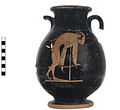
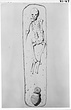
Length of shaft 2.12m; width 0.46m; depth from cover 0.60m. Man's skeleton stretched NE-SW with head at NE. Offering at foot of shaft, with the skyphos in the mouth of the pitcher ... 750-725 B.C ... Length of shaft 2.12m; width 0.46m; depth from cover 0.60m. ... Offering at foot of shaft, with the skyphos in the mouth of the pitcher.
|
Upper fill (top to around 4.50m.) was in a pit of large dimensions above the preserved well shaft. From the bottom and shaft proper no catalogued pottery. No tiling in place in well but fragments of tiles ... 3rd-4th c. A.D ... Upper fill (top to around 4.50m.) was in a pit of large dimensions above the preserved well shaft. From the bottom and shaft proper no catalogued pottery. |
Cistern System #1e: Shaft at 11/ΞΑ.
Agora XXIX: "Well (not cistern shaft, as in Agora XII) ... Communicates with water system through small hole (see C 8:1) probably fortuitously. Single fill, mostly of ... 350-300 B.C ... Cistern System #1e: Shaft at 11/ΞΑ.
Agora XXIX: "Well (not cistern shaft, as in Agora XII) ... |
Cistern System #1a: Shaft (Manhole) at 10/ΞΗ (10-11/ΞΖ-ΞΗ). Filling consistently late Hellenistic in hole and in passage; probably 1st c.
B.C. Coins:
26 May 1936 #1 ... 110-75 B.C ... Cistern System #1a: Shaft (Manhole) at 10/ΞΗ (10-11/ΞΖ-ΞΗ). |
Archaic Pit at 25/ΙΓ, near the northeast corner of the market square. Filling in upper part of shaft, cleared only to a depth of 3.10m because of rock conditions ... 600-550 B.C ... Filling in upper part of shaft, cleared only to a depth of 3.10m because of rock conditions. |
| Shaft oriented N to S (L. 1.30, W. 0.43 at bottom). Fill shot through with cinders and wood ash. Skeleton of a male about 50 years old.
Brann. PD 1065a ... 750-700 B.C ... Shaft oriented N to S (L. 1.30, W. 0.43 at bottom). |
Well East of Circular Building, at 25/ΙΗ.
Well dug originally in 5th c. B.C. and probably had POU fill. In 2nd c. A.D. the shaft was intersected by a horizontal vaulted brick tunnel belonging to the Brick ... 5th c. B.C.(?) ... A.D. the shaft was intersected by a horizontal vaulted brick tunnel belonging to the Brick Shaft system and the earlier fill above the line of the proposed tunnel floor was dug out. After construction of tunnel the old well shaft was filled up again, this time with a Roman dumped filling of second half of 2nd c. |
Well-shaft abandoned before use because of crumbling of rock.
From top to 15.00m. a dumped fill predominantly early Roman but containing material of late 1st c. B.C. to mid-1st c. A.D. A rock filled shaft ... 1st c. B.C. to mid-1st c. A.D ... Well-shaft abandoned before use because of crumbling of rock.
... A rock filled shaft below 15.00m. |
Cistern system on Kolonos Agoraios, shaft into south passage (81/ΝΘ). The fill again seemed to be a dumped fill; probably rather late 3rd. c. Coins:
8 June 1936 #1-#3 ... Late 3rd. c ... Cistern system on Kolonos Agoraios, shaft into south passage (81/ΝΘ). |
Archaic Well at 10/ΚΒ, directly west of the north end of the Stoa of Attalos.
Well, not cleared. a small amount of pottery gathered from the top of the shaft ... 600-550 B.C ... Well, not cleared. a small amount of pottery gathered from the top of the shaft. |
Cistern System #1f: Shaft at 1/ΝΘ = Well A. Scanty dumped filling. Coins:
19 February 1936 #2-#3
20 February 1936 #16-#20
21 February 1936 #5-#7
22 February 1936 #1 ... Mid-4th to 3rd c. B.C ... Cistern System #1f: Shaft at 1/ΝΘ = Well A. |
Well at 53/ΙΗ, east of the east Stoa Plateia. Diameter 1.40-1.50m. Shaft worked with chisel, tapers toward bottom. Plentiful water. Uniform fill with field-stones, perhaps including period of use ... 775-725 B.C ... Diameter 1.40-1.50m. Shaft worked with chisel, tapers toward bottom. |
| Well west of the Eponymous Heroes monument. The shaft was of irregular width (ca. 0.81m where the full circle was first preserved), sunk in soft bedrock clay much of which had collapsed around the top ... Ca. 600-550 B.C ... Well west of the Eponymous Heroes monument. The shaft was of irregular width (ca. 0.81m where the full circle was first preserved), sunk in soft bedrock clay much of which had collapsed around the top of the shaft and large masses of which had fallen from the sides of the shaft. |
Well Y, in area North of the West end of the Yellow Poros Foundation. The shaft had cut through the wall of an earlier well and the cavity had been packed with stones by the diggers of the new well. In ... Earth 5th c. B.C ... Well Y, in area North of the West end of the Yellow Poros Foundation. The shaft had cut through the wall of an earlier well and the cavity had been packed with stones by the diggers of the new well. In shaft, debris filling of clay and field stones. |
Well C - Passage, belongs with II - Brick Shaft. All dumped fills. No objects catalogued from Well C of section ΟΑ. One object (I 5422) catalogued from modern fill in shaft, one from dump (I 5545). Coins: ... 2nd c. A.D.- Byzantine ... Well C - Passage, belongs with II - Brick Shaft. All dumped fills. ... One object (I 5422) catalogued from modern fill in shaft, one from dump (I 5545). |
Dumped fill in a shaft which served as means of access leading to a water channel south of the Stoa of Attalos. Coins:
29 June 1933 #1 (disintegrated)
29 April 1936 #1-#3
4 May 1936 #1 ... Early 1st c. A.D ... Dumped fill in a shaft which served as means of access leading to a water channel south of the Stoa of Attalos. |
Well on the north slope of the Areopagus. Unfinished, probably because of hardness of rock, and refilled at once, perhaps with sanctuary dump and with collapsed rock from the shaft itself.
Diameter 1.15m ... 3rd quarter of the 7th c. B.C ... Unfinished, probably because of hardness of rock, and refilled at once, perhaps with sanctuary dump and with collapsed rock from the shaft itself.
Diameter 1.15m.
|
Diameter 0.95m; water level -9.10m.
Plais shaft cut in stereo from bottom of slender flask-shaped cistern. Scanty fill from house destruction in 5th c. A.D.; Christian lamps; unfinished statuette of Castor ... Late Roman ... Diameter 0.95m; water level -9.10m.
Plais shaft cut in stereo from bottom of slender flask-shaped cistern. |
A great shaft 2.65m in diameter and over 10m deep cut out in the mid 1st c. to serve in some connection with the Brick Shaft system (U 22:1). Filled in to top (layer 2) in late 1st- early 2nd c. A.D. with ... 18 March 1937,
1-13 April 1937,
24 May-14 June 1937 ... A great shaft 2.65m in diameter and over 10m deep cut out in the mid 1st c. to serve in some connection with the Brick Shaft system (U 22:1). |
| Unfinished well-shaft with debris filling (apparently of the Sullan sack), on the lower NW slopes off the Areopagus. Abandoned due to poor quality of bedrock.
Three closely contemporary fills, considered ... End 2nd c. B.C.-second quarter 1st c. B.C ... Unfinished well-shaft with debris filling (apparently of the Sullan sack), on the lower NW slopes off the Areopagus. |
Well on the lower north slope of the Areopagus. The pottery apparently belongs to a filling of one period, since it exhibited no marked difference in character to the bottom. No where was the deposit very ... Ca. 410-390 B.C ... Tile curbing in lower part of shaft |
Shaft fill, not mouth fill, of drawshaft at 42/Θ. This is part of the cistern system 44/ΙΓ - 46/ΙΑ - 42/Θ.
Thirteen stamped amphora handles; fragments of Arretine pottery; over half of bowls long-petal ... 1st c. B.C.-early 1st c. A.D ... Shaft fill, not mouth fill, of drawshaft at 42/Θ. |
Fillings in a stone-curbed well in the industrial area west of the Areopagus. Diameter (shaft)1.45m. Water level -5.20m. Drain at mouth 0.58m., increasing to a regular 74m. Coin:
24 July 1947 #5 Subdivisions: ... 350-325 B.C./3rd c. B.C ... Diameter (shaft)1.45m. Water level -5.20m. |
Fill in shaft; upper fill in lower chamber; fill in vaulted chamber. Coins:
29 April 1937 #1-#8
5 May 1937 #1-#27
26 May 1937 #1-#12
27 May 1937 #1-#10
28 May 1937 #1-#6
24 March 1938 #3-#7
12 June 1939 ... Late 4th c. A.D ... Fill in shaft; upper fill in lower chamber; fill in vaulted chamber. |
Rectangular shaft cut in rock with NE-SW orientation. Upper part of grave cut into fill over bedrock; this fill later swept away. Paving of small stones. Few human teeth and ribs.
(Dimensions: L. 1.62m, ... 725-200 B.C ... Rectangular shaft cut in rock with NE-SW orientation. |
| Geometric burial. Burial A in notebook.
Shaft in bedrock dug to 0.30m, oriented NE to SW. Upper part was disturbed by Grave XXIV. Skeleton of youth. L. as it lay 1.34m. Pots laid across grave at feet of ... 750-725 B.C ... Burial A in notebook.
Shaft in bedrock dug to 0.30m, oriented NE to SW. |
Well near west edge of level area south of the Hephaisteion. Dumped filling thrown in near end of 4th. c. but by far the greater part belonging to the 30 years before 350 B.C.
Diameter of shaft 0.98m ... Ca. 380-350 B.C ... Diameter of shaft 0.98m. Water level 11.10m. |
Cistern in Room 12, House C=House N.
Simple flask-shaped chamber with draw shaft, in House M, Room 1; no tunnels. Excavated as single fill, but later analysis of material suggested two fills. Coins:
24 ... 4th. c. B.C ... Simple flask-shaped chamber with draw shaft, in House M, Room 1; no tunnels. |
Well at 62/ΙΑ, 63/ΙΑ, at the northwest foot of the Areopagus. Use filling in the lowest meter of the shaft.
The upper part of the shaft was filled with clay containing only occasional fragments of pottery; ... Ca. 600-540 B.C ... Use filling in the lowest meter of the shaft.
The upper part of the shaft was filled with clay containing only occasional fragments of pottery; at the top a small supplementary filling of the Roman period; cf. |
A well in the industrial area west of the Areopagus, in part beneath one corner of the northwest room of the West Bath. A waterless shaft (diameter 1.05m) refilled with dug bedrock containing no pottery ... Early 6th. c ... A waterless shaft (diameter 1.05m) refilled with dug bedrock containing no pottery. |
Cistern shaft southeast foot of Kolonos Agoraios. Unstratified fill.
Ten stamped amphora handles; Type 34A lamp; many fragments of long-petal b suggesting material deposited ca. 140 or later. Cf. Pireus ... Ca. 200-125 B.C ... Cistern shaft southeast foot of Kolonos Agoraios. |
It may perhaps be assumed that in the 5th c. the Romans cleaned the well to 25.30m., thus removing 2nd c. and subsequent fill, and then began to reuse the shaft. Coins
20 May 1938 #6
21 May 1938 #1
25 ... POU 1st c. and 5th-6th c. A.D ... It may perhaps be assumed that in the 5th c. the Romans cleaned the well to 25.30m., thus removing 2nd c. and subsequent fill, and then began to reuse the shaft. |
Well 1: 5th c.
Shallow irregular shaft, probably originally dug in the Neolithic or the Middle Helladic period,but cleaned out and refilled with a filling composed of loosely thrown in dug bedrock and ... 5th c. B.C ... Shallow irregular shaft, probably originally dug in the Neolithic or the Middle Helladic period,but cleaned out and refilled with a filling composed of loosely thrown in dug bedrock and field stones, with a scattering of potsherds as late as the second half of the 5th c. |
Associated with the Tholos.
Originally a well but after it had been in use for a short time the shaft was partially filled in and the upper part widened to form a large cistern.
The pottery falls into ... 335-250 B.C ... Originally a well but after it had been in use for a short time the shaft was partially filled in and the upper part widened to form a large cistern.
|
| Well in Stoa Shop 3. Diameter at top 1.20m. The mouth o the well was overlaid by a large conglomerate block placed by the Stoa builders to seal it. Masses of pottery including many water-jars filled the ... Ca 520-480 B.C ... Masses of pottery including many water-jars filled the lower two meters of the shaft; scattered fragments only came from the upper dumped filling.
|
Well at 40/Λ, in the "plataia" ca. 600m north of the terrace wall and ca. 10m east of the Valerian wall. Top diameter of 1.00m, bottomm diameter 0.95m
The shallowness of the shaft, and the fallen condition ... 550-500 B.C ... Top diameter of 1.00m, bottomm diameter 0.95m
The shallowness of the shaft, and the fallen condition of the rock wall suggested that the well was abandoned and filled immediately, before completion. |
After the abandonment of the well and the collapse of the well-curb, the upper 2.00m. of the shaft were filled with a dump apparently dug up nearby. Material for the most part of the 5th c. B.C. but containing ... 7th c. A.D ... After the abandonment of the well and the collapse of the well-curb, the upper 2.00m. of the shaft were filled with a dump apparently dug up nearby. |
Cistern system, 88/ΝΓ (shaft and passages). Apparently a dumped filling of Roman times, drawn mostly from some Hellenistic deposit. Coins:
31 March 1937 #1-#5
1 April 1937 #4-#5
3 April 1937 #1-#2
5 April ... Hellenistic and Roman, 4th c. A.D ... Cistern system, 88/ΝΓ (shaft and passages). |
Well at 115/ΣΤ (all the 5th c. fills of 116/ΣΤ). The lower part of the shaft contained a heavy deposit of pottery and other objects of the late archaic period, both coarse and finer wares; probably a post-Persian ... Ca. 500-480 B.C.-Roman ... The lower part of the shaft contained a heavy deposit of pottery and other objects of the late archaic period, both coarse and finer wares; probably a post-Persian clean-up. A Roman well at 116/ΣΤ (D 15:2) was subsequently dug beside it, and later the party wall between the two broke at two points, allowing some of the filling from D 15:1 to fall into the deeper shaft of D 15:2; there is thus no stratification.
|
| The pit consists of an unlined, circular shaft measuring 1.10m. in diameter and at least 2.23m. in depth. The sides of the shaft have roughly cut hand-/foot-holds at irregular intervals and locations ... Late Roman to end of 4th c. A.D ... The pit consists of an unlined, circular shaft measuring 1.10m. in diameter and at least 2.23m. in depth. The sides of the shaft have roughly cut hand-/foot-holds at irregular intervals and locations. |
Well at 9/ΙΣΤ-ΙΖ has been cleaned and stripped of its tiles and original filling and bedrock thrown back into shaft.
Joins between sherds from all levels.
No coins or lamps. Containers examined 5 March ... 1st c. B.C ... Well at 9/ΙΣΤ-ΙΖ has been cleaned and stripped of its tiles and original filling and bedrock thrown back into shaft.
Joins between sherds from all levels.
|
Well dug through N 18:1 (cistern at 79/ΜΗ) on the lower north slopes of Areopagus; the cistern was the northern chamber of a system; the southern chamber is at 84/ΝΣΤ (N 19:1).
A single dumped deposit ... 3rd-4th c. A.D ... A single dumped deposit filled both the well-shaft and the cistern. |
| A well in the courtyard (Room 8) of a Byzantine House of Period II. The well was covered by a large squared poros wellhead and a marble puteal (apparently neither inventoried). Within the well shaft, the ... 14 July-9 August 1989
2-13 July 1990 ... Within the well shaft, the stratified deposit produced two dumped filings of debris that resulted from two distinct destructions, and these were separated by a filling that had accumulated during the Byzantine period of use. A smaller amount of fill at the very bottom of the shaft gave evidence for an earlier period of use of latest Roman date (Hesp. 66 (1997), p. 528). |
Digging terminated at 14.50m. due to falling bedrock. Scanty pottery remains at 10.00m. In the mouth and upper part of the shaft was a heavy dumped filling of much shattered fragments, for the most part ... Last quarter of 5th c. B.C ... In the mouth and upper part of the shaft was a heavy dumped filling of much shattered fragments, for the most part of the last quarter of the 5th c. but with a few pieces (uninventoried) of the second quarter of the 4th c. |
7th c. well below east part of Odeion Cavea Trench K). Use filling negligible; dumped filling of the second half of the 7th c. B.C.
Brann Well H. Diameter 1.10m. Cut into bedrock. During excavation seepage ... 650-600 B.C ... Steps cut on opposite sides of the shaft, 0.40m apart. |
A well in House T, Room 2W (Publ. House D), industrial area west of the Areopagus. Lower filling of dug bedrock including a small amount of pottery of the Geometric period. Gravelly filling in collapsed ... 3rd. quarter of 8th. c. B.C ... Gravelly filling in collapsed upper part of well shaft containing a few vases and fragments of the early 5th. c.; the filling in the well antedates the building of the house, shortly before the mid-century. |
| Grave 8 in notebook.
Inhumation in Tholos Cemetery. Length of shaft 1.75m; Width at upper end 0.95m; Depth from cover 0.70m.
One end cut into sloping rock.
Skeleton of a woman, with head southeast. Most ... 750-725 B.C ... Length of shaft 1.75m; Width at upper end 0.95m; Depth from cover 0.70m.
|
| A tile lined well under Room I of Byzantine House.
A concrete shaft belonging to the mill cut off the top of the well and left in place 3 complete sets of tiles and most of a fourth set. All but the lowest ... 17-18 c. A.D ... A concrete shaft belonging to the mill cut off the top of the well and left in place 3 complete sets of tiles and most of a fourth set. |
Well at 63/ΙΒ (in House H, Room 15). Upper fill mixed Hellenistic to 2nd c. or later. Probably thrown in in Early Roman times when House H was built. Contained many figurines; probably part of Koukla factory ... 12 August 1947 ... Diam. 0.88m. Plain shaft cut in bedrock. |
Well (diameter shaft 0.95m) with POU and dumped fillings, separated by about 2.00m. of plain mud apparently fallen from the collapsed sides of the well. The fillings are, however, closely contemporary ... Ca. 425-400 B.C ... Well (diameter shaft 0.95m) with POU and dumped fillings, separated by about 2.00m. of plain mud apparently fallen from the collapsed sides of the well. |
Well (diameter 0.91m, water level -7m) in House H, Room 10 (and pit over). Plain shaft cut in stereo; pit at mouth of well,reused as drainage pit at start of tile drain running west.
Scanty use filling ... Ca. 425-400 B.C ... Well (diameter 0.91m, water level -7m) in House H, Room 10 (and pit over). Plain shaft cut in stereo; pit at mouth of well,reused as drainage pit at start of tile drain running west.
... The upper part of the well was lined with tiles in the second half of the 4th. c. for use as a collecting basin for a water system, a channel of which entered the well shaft. This system was abandoned and the pit filled probably in the 3rd. c.
|
| Grave 16 in notebook.
Length of shaft 1.81m; width 0.64m; depth from cover 0.54m.
Skeleton of a woman , head at northwest end. Most of pots piled over feet and legs of skeleton at southeast end.
An iron ... 750 B.C ... Length of shaft 1.81m; width 0.64m; depth from cover 0.54m.
|
Well (stone-curbed shaft) near middle of Tholos which served the prior building.
Period of Use dated to ca. 500-480(?) B.C., Upper fill dated to ca. 480-470 B.C. or soon after in Agora XXX (a gradual ... Ca. 500-480 B.C ... Well (stone-curbed shaft) near middle of Tholos which served the prior building.
|
Tile-lined well at T/7-13/10,ca. 0.75m in diameter, top at ca. 64.90. Three tiles per circuit, ca. 0.63m high each; 10 rows of tiles. No POU.
Fill was largely dumped earth of the 3rd and 4th c. A.D., apparently ... Late 3rd to 5th century A.D ... Near the top was a piece of unfluted column shaft of a scale appropriate to the stoa; lower down were several fragments of parapet slabs, perhaps from the second storey. |
| Located in Middle Stoa, west, south aisle, beneath pressure pipe (cf. A 4900). The siting of the well is remarkable in its proximity to Well I 13:3, also Geometric in date, which was found in 1968 only ... Second half of 8th c B.C ... Diameter of just over 0.80m. with handholds cut into the west and east sides of the shaft at meter-long intervals all the way down.
|
| Cistern in the valley between the Areopagus and the Hill of the Nymphs. Simple, flask-shaped chamber withdraw-shaft; no tunnels. Mouth cut away in Byzantine times. Lower filling, 3rd c. B.C. Coins:
25 ... 25-30 April 1947 ... Simple, flask-shaped chamber withdraw-shaft; no tunnels. |
| Well in East Colonnade of Roman House H. Diameter 0.80m, lined with field stones set in mortar. used as a cistern as well.
No useful pottery dates. Capital from colonnade A 3866 and part of shaft found ... 29 July 1970 ... Capital from colonnade A 3866 and part of shaft found at 2.50m-3.00m, indicating destruction of house (late 6th, 580's by Slavs). |
| Well below Stoa Gutter opposite Pier 1.
Heavy dumped filling remarkable among Agora well-deposits both for the high quality and the good conditions of pottery of all sorts.
It represents the stock of a ... Ca. 520-490 B.C ... Short period of use, the shaft was abandoned as a well and used as a dumping place for a vast mass of broken pottery. |
Mycenaean Well (S/1,2-13/20,14/1). Underneath the NE Room of the Library of Pantainos, along its S side, as a cutting in bedrock containing reddish fill with bits of green bedrock. The feature is rectangular ... 30 June-23 July 1975 ... The depth of the feature , in particular in comparison with wells in the same area, would indicate that the shaft was unlikely to have served as a well, unless the water table in this area changed dramatically between ca. 1500 and ca. 400 B.C.
... B.C.) seems to indicate that the shaft of S 13:2 may not have been filled to the top originally (or the fill settled over centuries), and had been covered in some way, not to be rediscovered until the early Roman period.
The location of the well immediately beside a wall of the library main room, as well as the coincidence of the top edge of the well with the bottom level of the library Main Room wall, would suggest that the shaft was cut into during preparations for the construction of the library, which also removed any structural remains that may have been associated with the use phases of the Classical wells.
|
Well at 18/ΜΓ, on the lower north slope of the Acropolis, under the course of the later Panathenaic Way, west of the Archaic Building.
Diameter 0.97m. Water level 8m.
At the mouth of the well and to a ... Late 8th to 675 B.C ... The rock from this collapse filled the well-shaft down to a depth of 7m.
below this point lay the water jars from a period of use, to a depth of 8,50m. |
Unfinished well, south of the annex to the Poros Building, west of the Areopagus. The shaft was apparently never used as a well. The lower dumped filling contained a quantity of clean red clay, as if from ... Ca. 350-325 B.C ... Unfinished well, south of the annex to the Poros Building, west of the Areopagus. The shaft was apparently never used as a well. |
Well shaft cut through a cistern channel which was then packed with three amphorae (P 3123, P 3125, P 4201) of 1st or at latest early 2nd c. A.D. (These three amphorae could be considered with F 15:2) ... 3rd-4th c. A.D ... Well shaft cut through a cistern channel which was then packed with three amphorae (P 3123, P 3125, P 4201) of 1st or at latest early 2nd c. ... At 5.50 a group of fallen wall tiles arched over shaft which was empty to below 8.00 (at water level).
|
Homer A. Thompson ... Well at the northwest foot of the Areopagus. Use filling of the Roman period. After the abandonment of the well and the collapse of the well-curb, the upper 2m of the shaft were filled with a dump apparently ... 1st-3rd c. A.D., 5th century ... After the abandonment of the well and the collapse of the well-curb, the upper 2m of the shaft were filled with a dump apparently dug up from nearby. |
| Well at 89-90/ΙΗ-ΙΘ (diameter at top 1.10m), between the southeast corner over the mouth of of the Odeion and the Panathenaic Way. The well lay a thin layer of dug bedrock containing a few Hellenistic ... 650-625 B.C ... Carefully dug with a series of eleven steps 0.50m apart on one side of the shaft, ending 1.00m above the bottom. |
| Tom Milbank ... An unlined and relatively narrow (ca. 0.82m. in diameter) well cut through hard-pack and bedrock. Although three periods of use can be discerned in the stratigraphy of the well below a depth of ca. 5.47m., ... Middle Geometric I ... Friable bedrock exposed near the middle of the shaft probably caved in periodically during the well's use, thereby producing layers of gravel between the deposits of broken water jars. |
Cistern-shaft at the southeast foot of Kolonos Agoraios.
Nbp. 2369: Two chamber cisterns, 88/ΛΔ and 100/ΚΘ, united by a long straight passage running almost due N-S. A draw shaft at 95/ΚΘ is set just ... Upper fill, Late Roman with some Hellenistic.
Middle fill, Sullan debris to last quarter of 1st c. B.C.
Lower fill, 4th-3rd c. B.C.=POU and abandonment ... Cistern-shaft at the southeast foot of Kolonos Agoraios.
... A draw shaft at 95/ΚΘ is set just off the course of the passage to the east and opening into it.
|
A well about 2.00m. SE of the Tholos precinct wall. The presence of the water-clock strengthens the probability, suggested by its location, that the well served one of the public buildings in the neared ... Ca. 410-390 B.C ... The presence of the water-clock strengthens the probability, suggested by its location, that the well served one of the public buildings in the neared neighborhood. The shaft was stopped by a number of large blocks about half way down.
|
| The cistern was lined with stones at the top with an opening 0.80 m in diameter. For the most part, it seemed to cut into bedrock except along its northern edge where some 5th c. B.C fill remains and main ... 2-19 July 2010 ... B.C fill remains and main continue further down (Lot 663). The shaft has a cement lining with 4 sets of hand-holes place on opposite sides at intervals of about 0.30 m going down. |
Part of the cistern system 44/ΙΓ - 46/ΙΑ - 42/Θ. The filling of the 46/ΙΑ cistern shaft, with the exception of a little Roman at the top, was the same as the bottom fill of 44/ΙΓ - late Hellenistic, running ... Late 2nd-early 1st c. B.C ... The filling of the 46/ΙΑ cistern shaft, with the exception of a little Roman at the top, was the same as the bottom fill of 44/ΙΓ - late Hellenistic, running down to the end of the 1st c. |
|
|