|
|
Room C Fill of Floor at (T/13,14-13/17,19) No information. |
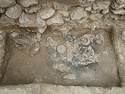
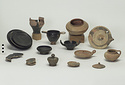
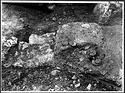
| David Scahill ... Below packed clay floors in Room 2 of Classical Building II; bordered on east and south sides by polygonal cross wall and back wall extension for Classical Building. Late Roman wall and drain installation ... LHIII A:1 ... Below packed clay floors in Room 2 of Classical Building II; bordered on east and south sides by polygonal cross wall and back wall extension for Classical Building. ... Loose fill of stones and earth with large number of Geometric sherds ranging from Protogeometric to late Geometric in date, from top of cutting extending down into layer of tomb contents. At floor of tomb, concentration of bone fragments and pots, mostly broken in situ, concentrated against the north side of the tomb, with some bone fragments across the middle, and on the south side with more pots. |
Fill under Room 7, library of Pantainos Stoa coin deposit
I. Packing beneath original floor.ca. 100 A.D. (Floor A)
II. Packing beneath second major floor. ca. 125-130 A.D. or later (Floor D) A. Walker ... |
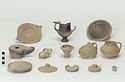
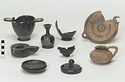
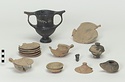
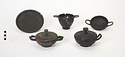
| Pyre against north face of polygonal wall, Room 2, Classical Building II. No floor preserved above, but the pyre is below floor level 51.820masl, preserved just to the east and above patchy floor with ... Ca. 275-260 B.C ... Pyre against north face of polygonal wall, Room 2, Classical Building II. No floor preserved above, but the pyre is below floor level 51.820masl, preserved just to the east and above patchy floor with plaster at ca. 51.70 ... Includes 2 chytra, small saucer and rilled rim plates. |
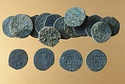
| Coin hoard. Room 2: soft soil north of floor surface. Coins:
23 July 1999 #924-#944. Anonymous folles with the head of Christ on the obverse dating between 770-1059 ... 23 July 1999 ... Coin hoard. Room 2: soft soil north of floor surface. |
| Pyre in House C, Room 12 (RSY=Pyre 9) in the industrial area west of the Areopagus.
Notebook refers to House N.
Beside west wall of room 12. Pottery, burnt bone, and cinders in a roughly round pit; disturbed ... Ca. 250 B.C. |
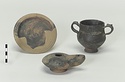
| Classical Pyre between floors in Room 2 of Classical Building II.
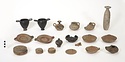
Below floor at 51.66 7masl. Broken pyre pots in fill of ash and carbon, from 51.541-51.513, resting on next floor at 51.513 masl, next ... Ca. 400-390 B.C ... Classical Pyre between floors in Room 2 of Classical Building II.
Below floor at 51.66 7masl ... Broken pyre pots in fill of ash and carbon, from 51.541-51.513, resting on next floor at 51.513 masl, next to foundation trench of crosswall between rooms 2 and 3. |
| Handler ... Found in an area of disturbed fill north of a floor surface in Room 4 of the Classical Commercial Building. The floor surface (n. 3 on the west side of Room 4) was preserved at 52.503-52.544 masl., and ... 2nd half 4th c. B.C ... Found in an area of disturbed fill north of a floor surface in Room 4 of the Classical Commercial Building. The floor surface (n. 3 on the west side of Room 4) was preserved at 52.503-52.544 masl., and was excavated in Lot ΒΖ 1758 (2nd half of the 4th c. ... AS 1396.3 in Study Collections-Case No. 99C-2 box V, while a bone bag now stored in drawer 33 (animal bones) |
| Grave V, under room 18 in House 3, plus burned deposit at 94/IΘ. Identified as sacrificial pyre by SIR on Agoraios Kolonos:
In southeast corner of house 3. 35 artifacts, bone and charred material in pit, ... Ca. 300-275 B.C. |
House C, Room 4 (Pottery dump of stamnos wall and fill below floor). Coins:
1 July 1947 #13
2 July 1947 #1
Coins from House IV:
14 May 1947 #1-#2
19 May 1947 #6-#7
20 May 1947 #32 ... First half 3rd c. B.C ... House C, Room 4 (Pottery dump of stamnos wall and fill below floor) ... Coins:
1 July 1947 #13
2 July 1947 #1
Coins from House IV:
14 May 1947 #1-#2
19 May 1947 #6-#7
20 May 1947 #32 |
| Marcie Handler ... It was situated in the NW corner of Room 3 in the Classical Commercial Building, just S of Wall 11, the cross-wall that divides Room 3 from Room 4 to the north. The pyre pots were found surrounded by ... Late 4th c. B.C ... It was situated in the NW corner of Room 3 in the Classical Commercial Building, just S of Wall 11, the cross-wall that divides Room 3 from Room 4 to the north. The pyre pots were found surrounded by fill with charcoal and burnt bone below a floor surface preserved immediately to the E (J/13,14-2/7,8; 52.20 masl.).
|
Classical commercial building, room 3, against south wall. Small fragments of pottery dispersed in fill overlying two floor levels (at 51.897 and 51.941 masl). Five objects of pyre type: ribbon-handled ... 4th c. B.C. |
| Marcie Handler ... Pyre under floor no. 9 in the center of Room 4. It was adjacent to the southern face of Wall 4, but at lower elevation than the lowest course of the wall foundation (which was found at 52.250 masl.), suggesting ... 375-350 B.C ... Pyre under floor no. 9 in the center of Room 4. It was adjacent to the southern face of Wall 4, but at lower elevation than the lowest course of the wall foundation (which was found at 52.250 masl.), suggesting that the pyre was deposited during a phase of the building that predates Wall 4. Pyre J 2:30 was located approximately 0.20m below Pyre J 2:28, which was excavated during the 2007 excavation season.
The oblong pit for Pyre J 2:30 was cut into Floor no 10 (removed in Lot ΒΖ 2122) and was covered by Floor no 9 (removed in Lot ΒΖ 2120), both of which dated approximately to the last quarter of the 5th c. |
| Sacrificial Pyre I, Classical Building II.
The pyre was set through the original floor level of the northern room of the Classical Building and apparently is the remainder of a ritual conducted when the ... Ca. 375-350 B.C. |
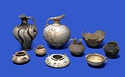
| Mycenaean Chamber Tomb under north side of Temple of Ares, towards its west end.(1951).
The tomb had a hasty and unfinished appearance oddly at variance with its long history and the quality of the pottery ... 1st: Myc IIB-IIA:1-2, 2nd: Myc. IIIC:1 (1450-1200 B.C.) |
| James Artz Pirisino Daniele Kylindreas Miltiades ... Excavation in Room 3 of ΒΘ West revealed 5 ceramic vessels in a row against the eastern face of Wall 12. 3 complete vessels (ΒΘ 122, 124, and 125) were catalogued, along with the base of a plain glazed ... 9th-11th c. A.D ... The fill in Room 3 was uniform in consistency, and no floor levels were found. ... All of the 2013 cataloged objects included in Deposit K 3:2 were found in the fill above this floor, with the pithos and some of the coins resting on it. The floor was left in situ at the end of the season.
2017 Addendum:
In 2017, we resumed excavation of Room 3, concentrating our efforts on the high baulk at the northeastern part of the room.
|
| Pyre 2 in Central House, Room X, under strosis 9. Signs of burning, carbonized food, animal bone.
In room south of courtyard. concentration of artifacts, bone, and charred material in floor makeup, no ... 290-275 B.C ... Pyre 2 in Central House, Room X, under strosis 9. Signs of burning, carbonized food, animal bone.
In room south of courtyard. concentration of artifacts, bone, and charred material in floor makeup, no pit discerned; pots not clearly clustered. The objects were found in digging a hard floor with a white clay surface (strosis 9, lot Φ 217), the earliest floor associated with phase 3 of the house and probably dating in the second quarter of the 4th c. |
| Pyre in Room 2, area west of street (RSY=Pyre 12).
In courtyard. Artifacts, bone, ash, carbon, and cinders in pit in floor sequence. The rectangular pit was cut into a white strosis with marble chips (ΠΠ ... 315-300 B.C ... Pyre in Room 2, area west of street (RSY=Pyre 12).
... Artifacts, bone, ash, carbon, and cinders in pit in floor sequence. The rectangular pit was cut into a white strosis with marble chips (ΠΠ 282), filled with red earth, and the surface then trodden hard. |
| Pyre in House N, room 2, layer 5 (RSY=Pyre 8).
Near northern corner of room 6. Artifacts, bone, burnt logs, and cinders in square pit dug from level of layer 5, through layers 5 and 6; thin clay floor ... 325-300 B.C ... Pyre in House N, room 2, layer 5 (RSY=Pyre 8).
Near northern corner of room 6. Artifacts, bone, burnt logs, and cinders in square pit dug from level of layer 5, through layers 5 and 6; thin clay floor laid over it. ... Layer 4, however, appeared to be a deliberate clay floor, suggesting continued occupation, with the pyre associated with floor renewal. |
South House, Room 12, over pebble mosaic floor. Herulian destruction debris in a house. Coins:
29 April 1956 #1-#7
2 May 1956 #1-#3
9 May 1956 #1
26 May 1956 #1-#4
2 June 1956 #1-#4 PD 1350 ... 9 May 1956 ... South House, Room 12, over pebble mosaic floor. ... Coins:
29 April 1956 #1-#7
2 May 1956 #1-#3
9 May 1956 #1
26 May 1956 #1-#4
2 June 1956 #1-#4 |
| Pyre in House C, Room 8 (RSY=Pyre 6).
Near east corner of room 8. Artifacts, burnt bone, burnt sticks, and large cinders in a shallow pit dug into surface of layer 3, and covered by layer 2. Some cinders ... 350-325 B.C.-end of 4th c. B.C ... Pyre in House C, Room 8 (RSY=Pyre 6).
Near east corner of room 8. Artifacts, burnt bone, burnt sticks, and large cinders in a shallow pit dug into surface of layer 3, and covered by layer 2. Some cinders from pyre in layer 2. These strata lay above the first floor of the third phase of the house. |
Construction fill below floor of Brick Building.
Areas involved:
a) Western portion of Room A: packing below floor.
b) Room B: packing below floor of northern,larger room.
c) Fill over water channel in ... First quarter 2nd century, before its end ... Construction fill below floor of Brick Building.
Areas involved:
a) Western portion of Room A: packing below floor.
b) Room B: packing below floor of northern,larger room.
c) Fill over water channel in smaller, southern room B; channel discovered by builders of Brick Building,rebuilt by them and covered over.
d) Foundation trench of earlier building beneath Brick Building, filled and covered by builders of Brick Building.
e) "Apparently from below floor of building" (nb.p. 1282).
... Coins:
14 July 1950 #1 (disintegrated)
18 July 1950 #1-#3 (disintegrated)
SS 11078-SS 11079 Uncertain from Q-R 10-11:2 or Q-R 10-11:1 |
Pit at 79-83/ΜΒ-ΜΖ (or 81/ΜΣΤ=pit under floor of Room 11 in Roman Bldg. 2, 82/ΜΓ, 83/ΜΕ=well at 83/ΜΗ). Purpose of pit obscure. Evidently filled in Hellenistic times and disturbed in Roman times. Coins: ... 275-200 B.C. with later disturbance ... Pit at 79-83/ΜΒ-ΜΖ (or 81/ΜΣΤ=pit under floor of Room 11 in Roman Bldg. 2, 82/ΜΓ, 83/ΜΕ=well at 83/ΜΗ). ... Coins:
26 February 1937 #1-#2
27 February 1937 #2-#3
1 March 1937 #1
3 March 1937 #1
6 March 1937 #1-#3
9 March 1937 #1-#4
29 March 1937 #4
3 April 1937 #4-#6
5 April 1937 #3-#4
6 April 1937 #4-#8
7 May 1937 #1(well dump) |
| Pyre in House T, Room 2 through floor of second period (RSY=Pyre 5) in the industrial area west of the Areopagus.
4th. c. BC.
Concentration of artifacts, burnt bone, and charcoal in floor makeup consisting ... 375-350 B.C ... Pyre in House T, Room 2 through floor of second period (RSY=Pyre 5) in the industrial area west of the Areopagus.
4th. c. ... Concentration of artifacts, burnt bone, and charcoal in floor makeup consisting of earth, dug bedrock, and marble chips, no pit discerned. The pyre was partly covered by a pebble floor associated with phase 3 of the house, but the fill in which it was found cut through a floor associated with the second phase, and it predates the abandonment of the house substantially. |
| Pyre in House T (= House D), Room 2 (5th c.) and fill east of pyre.
Earlier than the other pyres of this house.
Pottery, slivers of burnt bone, and heavy deposit of carbonized material and cinders in ... Ca. 420-410 B.C ... Pyre in House T (= House D), Room 2 (5th c.) and fill east of pyre.
... The deposit lay under a hard red clay floor, the lowest floor surface preserved in the courtyard. It was probably deposited in the course of the first phase of the house, when the floor was renewed. |
Debris, Room I of Street Stoa (R/16,20-13/10,15).
The lack of any rooftiles and similar architectural debris suggests that perhaps it was brought in from an adjacent area and dumped in the room. This is ... 6-8 May 1975 ... Debris, Room I of Street Stoa (R/16,20-13/10,15).
The lack of any rooftiles and similar architectural debris suggests that perhaps it was brought in from an adjacent area and dumped in the room. This is further suggested by the fact that the debris rested not on the floor but on bedrock dressed down to ca. 65.80m, well below the level of the threshold block. ... Another possible explanation is that the room was quarried for clean bedrock fill (perhaps by the builders of the Late Roman Building to the east), with the resultant filling of the room with destruction debris from Alaric's attack on the city, perhaps taken from the same area where the bedrock fill was to be used (cf. east, in Room 1 and the south half of Room 2. |
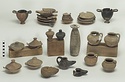
| Pyre 1 in Central House, Room XI, strosis 3. Sacrificial pyre with characteristic small vases amid carbonized twigs and bone.
Near north side of courtyard. This pit was cut slightly into strosis 3 (lot ... 1st quarter 4th c. B.C ... Pyre 1 in Central House, Room XI, strosis 3. ... This pit was cut slightly into strosis 3 (lot Φ 231), a 5th c. floor associated by the excavator with phase 2 of the house. Non-joining fragments of pyre pots in strosis 2 above (lot Φ 228) suggest that the pyre may have been dug from that level. |
Investigations in Room to N of Tholos, various layers and periods. ... 470 B.C.-post-Herulian reuse ... Investigations in Room to N of Tholos, various layers and periods.
... Layer VI-X.2 Repairs at the end of 5th c. or early 4th c. ... Layer III and IV.5 Debris over Hellenistic floor; end of 2nd. c. |
| Pyre in House D, Room 4 (RSY=Pyre 4) in the industrial area west of the Areopagus.
Notebook refers to House N.
Pottery belongs late in third quarter of the 4th. c. BC. Pyre burned near beginning of last ... 350-300 B.C ... Pyre in House D, Room 4 (RSY=Pyre 4) in the industrial area west of the Areopagus.
... The pyre pit was dug through layer 1 and into layer 2, both of which overlay the foundation of the wall between rooms 3 and 4. ... The hardened and reddened floor of the pit and the location of cinders under the pottery indicate the pyre was burnt in situ. |
|
|