|
|
Red fill with burning over south part of Heliaea. Post Herulian Metal- Worker's establishment. Coins:
20 May 1953 #1-#2
4 May 1953 #1 P 30199 (Κ 4282), B 1544-1546 (Κ 4281, Κ4283-4284) catalogued on May ... Late 3rd. c. A.D ... Red fill with burning over south part of Heliaea. |
"Red Fill" (extending to bedrock or near, over most of area). Mainly first century after Christ with later disturbance. Coins:
17 April 1936 #10-#13
18 April 1936 #1
20 April 1936 #13-#17
21 April 1936 ... 1st-2nd c. A.D ... Red Fill West of Odeion |
Small deposit including red figured fragments ... Second and third quarters of 4th c. B.C ... Small deposit including red figured fragments. |
Lower red fill with mixed Hellenistic pottery running into the 2nd. c. Coins:
4 May 1936 #1 ... 1-5 May 1936 ... Lower red fill with mixed Hellenistic pottery running into the 2nd. c. |
A smaller deposit, but with some good household pottery, and red-figure both Meidian and sub-Meidian ... 17-22 May 1939 ... A smaller deposit, but with some good household pottery, and red-figure both Meidian and sub-Meidian. |
Trench at 11/ΚΕ cut into the stereo (length 1.40m, width 0.50m). Coins:
5 April 1932 #5 (illegible).
Red figure pottery; coarse ware ... Mid-5th c. B.C ... Coins:
5 April 1932 #5 (illegible).
Red figure pottery; coarse ware. |
Fifth century Pit E of Stoa Room 11 with coarse pottery and a few black-glazed, some with stamping and red-figured pieces ... Ca. 450-425 B.C ... Fifth century Pit E of Stoa Room 11 with coarse pottery and a few black-glazed, some with stamping and red-figured pieces. |
Refuse pit at 51/Ζ; it had been partly cut away at the north by the late Roman retaining wall; the dumped filling a homogeneous deposit of figured, black and plain wares. Red figure oinochoe in the style ... Ca. 450-420 B.C ... Red figure oinochoe in the style of Meidias painter; red-figured pieces, black glazed ware; two ribbed mugs; fragmentary lamps; fragmentary terracotta figurine. |
Deposit of fine table ware and lekythoi, both black-figured and red; the plain wares closely resemble those from the well H 6:5 ... 470-450 B.C ... Deposit of fine table ware and lekythoi, both black-figured and red; the plain wares closely resemble those from the well H 6:5. |
It is a considerable deposit including both figured and plain wares, the red-figure consistently of the second quarter of the 4th c. Estimated Grid ... Ca 375-340 B.C ... It is a considerable deposit including both figured and plain wares, the red-figure consistently of the second quarter of the 4th c. |
Red sandy earth at inner corner of heavy late wall at 12/ΛΖ.
A. Walker coin deposit. Coins:
27 March 1934 #1-#12
28 March 1934 #1-#2 ... 2nd-3rd c. A.D ... Red sandy earth at inner corner of heavy late wall at 12/ΛΖ.
|
| Terracotta deposit in SW corner of Room K and E of Roman Wall L. Roman layer of red, compact earth.
Baskets 50,52,54. Coins:
18 July 2002 #1282
19 July 2003 #1295 ... 4th c. A.D ... Roman layer of red, compact earth.
|
"Red earth": Herulian destruction debris over Roman House and east of cistern B. Coins:
30 May 1935 #1-#8
31 May 1935 #1-#15 Sherds stored in container Lot ΠΘ 4b ... 27 May 1935
31 May 1935
3 June 1935 ... "Red earth": Herulian destruction debris over Roman House and east of cistern B. |
Pit in bedrock in front of Shop VII (= Pit in Stoa Colonnade in front of Shop VII). It contained a miscellaneous collection of sherds which included one scrap of red-figure ... Ca. 475-460 B.C ... It contained a miscellaneous collection of sherds which included one scrap of red-figure. |
Pit in ancient road, ca. 73/ΜΣΤ The filling of this pit contained quantities of coarse pottery, principally fragmentary amphoras, but including also some glazed and semi-glazed pieces and fragments of ... Ca. 350-325 B.C ... The filling of this pit contained quantities of coarse pottery, principally fragmentary amphoras, but including also some glazed and semi-glazed pieces and fragments of three red-figured vases. |
A drain pit with red gravely fill. Coins:
5 April 1939 #1-#8
Pottery continuing to at least 3rd c. A.D. ADDENDA: See also tins Lot ΝΝ 70, ΝΝ 71.
ADDENDA: P 14822 probably also belongs ... Mixed Hellenistic to Roman ... A drain pit with red gravely fill. |
Pit 2 in Grave area. Small deposit in a pit; a fragment of a red-figured nuptial lebes recalls the early Kerch style of the second quarter of the 4th c.; the deposit as a whole runs somewhat later ... Ca. 375-315 B.C ... Small deposit in a pit; a fragment of a red-figured nuptial lebes recalls the early Kerch style of the second quarter of the 4th c.; the deposit as a whole runs somewhat later. |
Small compact deposit. Cutting. High proportion of good black glaze; 21 loom weights (19 pyramidal, 2 lentoid); a very large red-figured skyphos somewhat recalls the style of earlier work of the Dinos ... Ca. 430-420 B.C ... High proportion of good black glaze; 21 loom weights (19 pyramidal, 2 lentoid); a very large red-figured skyphos somewhat recalls the style of earlier work of the Dinos Painter. |
Red Figure Pocket in front of Retaining Wall at 74-77/ΛΖ-ΛΘ.
Pit , a large cutting in bedrock, irregular in outline, reaching a depth of ca. 1m; dumped filling of alternating layers-broken pottery fragments ... Ca. 430-410 B.C ... Red Figure Pocket in front of Retaining Wall at 74-77/ΛΖ-ΛΘ.
|
| Investigations in the area of Archaic Temple Added by E.V June 1963 ΕΛ 324-331. In the annual report for 1959 both the building of the temple itself, and the red limestone addition are dated in the early ... First half of 6th c. B.C. - early 5th c. B.C ... III Temple, red limestone addition: mainly late 6th and early 5th c. |
Lined with small stones.
Difference noted between the pottery from the top and that from the bottom. Coins:
11 April 1933 #13 (disintegrated)
12 April 1933 #1-#6 (disintegrated) (Coin no. 1. N 18194 found ... Turkish ... N 18194 found in red earth above stoa foundations, not sure if it belongs in this deposit). |
S.W. of Archaic Temple : Pocket in bedrock. The pocket was cut through a red clay floor. 71 sherds.
Objects: loom weights; lamp.
Early ware: Gray Minyan; Mycenaean; Protogeometric-Late Geometric; Subgeometric; ... Early 6th c. B.C. and earlier ... The pocket was cut through a red clay floor. |
A dumped filling including red figured fragments of the second quarter of the 4th c. B.C. Coins:
25 June 1931 #12 (in strosis above pottery deposit) 15 November 1952, going through the containers Tin 59-Box ... Ca. 375-350 B.C ... A dumped filling including red figured fragments of the second quarter of the 4th c. |
Chamber cistern at 95/Κ and Cistern shaft at 95/ΚΕ plus the passage between. System heavily disturbed throughout in Turkish times except for a small amount of red fill on floor of shaft. Coins:
4 May 1936 ... Hellenistic ... System heavily disturbed throughout in Turkish times except for a small amount of red fill on floor of shaft. |
Scanty debris filling in a pit. The wishbone-handled bowl (P 16753) is of the middle of the third quarter of the 5th. c. century, as are also two red figured fragments, P 25820 and P 25821; the deposit ... Ca. 450-400 B.C ... The wishbone-handled bowl (P 16753) is of the middle of the third quarter of the 5th. c. century, as are also two red figured fragments, P 25820 and P 25821; the deposit as a whole is somewhat later. |
A tiled well with POU from 9.30-10.80m. and dumped fill above 9.30m. The dumped fill differs from lower fill only in the less frequent appearance of fragments of micaceous water jars and the occurrence ... 3rd c. A.D. with destruction at 267 A.D ... The dumped fill differs from lower fill only in the less frequent appearance of fragments of micaceous water jars and the occurrence of Roman D ware plate fragments and of large brick red amphorae with fluted handles.
|
Unfinished well, all one fill; solid bedrock at a depth of -2.47m.
It contained masses of broken rooftiles and probably was used as a refuse pit after the sack of Athens by Sulla.
Twenty-three stamped ... Early 1st c. B.C ... Twenty-three stamped amphora handles; "Pergamene" ware; "Samian" ware and Pompeian-red ware must be intrusive; two-thirds of bowls long-petal. |
| "Perhaps a cremation burial ... " nbp. 811. "Sacrificial pyre, disturbed," GRE, deposit nb.
In room on east side of building. Concentration of artifacts, fragments of bone, and abundant cinders in stratum, ... Early 3rd c. B.C.-Ca. 250 B.C ... The pyre was found while excavating an undated red fill that lay over the 5th c. building fill. |
The filling from top to bottom uniform, yielding small bits of ancient worked marbles and pottery of the fifth and fourth centuries B.C. mixed with undecorated coarse ware, probably of Byzantine times ... 5th c. A.D.-Byz ... A sherd from the mouth of the well (P 2223, red figure) removed from contents list by E.V.
|
Dumped filling of 6th c. A.D. Coins:
3 May 1939 #1-2 (red earth above well)
9 June 1939 #1
10 June 1939 #1
12 June 1939 #1-#5
13 June 1939 #1
19 June 1939 #1-#2, #3 (Dump)
7 May 1940 #1
9 May 1940 #1
27 ... Early 1st-5th c. A.D. POU ... Coins:
3 May 1939 #1-2 (red earth above well)
9 June 1939 #1
10 June 1939 #1
12 June 1939 #1-#5
13 June 1939 #1
19 June 1939 #1-#2, #3 (Dump)
7 May 1940 #1
9 May 1940 #1
27 May 1940 #1
28 May 1940 #1 (Dump) |
The almost complete red figure hydria set into this cutting suggests the possibility of a 5th c. burial put into a much earlier grave cutting; however, the remainder of the filling appears thoroughly disturbed ... 450-425 B.C- Late Roman disturbance ... The almost complete red figure hydria set into this cutting suggests the possibility of a 5th c. burial put into a much earlier grave cutting; however, the remainder of the filling appears thoroughly disturbed.
|
Plaster dump at Q/2,5-6/7,9.
Layer 5 in "Wall Painted Room" of Roman House ε. Layer resting on bedrock and covered partially by good strosis (55.26m.). Fill was red with mudbricks, tiles, much plaster ... Late 1st-early 2nd c. A.D ... Fill was red with mudbricks, tiles, much plaster. |
| Identified as pyre by SIR.
In room E. Burnt "pocket" found while digging red earth that contained late Hellenistic pottery, including a fragment of Pergamene (discarded). No pit was discerned, but concentration ... 3rd quarter 4th c. B.C ... Burnt "pocket" found while digging red earth that contained late Hellenistic pottery, including a fragment of Pergamene (discarded). |
Dug as Metroon Porch Pit A and Pit C (layers II and III). ... 7th-6th c. B.C ... In the lowest layer the dug bedrock was mixed with viscous red earth. |
| Dumped filling mostly of 3rd c. A.D., but dumped as late as 5th century. Nbp. 143: The fill in this cistern was of three kinds: to within .60m. of the floor plain broken bedrock with no sherds; then a ... 10-17 February 1937 ... Nbp. 143: The fill in this cistern was of three kinds: to within .60m. of the floor plain broken bedrock with no sherds; then a layer 15-20 cm. thick with Turkish sherds, and [then] Roman 3rd c. pottery, mostly fragments of micaceous red water jars, over the floor. |
Well at 45/Θ (Skytha Well) near the north side of the market square. No period of use was distinguished, since it was impossible to clear the well to the bottom. The considerable quantity of dumped filling ... Ca. 460-440 B.C ... The considerable quantity of dumped filling included red-figure and black glaze, semi-glaze kitchen-ware, and coarse cooking ware and storage jars. |
Lower filling mostly of second half of 4th c. B. C. and earlier, but perhaps dumped in 3rd c. B.C. Upper filling mixed to Roman (4th c. A.D.). Pottery in container (9-22-58) is mostly second half of 4th ... Ca. 375-325 B.C. with late-3rd-century disturbance ... Pottery in container (9-22-58) is mostly second half of 4th c., but note some earlier and little battered, as the red-figured chous and the lamp. |
See I 870, a piece of which was found in disturbed red fill in Β' southeast of Tholos.
Although apparently from the same context as P 5339 (tins 24-26, undisturbed fill), P 5336-P 5338 are recorded from ... 27 February-8 April 1935 ... See I 870, a piece of which was found in disturbed red fill in Β' southeast of Tholos.
|
| Pyre in Room 8 of Roman House H. Concentration of artifacts, bone, and flecks of carbon in stratum, no pit discerned. the pyre lay within a red fill apparently contemporary with it, but with some later ... 300-290 B.C ... Concentration of artifacts, bone, and flecks of carbon in stratum, no pit discerned. the pyre lay within a red fill apparently contemporary with it, but with some later intrusions; no trace of a floor above it survives. |
Evidence of stratification into five layers, although joins between the layers. Layer VI added when the construction of the Roman building above required it. No subdivisions assigned.
Flask-shaped cistern ... Early 3rd-late 2nd c. B.C ... Layer I: red earth in the central depression, probably the accumulation of the last period of use of the cistern as a source of water. ... Layer III: fine red earth. It was put in to fill the cistern immediately after Layer II, and having settled, was later supplemented with layers IV and V, in close succession. |
| Shallow pit in bedrock on the upper terrace, ca. 3m. southeast of the Rocky Outcrop. Uncatalogued material: 46 sherds, 61 terracotta figurines and 4 objects.
Early ware : Neolithic; Gray Minyan; Mycenaean; ... Archaic with intrusions ... Late Roman ware : combed ware; coarse ware; red-glazed. |
Ostrakon Pit (Horos Terrace Trench). Oval pit cut into bedrock. Packed filling of stones, coarse sherds and roof tiles; among these a few fragments of finer vases and 22 ostraka, probably from the ostracaphoria ... Ca. 490-480 B.C. and later ... A single fragment of a red-figured lid (P 23018) indicates that the filling of the pit must have taken place as late as the last years of the century (Deposit nb).
|
Early cutting beside Great Drain: 103-111/Λ-ΛΓ (= "Deep cutting" Pit at 107/ΛΑ).
Abandonment filling in channel for early drain; the fragment of a red figured bell krater, P 17000, probably to be dated ... Ca. 425-395 B.C ... Abandonment filling in channel for early drain; the fragment of a red figured bell krater, P 17000, probably to be dated between 400 and 397 BC, is the latest dated object from the deposit, otherwise a consistent filling of the last quarter of the 5th. c. with some earlier material.
|
| The cistern was lined with stones at the top with an opening 0.80 m in diameter. For the most part, it seemed to cut into bedrock except along its northern edge where some 5th c. B.C fill remains and main ... 2-19 July 2010 ... c) Lot 669 : 50.648-49.993, gravelly and clay-like fill with patches of pure brown or bright red clay. |
| A well at the northeast corner of Classical Building, behind back wall. Dumped fill appears to have occurred as a single event as there are joining sherds throughout.
POU date ca. first half 5th c. B.C.; ... 5th c. B.C ... Pottery includes much black glaze plus good examples of black figure and red figure, several lekythoi. |
| Julia Shear ... Burial. Roman Temple south half, in fill south of temple crosswall and norh of polygonal wall, layer 37a.
Small, roughly circular pit. The diameter of the pit appeared to be only slightly greater than ... Late Helladic IIIC Late-Final Mycenaean/Submycenaean ... The diameter of the pit appeared to be only slightly greater than the maximum diameter of the amphora (P 32307), which is 0.254m
The fill of the pit was a fine, loose-textured, dark red-brown earth, distinct from that of the surrounding fill. |
Well on the north slope of the Areopagus; depth at 9.65m; scanty dumped fillings. From about 3.20m to the bottom, little but tile fragments appeared; in the fillings above, the lower is characterized by ... Ca. 350-290 B.C ... From about 3.20m to the bottom, little but tile fragments appeared; in the fillings above, the lower is characterized by a fragment of a red-figured bell-krater; the filling above it is substantially later. |
"Debris Pit" beneath starting line in Panathenaic Way.
Dug as
Trench B (1971), pp. 1631-1649 (notebook not seen, PF);
finds record both Layer 28 and beneath Layer 28.
Trench I, pit 16a, (1973), pp. 3010-3022 ... 2 August 1971
4-6 July 1973
27 June-11 July 1980 ... -Below fill consisted of red clay from disintegrated mud brick, mixed with charcoal in large quantities.
|
| Identified as Pyre by SIR.
Debris filling of the middle of the 4th c. B.C. including the remains of a sacrificial pyre.
Objects dispersed in red-clay fill uncovered in removal of modern staircase. A broken ... 4th c. B.C. disturbed ... Objects dispersed in red-clay fill uncovered in removal of modern staircase. |
North of Eleusinion: Fill in Room 3 of Roman Building. 614 sherds (6 miniature shapes, 20 intrusive sherds).
Objects : terracottas; loom weights; spindle whorls; disks; handmade tray; lamps.
Early ware ... First half of 6th c. B.C.-Mixed Fill to ca. 480 B.C ... Intrusions : red figure; plemochoai; lebes; oinochoe; kantharos; cup-kantharos; bowl. |
Unfinished well, south of the annex to the Poros Building, west of the Areopagus. The shaft was apparently never used as a well. The lower dumped filling contained a quantity of clean red clay, as if from ... Ca. 350-325 B.C ... The lower dumped filling contained a quantity of clean red clay, as if from an industrial establishment; also some marble chips and a scattering of pottery fragments. |
The absence of certain shapes (no kantharoi or cup-kantharoi) may be due to the nature of the establishment from which the material came. Also, absence of rouletting save for one example. The lack of these ... Ca. 390-375 B.C ... Coins:
Cf. 17 May 1933 #1-#10
18 May 1933 #1-#2
20 May 1933 #1
23 May 1933 #1
Bolsals; plates; many "coarsely glazed' plates; small "coarsely glazed" saucers; black-glazed bowls; fish-plate; "animal askoi"; red figured bell-krater fragment; small black-glazed bowl fragments; one piece of rouletting; lamps. |
| Pyre in House T (= House D), Room 2 (5th c.) and fill east of pyre.
Earlier than the other pyres of this house.
Pottery, slivers of burnt bone, and heavy deposit of carbonized material and cinders in ... Ca. 420-410 B.C ... The deposit lay under a hard red clay floor, the lowest floor surface preserved in the courtyard. |
| Sacrificial Pyre I, Classical Building II.
The pyre was set through the original floor level of the northern room of the Classical Building and apparently is the remainder of a ritual conducted when the ... Ca. 375-350 B.C ... Bits of bright blue and bright red pigment were found in the fill around the vessels. |
| Pyre in Room 2, area west of street (RSY=Pyre 12).
In courtyard. Artifacts, bone, ash, carbon, and cinders in pit in floor sequence. The rectangular pit was cut into a white strosis with marble chips (ΠΠ ... 315-300 B.C ... The rectangular pit was cut into a white strosis with marble chips (ΠΠ 282), filled with red earth, and the surface then trodden hard. |
| Pyre in House T, Room 1, Layer 5-6 (RSY=Pyre 3) in the industrial area west of the Areopagus.
First quarter 4th. c. B.C.
Artifacts, bone, and cinders in pit in floor sequence. The pyre was found in digging ... 400-375 B.C.(?) ... The hard red earth under the pyre indicates that it was burnt in situ, but a few centimeters of earth between the floor of the pit and the vessels suggests vessels were cleaned out and then thrown back in. |
Fills from construction and reconstruction of a house. "Brown House" = House A (RSY Hesp. 20) (and pit under Layer 4) in the industrial area west of the Areopagus.
Under the original floor of this house ... Second half of the 5th. c. B.C ... Under the original floor of this house were sherds including two red figured pieces (P 17137, P 19880). |
Early Roman pit at P/3-6/6,7
Layer 4a in Room 6 of Greek House δ, area P/2,3-6/6,8.
Pit in NW corner of Room 6 bounded by walls of Room to North and West, cut into preexisting layers to east, cutoff by ... 17 May 1971 ... Loose earth, red and black earth (especially black toward bottom); tiles, bones, carbon, glass, unidentifiable bronze pieces, very large iron nails with round heads, small iron nails, iron staples, plaster, some pieces of vitrified pottery.
|
No period of use. Below the upper (Early Roman) dump extending down to ca. 6.10m. was a dumped fill of broken pottery in great quantity, including a high proportion of red-figured fragments. Masses of ... Ca. 430-400 B.C.
Late 1st c. B.C.-mid 1st c. A.D ... Below the upper (Early Roman) dump extending down to ca. 6.10m. was a dumped fill of broken pottery in great quantity, including a high proportion of red-figured fragments. |
| Circular pit and irregular cutting north of it. Diam. of pit ca. 0.80m; Dimension of irregular cutting ca. 1.00x1.20m. The pit was dug into bedrock and filled with red earth which was packed with undisturbed ... Second half of 7th c. B.C ... The pit was dug into bedrock and filled with red earth which was packed with undisturbed pottery. |
| Rubbish Pit . Pit cut through a house floor. In courtyard, beside door to room 3. Artifacts, bone and scattering of large cinders in roughly rectangular pit dug through floor bedding and covered by red, ... 325-300 B.C ... Artifacts, bone and scattering of large cinders in roughly rectangular pit dug through floor bedding and covered by red, Hellenistic fill, below a layer of decayed mudbrick. |
Fillings in a well on south slope of Kolonos Agoraios. The shaft reached a depth of 20.28m., but produced no use filling. The lower part, from water level at 12.60m. to bottom, provided only mud and gravel ... Ca. 425-400 B.C ... Dumped filling from 3.00m. to 12.60m. including red-figured fragments which extend over much of the second half of the 5th. c. |
| Mycenaean tomb: Myc. III A:1-2.
SAI
Small rectangular chamber, 2.30m wide by 1.80m deep,, entered from the east through a dromos 1.10m wide which contracted to a doorway 0.92m. wide. the doorway preserved ... 2nd half of 14th c ... SAI
Small rectangular chamber, 2.30m wide by 1.80m deep,, entered from the east through a dromos 1.10m wide which contracted to a doorway 0.92m. wide. the doorway preserved its rough stone blocking wall to a height of 0.70m to 0.80m., and the dromos the firm red earth with which it had been packed to a height of 1.30m.
|
Disturbed "Votive Deposit" at 27-28/ΙΖ-ΙΗ
Reddish fill in five circular cutting in bedrock, considered by the excavators to have been one deposit. Fill was disturbed in later periods, probably by construction ... 7th c. B.C, with intrusions ... Intrusions:
Red-ware; late Roman; Late Roman lamps; coarse ware, combed ware; micaceous water jugs; yellow/white glaze; lidded bowl; shallow coarse ware dish. |
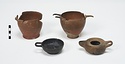
| A compact group of four complete vases and a lamp, found on a house floor; possibly the remains of a sacrificial pyre but without evidence of burning or the characteristic votive vases.
Layer II, "nest ... 425-400 B.C ... The pottery types suggest an identification as a pyre; the close similarity of the two skyphoi in size and firing (unevenly fired red) suggests that they were part of the same kiln batch and were purchased together. |
| Dorothy Burr Thompson ... Grave 1. Urn cremation (trench-and-hole), adult female 30-40 years old).
Mentioned as Grave XVII in Deposit list.
Consisted of a roughly circular pit, approximately 0.30-0.40m in diameter, cut into ... Late Protogeometric ... Virtually nothing of the pyre trench survived, but it's presence was indicated by hard red-colored burned earth packed tightly against the rim of the amphora along the northwest side. |
| Rodney S. Young ... Grave 3 in notebook (E.L. Smithson: Grave XIII: PG). Urn cremation (trench-and-hole), adult female.
JP
Rectangular trench, measuring approximately 1.10x0.45m, but which may have been larger, cut through ... Late Protogeometric ... "Burned earth" fired red with the odd pyre sherd noted on the floor and spilling into the urn-hole". 2. layer of ash and charcoal. 3. |
Fillings in and to the north of Building A/Poros Building/Greek Building ("Strategeion"), the accumulation mostly a late archaic dump, but not deposited till near the middle of the century. Most of the ... First half of 5th c. to ca. 460-450 B.C ... P 4810, P 4812) were found beneath the mosaic floor in the NE corner of the building or in red or green fill nearby. |
Well ΑΒ located on the lower terrace to the north of the sanctuary(diameter 1.10m). Foot-holes were cut into the shaft at intervals of ca. 0.40m. The fill consisted mostly of small stones, dug bedrock, ... Second quarter of the 6th century B.C ... Coarse ware-plain ware : amphora; lekane; pithos; cooking wares; unglazed; mottled black/brown-glazed ware; mottled red/brown-glazed ware; coarse ware. |
Washed-in filling at the base of the Acropolis cliffs, some 7m. east of the Klepsydra; the fill was characterized by teh fragments of a series of red-figured oinochoai of special shape, of the late 5th ... Late 3rd c. B.C ... Washed-in filling at the base of the Acropolis cliffs, some 7m. east of the Klepsydra; the fill was characterized by teh fragments of a series of red-figured oinochoai of special shape, of the late 5th c. |
| Brian Martens ... Mycenaean Chamber Tomb J 1:11, located in the area north of Wall K, was partially excavated during the 2014 season. At this point the full western extent of the chamber has not been located because of ... LHIIIA ... Only a small portion of the northern edge, cutting into the rocky red virgin fill, could be revealed; the remainder is presently concealed under the scarp of still-standing Wall P. the stomion and its intact blocking wall were found behind a thin layer of fill centered at the western side of the chamber. |
Cistern at the southeast foot of Kolonos Agoraios.
Nbp. 2369: Two chamber cisterns, 88/ΛΔ and 100/ΚΘ, united by a long straight passage running almost due N-S. A draw shaft at 95/ΚΘ is set just off the ... Use filling of late 4th-early 3rd c. B.C.
Accumulative fillings of late 3rd-early 2nd and late 1st c. B.C.
Upper dumped filling of 3rd c. A.D ... Subdivisions:
.1=Upper Roman fill
.2=Lower Hellenistic fill
.3=Red earth at bottom=POU |
| James Artz Pirisino Daniele Kylindreas Miltiades ... Excavation in Room 3 of ΒΘ West revealed 5 ceramic vessels in a row against the eastern face of Wall 12. 3 complete vessels (ΒΘ 122, 124, and 125) were catalogued, along with the base of a plain glazed ... 9th-11th c. A.D ... Plain glaze ware; Constantinople white ware; monochrome glaze; green and brown painted ware; combed ware; ridged ware; gouged ware; amphora toe; incised coarse ware; Roman lamp fragment and red wares; classical red and black glaze (including geometric, archaic, and classical); coarse base with strange shape, handle and neck close to base; coarse handles, bases, rims, and body sherds; micaceous body; cooking ware, including joining lid fragments; painted and unpainted plaster; roof and floor tile fragments; pithos lid, rim and body fragments; worked stone; stone revetment; bone; metal; glass |
|
|