|
|
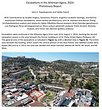
| Athenian Agora 2023: Preliminary Report ... John K. Papadopoulos Debby Sneed ... A summary of the first excavation season in Section ΒΚ, an area beneath a building demolished in the fall of 2022.
Prior the excavation a geophysical survey was undertaken.
Modern, Ottoman, and Byzantine ... 12 Jun-4 Aug 2023 ... All material was collected and kept (pottery, bone, shells, etc.). All soil was dry sieved and flotation samples and phytolith samples were taken for each context.
The pottery was sorted and read by experts.
|
| Excavations in the Athenian Agora, 2025: Preliminary Report ... John K. Papadopoulos Debby Sneed ... The 2025 excavation is the third excavation season in the ΒΚ section, divided into three trenches: ΒΚ North, ΒΚ South, and ΒΚ West, and covers the central part of the Stoa Poikile. The excavation practices ... 9 Jun-1 Aug 2025 ... The study of pottery revealed that only Byzantine, Ottoman, and Early Modern pottery came from closed stratified deposits, whereas Greek and Roman period pottery came from disturbed contexts. |
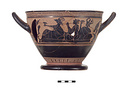
| Investigations in the Area of the Tholos 1937 ... Homer A. Thompson ... An overview of the work carried out in the area of the Tholos in 1937. The 6th century B.C. accumulation was stripped away revealing a complex of foundation walls, of limestone polygonal construction, ... 5 Apr 1937-21 Jul 1947 ... Black-figured pottery found in the debris overlying the floors of the earlier houses provide a terminus post quem for the earliest Tholos. |
| Preliminary Report on the 2013 Excavation Season ... John McK. Camp II ... Excavations were carried out in several areas, spanning Mycenaean to Byzantine times.
Full exploration in Section ΒΘ East was prevented since the Byzantine walls could not yet be removed, but a trial trench ... 10 Jun-2 Aug 2013 ... Fragmentary but high quality pottery of the Archaic period were found in numerous areas. Mycenaean pottery and scattered human bones indicate at least one Mycenaean tomb in the vicinity. |
| Report on Excavations in the Athenian Agora 1990 ... T. Leslie Shear, Jr ... This is a report on the archaeological field work conducted in the Athenian Agora during the period from December 1989 to December 1990. The actual excavation period was preceded by preparatory operations ... 4 Jun-3 Aug 1990 ... A well was dug and produced a large amount of pottery.
In Section ΒΗ mostly modern fills were excavated. |
| Excavations in the Athenian Agora, 2024: Preliminary Report ... John K. Papadopoulos Debby Sneed ... A summary of the second excavation season in Section ΒΚ, in the area beneath the former building at 14 St. Philip Street.
The area was divided into three trenches and yielded mixed material from the Modern ... 10 Jun-2 Aug 2024 ... Experts sorted and examined pottery. They counted the tiles and kept a sample.
|
| Preliminary Report on the 2001 Excavation Season ... John McK. Camp II ... Excavations were carried out at the northwest of the Agora in sections ΒΖ and ΒΕ, and in the area of the Eleusinion in section ΕΛ.
In Section ΒΖ, the investigation of the settlement of the 11th century ... 11 Jun-3 Aug 2001 ... In section ΕΛ, the area just south of and uphill from the Eleusinion was excavated, along the east face of the late Roman fortification wall. Some pottery fragments from the time of the wall's construction were found, but for most part a thick layer filled with fragmentary pottery from the late 3rd and early second centuries B.C. was excavated. |
| Section Φ Season of 1937 ... Eugene Vanderpool ... In antiquity the area included in Section Φ lay outside the Agora proper and were apparently occupied only by houses and small buildings. The earliest period of which any considerable remains were found ... 25 Jan-17 Jun 1937 ... The earliest period of which any considerable remains were found was the Geometric: three Protogeometic graves and one well, as well as one Geometric grave and one disturbed well, were discovered and excavated.
Pottery from the 2nd and 3rd quarters of the 6th century B.C. were found in a small hollow in the bedrock. A big well was excavated and black-figured and red-figured pottery was found. Some of the objects from the well belong to the early years of the 5th century B.C.
|
| Agora Excavations 1995 Preliminary Report ... John McK. Camp II ... Excavations continued in the areas of the Panathenaic Way, west of the Stoa Poikile, and in and around the Classical commercial building north of the Stoa Poikile.
In the Panathenaic way the exploration ... 12 Jun-4 Aug 1995 ... It produced pottery for domestic use, dating to 510-480 B.C. |
| Section ΛΛ 193
Excavation Summary ... Dorothy Burr Thompson ... Excavations in Section ΛΛ revealed that the original contour of Kolonos Agoraios had been much sharper than in modern times. No traces of early graves were found in the area; first sign of habitation is ... 1 Feb-23 Jun 1937 ... No traces of early graves were found in the area; first sign of habitation is pottery from the last half of the 5th century B.C. found in metal working pits in connection with a drain and a road. |
| Section ΝΝ
Season of 1939 ... Rodney S. Young ... Section ΝΝ lies at the mouth of the valley between Pnyx and Areopagus, which was the important thoroughfare from the Agora to the Pnyx and to the southern parts of the city, as well as to the Piraeus Gate, ... 26 Sep 1938-24 Jun 1939 ... The most important group of finds is the pottery from the archaic graves. |
| Agora Excavations Preliminary Report - Summer 2014 ... John McK. Camp II ... Excavations in 2014 were carried out in three sections: ΒΘ, ΒΓ and ΒΖ.
In Section ΒΘ, overlying the Painted Stoa, the Byzantine houses of the 11th century A.D. were further exposed in the western part ... 9 Jun-1 Aug 2014 ... Two skeletons were found along with pottery and beads from a necklace.
|
| Section ΜΜ
Season of 1939 ... Homer A. Thompson ... Section Μ was to be refilled this year and supplementary explorations took place to resolve some remaining obscurities. The most significant discovery was a road running northwest-southeast, probably the ... 20 Feb-8 Apr 1939 ... The history of the road is well documented by the pottery from its successive layers of gravel, the earliest being Neolithic, going down to at least Roman times.
|
| Section X
Miscellaneous Notes Compiled in Summer of 1946 ... Margaret Crosby ... This report is a summary of the excavations taken place in 1937 as well as in 1946.
Some pottery indicate habitation in the area from the Geometric period. Two shallow graves of the 6th and 5th centuries ... 27 May-21 Jun 1946 ... This report is a summary of the excavations taken place in 1937 as well as in 1946.
Some pottery indicate habitation in the area from the Geometric period. |
| Preliminary Report on the 2012 Excavation Season ... John McK. Camp II ... Excavations were carried out in four areas during the 2012 season: three in the area of the Painted Stoa at the northwest corner of the Agora (sections ΒΗ, ΒΖ, ΒΘ), and one in the Panthenaic Way (section ... 11 Jun-3 Aug 2012 ... It dates to the 4th and 5th centuries A.D. and contained a large amount of pottery of which many pieces were intact. |
| Athenian Agora
Excavation Summary for 2021 ... John McK. Camp II ... Excavations continued in sections ΒΖ and ΒΘ in and under the Classical Commercial Building, the Painted Stoa, and the orthostate enclosure suggested to be the Leokoreion.
In section ΒΖ the goal was to ... 14 Jun-6 Aug 2021 ... In section ΒΖ the goal was to find out more about the later Archaic remains, perhaps houses or shops, underlying the Classical building. Pottery of the 8th century B.C. and the discovery of another well suggest that the area was used for habitation in the Iron Age after centuries as a burial ground. |
| Preliminary Report on the 2008 Excavation Season ... John McK. Camp II ... Excavations took place in three sections, two north of Hadrian Street (ΒΗ and ΒΘ) and one in the old area south of the Tholos (Γ).
In Section ΒΗ, layers in, over and behind the building identified as the ... 10 Jun-1 Aug 2008 ... Some fill contained pottery of the 8th and 7th centuries B.C., perhaps indicative of earlier houses or disturbed burials. |
| Agora 2019 - Summary Report ... John McK. Camp II ... Excavations were carried out in four sections: in Section ΝΝ in the southwest corner of the archaeological site, and in the northwest corner of the Agora in Sections ΒΖ, ΒΘ East and ΒΘ West.
Section ΝΝ ... 10 Jun-2 Aug 2019 ... Early pottery was found but no tomb. |
| ΚΚ Excavation Report 1936 ... Dorothy Burr Thompson ... Section ΚΚ, the area inside the modern fence around the so-called Theseion, was cleared to bedrock in order to determine the entire history of that portion of Kolonos Agoraios. Excavation revealed that ... 10 Feb-13 Mar 1936 ... Dumps of working chips of poros and marble from the time of the of construction of the temple, and the pottery found within them, suggest that work must have begun about the middle of the 5th century. |
| Preliminary Report on the 2009 Excavation Season ... John McK. Camp II ... Excavations were conducted in four sections: Γ, ΒΘ, ΒΗ and ΒΖ.
In Section Γ, the investigation of the Classical buildings south of the Tholos continued with the aim to find out if they were civil, commercial ... 8 Jun-31 Jul 2009 ... Byzantine pottery started to emerge by the end of the season. |
|
|