|
|
| Rebecca Wood Robinson ... Mycenaean Grave C. Lisa's list mentions also Grave D ... Myc. IIIA 1:2 ... Mycenaean Grave C ... Lisa's list mentions also Grave D. |
Grave of 38 year-old female, head NW, legs drawn up. Apparently unlined cist in bedrock or hard-packed dug-bedrock, its outlines no longer distinguishable from surrounding fill. Above skeleton, a number ... Mycenaean? ... Mycenaean (?) Grave |
Mycenaean Grave, disturbed, in scarp E of Stoa, a little to the south of the group of tombs clustered around Pier 12. No remains (perhaps a child's grave whose bones had completely disintegrated).
Small ... Myc. IIIA:2-B ... Mycenaean Grave, disturbed, in scarp E of Stoa, a little to the south of the group of tombs clustered around Pier 12. No remains (perhaps a child's grave whose bones had completely disintegrated).
|
| Mycenaean grave to west of House N, room 5, with the burial of two young children. Rough rectangular cutting in soft stereo (0.95x0.64x0.28), lying under the western wall of a Geometric house, contained ... Myc. III C:1 ... Mycenaean grave to west of House N, room 5, with the burial of two young children. ... The cup had been placed in an upright position at the bottom of the cutting, before the upper body was put in, but because of the cramped space and double up postures, it seems likely that both burials took place simultaneously.
The grave was not lined but had apparently been covered with small stones. |
| Eugene Vanderpool ... "Submycenaean" grave into Mycenaean gully.
Rectangular trench cut partly in bedrock, partly through Mycenaean domestic filling. No pottery catalogued ... Late Helladic IIIC-Early Protogeometric ... "Submycenaean" grave into Mycenaean gully.
Rectangular trench cut partly in bedrock, partly through Mycenaean domestic filling. |
| Mycenaean Grave F.
It seemed to be more as a collection of bones and offerings, presumably swept aside to make room for later burials; they are east of and slightly higher than children's graves A and ... Myc. IIIA ... Mycenaean Grave F.
It seemed to be more as a collection of bones and offerings, presumably swept aside to make room for later burials; they are east of and slightly higher than children's graves A and B. |
Mycenaean Grave inside NW corner of N extension of Stoa.
It was set deeply down, ca. 1.50m below the surface. Excavation revealed a single skeleton, extended, with head to east, and legs bent up at the ... Myc. III B ... Mycenaean Grave inside NW corner of N extension of Stoa.
|
| Mycenaean grave.
Small pit grave (0.50m by 1.35m by 0.75m deep) containing the skeleton of an infant girl. Although a simple grave with a single interment, the pit was packed with gifts. These consisted ... No later than mid-15th c ... Mycenaean grave.
Small pit grave (0.50m by 1.35m by 0.75m deep) containing the skeleton of an infant girl. Although a simple grave with a single interment, the pit was packed with gifts. |
Mycenaean well and grave.
Single burial, that of a middle-aged man, had been made in the mouth of an unproductive well near the southeast corner of the South Square ... Myc. IIIB-C:1 ... Mycenaean well and grave.
|
| Mycenaean grave. It consisted of a shallow rectangular cutting in bedrock about 1.40m by 0.70m, but it was probably somewhat bigger, since the east side and a large part of the north side had been cut ... Myc. IIIA:1-2 ... Mycenaean grave. It consisted of a shallow rectangular cutting in bedrock about 1.40m by 0.70m, but it was probably somewhat bigger, since the east side and a large part of the north side had been cut away by later builders. It contained a single burial, that of a small child, laid lengthwise in the grave along the south side. |
| Eugene Vanderpool Homer A. Thompson ... Mycenaean Grave to W. of "Court Room" below Stoa Terrace with "Ballot Box" (Grave XXIX).
Unusual type, conforming neither to our pit nor to our cist graves, and consisted of two parts. The outer part was ... Mycenaean III A-B ... Mycenaean Grave to W. of "Court Room" below Stoa Terrace with "Ballot Box" (Grave XXIX).
... The inner part of the grave was revealed when the stone packing along the north side had been removed. ... Aside from the uncanonical form of grave, the greatest interest attaches to the unusual group of offerings which suggest the burial of an artisan with his tools of trade. |
E.D. Townsend Vermeule ... PG grave no. 1. Mycenaean Chamber tomb under Temple of Ares. No remains, but cf. P 21275. Cf. under J 7:2 (PG grave no. 1), Agora XIII, pp. 183-190 ... Protogeometric ... PG grave no. 1. Mycenaean Chamber tomb under Temple of Ares. ... Cf. under J 7:2 (PG grave no. 1), Agora XIII, pp. 183-190. |
| Mycenaean Grave.
One of the first Mycenaean burials found in the Agora. It consisted of a regular cist, carefully cut with vertical sides and a flat bottom, measuring 1.90m by 0.55m. There were apparently ... LH III (c. 1200) ... Mycenaean Grave.
One of the first Mycenaean burials found in the Agora. ... There were apparently originally covering slabs, but these were missing. The grave had been disturbed in Roman tines and again by a Turkish bothros which cut into it.
|
Mycenaean Grave W. of Circular Building. Measuring 1.40m by 0.55m and it was covered with a few rough stone covering slabs, under which lay the skeleton of an adult with the head to the north and the knees ... Myc. III A2-B ... Mycenaean Grave W. of Circular Building. ... The notebook records the fact that the grave was full of water and the bones later collapsed.
|
Mycenaean Grave below Stoa stylobate opposite pier 21, about 0.75m below the bottom of the Stoa conglomerate foundations. Although only the south side and the west end could be certainly fixed, the dimensions ... Myc. III A-early IIIB ... Mycenaean Grave below Stoa stylobate opposite pier 21, about 0.75m below the bottom of the Stoa conglomerate foundations. ... Tumbled in the grave were three rough stone slabs, presumably from a covering. |
Eugene Vanderpool Homer A. Thompson ... Mycenaean burial (no offerings) in NW corner of Stoa Terrace (original north end).
" It consisted merely of an adult skeleton lying in an extended position with head to east and the left leg slightly flexed ... Mycenaean or Protogeometric ... Mycenaean burial (no offerings) in NW corner of Stoa Terrace (original north end).
" It consisted merely of an adult skeleton lying in an extended position with head to east and the left leg slightly flexed at the knee. ... Although the exact form of the grave was not determined- the tomb looks more like a partially-lined simple pit grave than a true cist-and despite the fact that no grave goods were found, the tomb was designated Mycenaean, although the excavator always thought of it as Protogeometric."
According to Papadopoulos "a Mycenaean date for the tomb cannot be established and remains a possibility, and a Protogeometric date, on the basis of the evidence, cannot be categorically dismissed."
|
| Eugene Vanderpool ... Mycenaean Grave under Stoa Terrace, at original north end of Stoa; and PG vases on patches of stones over this burial, and to NE (formerly P 8:7). Cf. Q 8:13. No remains. In some records as Grave XLV ... 1 December 1953 ... Mycenaean Grave under Stoa Terrace, at original north end of Stoa; and PG vases on patches of stones over this burial, and to NE (formerly P 8:7). ... In some records as Grave XLV.
Two patches of fieldstone paving on bedrock located about 3m west of Q 8:7. ... The other, about a meter to the west and larger, was continuous with the stony filling of a "cist" grave, though to be Mycenaean, directly below. |
Mycenaean Grave (grave with kylikes).
Small irregular pit (about 0.70m by 0.45m by 0.50m deep). it was full of Mycenaean sherds and fragmentary pots, mostly kylikes, but also contained occasional scraps ... Mycenaean IIIB-C ... Mycenaean Grave (grave with kylikes).
Small irregular pit (about 0.70m by 0.45m by 0.50m deep). it was full of Mycenaean sherds and fragmentary pots, mostly kylikes, but also contained occasional scraps of bone and several small stone slabs lying in no order. Originally termed a grave, there is nothing in favor of this identification and much that argues against it. |
| Mycenaean Double Grave (Graves A and B).
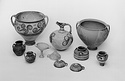
Grave A was in Layer II. We laid a skull and a few other bones, three vases and a stone bead. We have dug to a maximum of about 0.06m below the top of Layer II ... Myc. IIIA/B ... Mycenaean Double Grave (Graves A and B).
Grave A was in Layer II. ... To the South of Grave A and separated from it by a narrow wall apparently of bedrock, was part of another grave. |
| Eugene Vanderpool ... Grave. Bones discarded.
Burial lies over dromos of Mycenaean chamber tomb N 21-22:1. The roots of a tree had upturned the bones, but the head probably lay at the northeast ... Middle Geometric II ... Grave. Bones discarded.
Burial lies over dromos of Mycenaean chamber tomb N 21-22:1. |
| Susan I. Rotroff ... Grave 4 under Royal Stoa. Cist Grave cut into bedrock and lined with limestone and schist slabs. There were two layers of cover slabs with a layer of dirt between. Grave measured 0.98x0,25-0,32x0,25-0,30 ... Final Mycenaean/Submycenaean |
| Mycenaean Burial.
The cutting was roughly rectangular (1.60 by 0.50m) and was once covered with rough stone slabs, two of which were found over the body. The skeleton, presumably that of a man, lay in ... Myc. III A-B ... Mycenaean Burial.
The cutting was roughly rectangular (1.60 by 0.50m) and was once covered with rough stone slabs, two of which were found over the body. The skeleton, presumably that of a man, lay in a somewhat contracted position with the head at the southeast and with the offerings, two pots and a bronze knife, at this end of the grave. |
| E.D. Townsend Vermeule ... Protogeometric Grave no. 2 at North of Temple of Ares (Grave XXXVII). Rectangular stone-lined pit in filling of Mycenaean chamber tomb (J 7:2); the skeleton of a boy. Cf. P 21275 which is from the "preliminary ... Middle Protogeometric ... Protogeometric Grave no. 2 at North of Temple of Ares (Grave XXXVII). Rectangular stone-lined pit in filling of Mycenaean chamber tomb (J 7:2); the skeleton of a boy ... P 21275 which is from the "preliminary exploration" of protogeometric burial on the north side of the Temple of Ares, not within this grave. More likely belonging to J 7:1 BIS. |
| Dorothy Burr Thompson ... Grave 28 in notebook. (E.L. Smithson: Grave V: SM). No remains, probable child inhumation. Just one cup for offering (P 7693). Negs. X-77, X-78 ... Final Mycenaean/Submycenaean/Early Protogeometric |
| Rodney S. Young ... Destroyed urn cremation. No remains. Originally assigned as part of Tomb C 9:14 (Grave 7)
JP
"Large fragments of an urn were found in the packing of a Hellenistic water channel which cut through a LPG ... Final Mycenaean/Submycenaean |
| Susan I. Rotroff ... Grave 2. Adult female inhumation. Grave extending under the south retaining wall of the Temenos of the Royal Stoa. It is oriented ne-sw, with head at sw. Grave built of slabs of schist, with packing of ... Final Mycenaean/Submycenaean |
| Mycenaean Grave at SE corner of Pier 12 (Burial 9).
There are no traces of dromos, which must have been located at the north and have been cut away by the trench four the south stylobate of the Square ... Myc. III A:1 ... Mycenaean Grave at SE corner of Pier 12 (Burial 9).
... The walls were preserved to a height of 0.065m, and the grave was full of broken bedrock with a little soft brown silt around the bones. The broken bedrock plus the presence of more than one burial is certain indication of a chamber tomb rather than a pit grave. The two skeletons lay along the east side, more or less in order, with the bones resting directly on the bedrock floor |
| Susan Rotroff ... Grave 1. Burial of a child perhaps 6 years old, covered by broken amphora. Skeleton lay extended on its back, oriented N-S, with head at south. No grave gifts. PD 2207 ... Final Mycenaean/Submycenaean |
| Dorothy Burr Thompson ... Grave 23 in notebook (E.L. Smithson: Grave IV: SM). Few bones: discarded. JP says 46/ΜΖ-MΗ
Negs. KK 99, KK 100, KK 101, X-61, X-62, X-63 PD 433 ... Final Mycenaean/Submycenaean |
| Dorothy Burr Thompson ... Grave 25 in notebook. (E.L. Smithson: Grave I: SM). Bones discarded. In some records as Grve XIV (JP)?
Notebook says (p. 947) contents: hard earth, no bones. Lisa's list says bones discarded.
Negs. X-75, ... Final Mycenaean/Submycenaean |
| Eugene Vanderpool ... Grave (E.L. Smithson: Grave XXXVIII: PG)
Shallow oval cutting in natural bedrock lintel of Mycenaean chamber tomb O 7:5, containing a large two-handled cooking pot. Within, the unburned bones of a foetal ... Developed-Later Protogeometric ... Grave (E.L. Smithson: Grave XXXVIII: PG)
Shallow oval cutting in natural bedrock lintel of Mycenaean chamber tomb O 7:5, containing a large two-handled cooking pot. |
| Susan I. Rotroff ... Grave 5. Adult (female?) inhumation.
Cist grave lined and covered with slabs of limestone, sandstone and schist. Cut into virgin soil under Royal Stoa at I/12,13-5/3,4. Grave measures 1.79x0.39-0.49x ca ... Final Mycenaean/Submycenaean |
| Kevin Daly ... Grave in north room of Roman temple, west of well J 2:4; adult inhumation ... Late Helladic IIIC Late-Final Mycenaean/Submycenaean |
| Eugene Vanderpool ... E.L. Smithson: Grave XXXV. Adult female inhumation. Deposit summary and notebook write at 31/Θ-I ... Final Mycenaean/Submycenaean-Early Protogeometric |
| Dorothy Burr Thompson ... Grave 4 in notebook. (E.L. Smithson: Grave XLIV). No remains (not really a grave, note on p. 331).
Roughly rectangular patch of unworked fieldstones, measuring about 1.20x0.80m neatly laid on bedrock, ... 19-21 March 1932 ... Grave 4 in notebook. ... Smithson: Grave XLIV). No remains (not really a grave, note on p. 331).
... The similarity of this feature to funerary deposit/ Q 8:12 in the cemetery along the south bank of the Eridanos, and in close proximity to Mycenaean and Early Iron Age graves, suggests that both deposits are funerary in nature. |
| Marcie Handler ... This deposit is a Mycenaean cist grave with two cover slabs, a type of burial described by Immerwahr in Agora XIII (pp. 103-104). Cist graves appear side by side with chamber tombs in the Mycenaean cemeteries ... LHIIB-LHIIIA:1 ... This deposit is a Mycenaean cist grave with two cover slabs, a type of burial described by Immerwahr in Agora XIII (pp. 103-104). Cist graves appear side by side with chamber tombs in the Mycenaean cemeteries of the Agora.
The cutting for the grave measured 1.80m long (E to W) and 1.06m wide (N to S). |
| Mycenaean Grave to W of Pier 12 (Burial 11).
The northern part of the tomb had been cut away by the foundation trench for the south stylobate of the Square Building that preceded the Stoa, and the dromos, ... Myc. IIB-IIIA:1 ... Mycenaean Grave to W of Pier 12 (Burial 11).
... Although it might be argued from the single internment and the absence of any preserved dromos that this was a pit grave, the location of the body along the edge of the cutting would seem rather to indicate a small chamber tomb that has been cut away at the north. |
| Mycenaean Small Chamber tomb.
The cist measures 1,90m E to W, 0.75-0.90m N to S, max. depth -1.30m. Nothing was found in it; cleaned in modern times and used as a cesspool. Some of the SW part of it had ... Myc. IIIA, early 14th c. |
Mycenaean burial, disturbed (Piers 12-13 east). Plan unclear.
Bones discarded.
It was found in the trench for the east stylobate of the Square Building. It was so badly disturbed by the Classical builders ... Myc. IIIA:2 ... Mycenaean burial, disturbed (Piers 12-13 east). ... It was so badly disturbed by the Classical builders that it is impossible to tell anything about the plan, whether it was a small chamber tomb or a pit grave. |
| Homer A. Thompson ... PG grave north of Stoa Pier 19 (Grave 6). In some records as Grave XLIII.
Unlined rectangular pit cut into a shallow depression in bedrock that was formed by the collapse of the roof of Mycenaean Chamber ... Developed Protogeometric ... PG grave north of Stoa Pier 19 (Grave 6). In some records as Grave XLIII.
Unlined rectangular pit cut into a shallow depression in bedrock that was formed by the collapse of the roof of Mycenaean Chamber Tomb Q 8:8. ... On the floor of the pit, " a few bones and the skull" of the deceased were encountered, the cranium evidently at the south end of the grave. Fieldstones filled the tomb pit and the depression to the level of the undisturbed bedrock surrounding it. |
| Eugene Vanderpool ... Grave (E.L. Smithson: Grave III: SM).
The close proximity and similarity of this tomb and tomb M 16-17:1 strongly suggests that they were intentionally laid out in relation to one another and were contemporary ... Late Mycenaean/Submycenaean-Earliest Protogeometric |
| Eugene Vanderpool ... Grave (E.L. Smithson: Grave II: SM).
Unlined trench, roughly the size of the deceased, cut into bedrock to a depth of just over 1.50m. Oriented north-south, the tomb pit measured 1.69m in length (length ... Late Mycenaean/Submycenaean-Earliest Protogeometric |
| Susan I. Rotroff ... Burial 3 beneath the floor of the Stoa Basileios. It consisted of a rectangular pit cut into bedrock to a depth of 0.44m, lined on all sides and covered with an admixture of narrow stone slabs of soft ... Final Mycenaean/Submycenaean |
| Mycenaean Tomb to NE of Pier 19 (Burial #1)
Most of the doorway and the dromos had been cut away by the ancient Stoa builders. The dimensions of the chamber were 2.90m wide by 1.60m deep. Unusual features ... Myc. III A:1 ... Mycenaean Tomb to NE of Pier 19 (Burial #1)
Most of the doorway and the dromos had been cut away by the ancient Stoa builders. ... Unusual features of the tomb were a small recess in the back or south wall, in which stood the askos, and a rough stone slab which was found on the floor near the center of the east side, but which may once have been a grave marker at ground level.
|
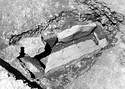
| Mycenaean Chamber Tomb occupies a considerable part of the western half of section ΕΕ; lies about half way up the north slope of the Areopagus towards its eastern end, just below the highest point of the ... Myc. III A:1 ... Mycenaean Chamber Tomb occupies a considerable part of the western half of section ΕΕ; lies about half way up the north slope of the Areopagus towards its eastern end, just below the highest point of the hill. ... There is only one grave cutting in the floor of the chamber, neatly placed in the SW corner (1.80m length; 0.60m width; 1.20m depth). ... Body and offerings were removed from the grave not long after they had been placed there (Mycenaean times); the chamber must had been entered by digging down from the top in the western half. |
| Mycenaean Chamber Tomb below Middle Stoa Terrace.
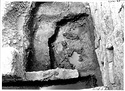
The tomb was entered from the west by a stepped dromos, at least 4.20m long by 1.10 to 1.50m. wide, splaying slightly toward the doorway, which was 1.26m ... Myc. IIIA:1 ... Mycenaean Chamber Tomb below Middle Stoa Terrace.
... The doorway was found blocked with a stone packing, which included near its top a broken conglomerate grave marker, and which proved to have been erected at least three times; during one of the occasions of reopening, the doorway was widened 0.20m to the north. |
|
|