|
|
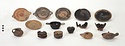
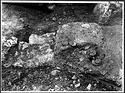
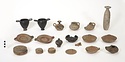
| Pyre in House C, Room 8 (RSY=Pyre 6).
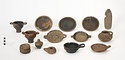
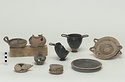
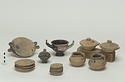
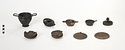
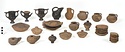
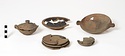
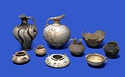
Near east corner of room 8. Artifacts, burnt bone, burnt sticks, and large cinders in a shallow pit dug into surface of layer 3, and covered by layer 2. Some cinders ... 350-325 B.C.-end of 4th c. B.C ... Artifacts, burnt bone, burnt sticks, and large cinders in a shallow pit dug into surface of layer 3, and covered by layer 2. Some cinders from pyre in layer 2. These strata lay above the first floor of the third phase of the house. |
N-S Cut on 50m. line (area of Road, area of Stoa, area N of Stoa) various levels and dates over the three areas.
Investigations to the northwest of the market square in the area of the road running out ... Prehistoric to Roman ... A.D.
Layer II: 1st-2nd c. ... B.C., Geometric, Helladic
Layer IX: Late-Middle Helladic
See also cut on 20m. line (F-G 3:1) ... Coins:
8 March 1939 #1 (stoa, layer IV), #2 (stoa, layer V), #3 (road, layer VI)
9 March 1939 #1-#1a (road, layer VII), #2 (stoa, layer VII)
10 March 1939 #1-#2 (road, layer VII-VIII), #3 (road, dump) |
| James Artz Pirisino Daniele Kylindreas Miltiades ... Excavation in Room 3 of ΒΘ West revealed 5 ceramic vessels in a row against the eastern face of Wall 12. 3 complete vessels (ΒΘ 122, 124, and 125) were catalogued, along with the base of a plain glazed ... 9th-11th c. A.D ... Excavation in Room 3 of ΒΘ West revealed 5 ceramic vessels in a row against the eastern face of Wall 12. 3 complete vessels (ΒΘ 122, 124, and 125) were catalogued, along with the base of a plain glazed flat-bottomed basin (ΒΘ 121). ... The fill in Room 3 was uniform in consistency, and no floor levels were found. The approximate elevation at which the 3 complete vessels were found was 53.630. |
Destruction Layer, Brick Building.
It represents material from the layer of fallen brick covering the floor and wall socles of the Brick Building and therefore marking the destruction of the structure ... To ca. 165 ... Destruction Layer, Brick Building.
It represents material from the layer of fallen brick covering the floor and wall socles of the Brick Building and therefore marking the destruction of the structure. ... Coins:
14 February 1936 #1
15 February 1936 #2
21 February 1936 #1, #3
22 February 1936 #1 |
Within the precinct of the Hephaisteion, about 10m. north of the north stylobate of the temple.
Flask-shaped pit (W. (bottom) 3.14 x 2.73m) probably originally intended as a cistern; used for dumping ... Ca. 375-310 B.C.-Byzantine ... At 1.60m. a layer of stones, also containing some pottery, had been dumped in over the furnace waste. ... Subdivisions:
.1=Layer I, top (Mid-late Byzantine)
.2=Layer II of stones
.3=Layer III, bottom |
Road SE of altar, below 51.56m.
In 1981, p. 1883: "A single pass, ca. 0.03m. thick and we hit another surface, at 51.56m. which we take as Layer XV. Fairly loose gravelly fill under surface, sandy, greenish ... 1st c. B.C ... In 1981, p. 1883: "A single pass, ca. 0.03m. thick and we hit another surface, at 51.56m. which we take as Layer XV. Fairly loose gravelly fill under surface, sandy, greenish and deep. Masses of pottery at J/5-3/15,16." and "Patch of fill to south at a level of ca. 51.62m. which we take down ... Similar gravel and sand and sherds as above." ... A note on p. 1961 of the field notebook: "Same as Layer XV, p. 1883" justifies including the finds from that layer in this deposit. |
N-S Cut on 20m. line (area of Road, area of Stoa, area N of Stoa)
various levels and dates over the three areas.
Investigations to the northwest of the market square in the area of the road that bordered ... Protogeometric to Late Roman ... A.D.
Layer V: "Augustan"
Layer VI: chiefly 4th c. ... Area of Stoa:
Layer I: Early Roman
Layer II: Hellenistic
Layer III: 1st c. ... B.C.
Layer V: 8th-7th c. |
| "Koumanoudes' Well.
Tile-lined well (diam. 0.85m) at SE corner of courtyard of Roman House E, at top built wall of stones and mortar, bedrock at bottom. Coin
7 August 1971 #495-#500
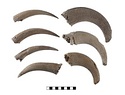
13 August 1971 #507 ... 28 July-6 August 1971 ... Layer 1 :0-13.20 Backfill from Koumanoudes' excavation ... Layer 2: 13.20-15.05 Destruction (Herulian) debris, plaster, revetment, bones, horns. ... Layer 3:15.05-16.20 POU. |
| Classical dump at N/1,6-6/6,8.
Layer 14 in Early Trench E. A tremendously thick layer of dumped fill with ceramic contents ranging down through the second half of the 5th century and into very early years ... Late 5th c. (Early 4th c.) |
Crosscut between Middle stoa Piers 1 and 2 from west (south aisle), layer II.
Chiefly late 5th to mid-4th c. B.C. Coins:
2 July 1965 #1 ... Late 5th to mid-4th c. B.C. |
Accumulated fillings in the Bouleutrion Plateia beginning in late 5th c. B.C. and continuing into the 3rd c. A.D., reaching a depth of 0.20-0.30m. (Hesp. 6 (1937), p. 168. Subdivisions:
.1=Layer I
.2=Layer ... 5th c. B.C.-3rd c. A.D ... Subdivisions:
.1=Layer I
.2=Layer II
.3=Layer III
.4=Scraping Bedrock |
Early Roman pit at P/7-6/4,6
layer Ia in Room 7 of Greek House δ. Black earth fill with much carbon.
Plaster, nails, glass, bones (also bones from deposit P 6:4).
Coin
5 June 1971 #395 ... Early Roman |
A great shaft 2.65m in diameter and over 10m deep cut out in the mid 1st c. to serve in some connection with the Brick Shaft system (U 22:1). Filled in to top (layer 2) in late 1st- early 2nd c. A.D. with ... 18 March 1937,
1-13 April 1937,
24 May-14 June 1937 |
Fillings below the courtyard floor of the Poros Enclosure west of the Areopagus. The lowest layer, over bedrock, is of the archaic period and may have accumulated on the spot before the start of building ... First half of 5th c. B.C ... The lowest layer, over bedrock, is of the archaic period and may have accumulated on the spot before the start of building operations. ... Subdivisions:
.1=layer 1, surface
.2=layer 2
.3=layer 3 |
| Pyre in north central room of house, measuring 0.50m east-west by 0.35m north-south. Pottery, bone, and burnt material in pit dug into layer IIb (crushed bedrock floor: lot Ω 464, 4th c.) and covered by ... 350-325 B.C. |
| Mycenaean Double Grave (Graves A and B).
Grave A was in Layer II. We laid a skull and a few other bones, three vases and a stone bead. We have dug to a maximum of about 0.06m below the top of Layer II ... Myc. IIIA/B |
| Dumped filling mostly of 3rd c. A.D., but dumped as late as 5th century. Nbp. 143: The fill in this cistern was of three kinds: to within .60m. of the floor plain broken bedrock with no sherds; then a ... 10-17 February 1937 |
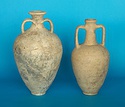
| Marcie Handler ... A deposit of six amphorae and one micaceous water jar was excavated between 20 June and 6 July 2005 in the area north of Wall K. The neck and one handle of one of the amphorae (BZ 1213) had been poking ... Ca. 1st c. A.D. |
Nbp. 3104: When dug, the fill of the well divided itself into 3 deposits.
Objects catalogued from the "earth" are: L 4838, P 21602, P 21603, P 21604. Dumped filling of Turkish times. Coins:
17 May 1937 ... Late 6th-7th c. A.D. |
| Julia Shear ... Burial. Roman Temple south half, in fill south of temple crosswall and norh of polygonal wall, layer 37a.
Small, roughly circular pit. The diameter of the pit appeared to be only slightly greater than ... Late Helladic IIIC Late-Final Mycenaean/Submycenaean |
| Pyre in House T, Room 2 through floor of second period (RSY=Pyre 5) in the industrial area west of the Areopagus.
4th. c. BC.
Concentration of artifacts, burnt bone, and charcoal in floor makeup consisting ... 375-350 B.C ... The pyre was partly covered by a pebble floor associated with phase 3 of the house, but the fill in which it was found cut through a floor associated with the second phase, and it predates the abandonment of the house substantially. The artifacts rest on a heavy layer of charcoal and ash, with burnt bone throughout, suggesting burning in situ. |
| Tiled Well at S edge of E-W Road, 73/ΜΗ. Contemporary upper and lower fills separated by layer of sterile mud.
Latest coin dates ca. 200. Koan amphora handle with stamped handle dates slightly after 200 ... 210-160 |
| Artifacts, burnt bone, ash, cinders and charcoal in pit in bedrock. The pyre lay directly under mosaic floor A. the deposit is not badly disturbed, however, and it is possible that it was laid immediately ... Early second quarter of 4th c. B.C. |
"Foundry Pit": N-S Cut on 50m. line (area of Stoa, Layer VII, with slag). A foundry pit in the courtyard of a small metalworking establishment outside the Agora to the northwest.
Both the courtyard and ... Ca. 375-350 B.C. |
| Pyre in Horos Terrace Trench, East end, set into Strosis 5.
In room 1 (court), near north wall. Concentration in stratum, no pit discerned; described as a "little nest of pots" within layer V (Lot ΜΣ ... 350-325 B.C. |
| Well cut into bedrock, associated with late Roman building G in ΕΛ 1.2m in diameter, narrows to 0.5m at bottom. Disturbed by later pits at top. Excavated from 85.77-79.25m (6.52m), but bedrock at 85.91m ... Late 4th/early 5th AD |
Accumulated debris on the west side of the market square.
Related layers added 1999/2000 (JWH), e.g. "Gravelly layer above burning", "Clearing Classical floor", "Lowest level above bedrock", "Below burning", ... First half of 5th c. A.D ... "Gravelly layer above burning", "Clearing Classical floor", "Lowest level above bedrock", "Below burning", etc.
... Apparently the burnt layer runs through sections Α, ΟΕ and Ε as well. ... Coins:
4 March 1933 #1-#4
8 March 1933 #1-#2
9 March 1933 #1-#12
10 March 1933 #1-#9 and #10-#12
11 March 1933 #1-#17 (Below burning)
13 March 1933 #1-#3 and #4-#7 and #8
14 March 1933 #1-#3
15 March 1933 #1-#4
16 March 1933 #1-#29 (above burning) and #30-#44 and #45-#48
17 March 1933 #1-#68 and #69-#88
18 March 1933 #1-#14 (above burning) and #15-#17
20 March 1933 #36-#50 and #51-#53
21 March 1933 #1-#51 and #52-#59
22 March 1933 #45-#92 and #106-#108
23 March 1933 #1-#12
24 March 1933 #1-#20
28 March 1933 #1-#29
31 March 1933 #1-#7
1 April 1933 #3-#13
3 April 1933 #1-#3 and #4-#7
5 April 1933 #22
10 April 1933 #3-#27 (SE corner of Dorpfeld's Stoa Bas.)
11 April 1933 #1-#38
12 April 1933 #38-#39 (SE corner of Dorpfeld's Stoa Bas.)
20 April 1933 #7-#14
21 April 1933 #13-#17
22 April 1933 #6-#20 (#19, #20 from dump)
24 April 1933 #2-#6
25 April 1933 #2-#4
26 April 1933 #1-#3
27 April 1933 #1-#7 and #8-#12
28 April 1933 #1-#6
3 May 1933 #5-#123
4 May 1933 #1-#21 and #22-#42
5 May 1933 #1-#22
6 May 1933 #1-#2
8 May 1933 #26
9 May 1933 #5-#6
12 May 1933 #1-#73
13 May 1933 #1-#9
15 May 1933 #1-#22
16 May 1933 #1-#13 and #17-#18
17 May 1933 #6-#16 and #17-#19 and #20-#32
18 May 1933 #1-#10 (Lowest layer above class. floor)
19 May 1933 #1-#15 and #16-#19
20 May 1933 #1-#21 and #22-#29
22 May 1933 #1-#62
23 May 1933 #1-#34 and #35-#36
24 May 1933 #1-#6
27 May 1933 #1-#25 and #26-#28
29 May 1933 #1-#31 and #32-#33
30 May 1933 #1-#5 and #6-#11
31 May 1933 #1-#5 and #6-#8
1 June 1933 #1-#15 and #19-#22
2 June 1933 #16-#33 and #35-#37
3 June 1933 #1-#9
5 June 1933 #1-#22 and #23-#25 and #27-#28
6 June 1933 #1-#3 and #9-#11 and #12
7 June 1933 #29 (disintegrated)
8 June 1933 #24
9 June 1933 #1-#2
15 June 1933 #9-#13 |
May be of Hellenistic origin when cistern system went out of use.
For a general note on the cistern see Nb. ΟΕ III, pp. 246 ff.
Objects from B 586 various depths (no subdivision): S 2324-S 2330,
P 34894, ... Late 2nd-early 6th c. A.D ... Subdivisions:
.1=Layer VIII
.2=Layer VII
.3=Layer VI
.4=Layer V
.5=Layer IV
.6=Layer III
.7=Layer II
.8=Layer I
Estimated Grid |
Pit in House T, Room 3 (through layer 6), in the industrial area west of Areopagus. Very likely pit may have been respectable archaic context, but nothing to go on beyond the two catalogued pieces (LT ... Ca. 500-480 B.C ... Pit in House T, Room 3 (through layer 6), in the industrial area west of Areopagus. ... No container for this pit, and also apparently none for layer 6? Layer 5 us described as "5th-4th c. |
| Use filling of middle of 1st to late 6th c. (Roman Group M); dumped filling of 9th and 10th c. Down to a depth of about 21.00m. the fill of the well contained very few objects, the latest of them being ... 1st-6th c. A.D ... Coins:
5 April 1937 #1-#3
6 April 1937 #1-#7
7 April 1937 #1-#32
8 April 1937 #1-#82
9 April 1937 #1-#4
10 April 1937 #1-#3
12 April 1937 #1-#2
13 April 1937 #1
14 April 1937 #1-#14
15 April 1937 #1-#9
16 April 1937 #1-#7 ... Subdivisions (as recorded, .1 is at the bottom). (Layer numbers as revised by HSR, some depths indistinguishable in notebooks): .14=Layer XIV, 0.00-22.40m.
.13=Layer XIII, 21.00-22.40m.
.12=Layer XII, 22.40-23.20m.
.11=Layer XI, 23.20-26.40m.
.10=Layer X, 23.20-26.40m. [cannot distinguish depths from XI]
.9=Layer IX, 23.20-29.00m.
.8=Layer VIII, 26.40-29.00m.
.7=Layer VII, 29.00-30.40m.
.6=Layer VI, 29.00-30.40m.
.5=Layer V, 29.00-32.00m.
.4=Layer IV, 29.00-32.00m.
.3=Layer III, 32.00-32.50m.
.2=Layer II, 32.50-34.20m.
.1=Layer I, 34.20-35.30m., bottom fill. |
Investigations in Room to N of Tholos, various layers and periods. ... 470 B.C.-post-Herulian reuse ... Layer VI-X.2 Repairs at the end of 5th c. or early 4th c. B.C.
Layer V.3 Second period; reconstruction in third quarter of 4th c. ... B.C., towards end of first quarter.
Layer III and IV.5 Debris over Hellenistic floor; end of 2nd. c. |
| Well in Room 6 of Street Stoa U/2,U/3-13/15.
Associated with the building lying under the Roman Street Stoa. Its fills divided into 5 separate layers, with the bulk of finds belonging to Layer 1, the ... 14 June-21 August 1973 ... Well in Room 6 of Street Stoa U/2,U/3-13/15.
Associated with the building lying under the Roman Street Stoa. ... In this layer the bulk of sherds and vases was greater than the bulk of earth. ... It produced one box of pottery and three catalogued items.
Layer 3. 50.43m-49.93 (boxes 76-77). |
Roman Group L.
Layer I (cont. 59-64) Pre-Herulian second half of 3rd c. (bottom, 15.95-13.90).
Layer II (cont. 42-58) 4th c.-first quarter of 4th c. (11.90-13.90).
Layer III (cont. 17-41) -4th c. (10.00 ... Second half 3rd c.-early 5th c. A.D ... Roman Group L.
Layer I (cont. 59-64) Pre-Herulian second half of 3rd c. (bottom, 15.95-13.90).
Layer II (cont. 42-58) 4th c ... Layer IV (cont. 1-16) nearly 5th c. |
Early Roman pit at P/3-6/6,7
Layer 4a in Room 6 of Greek House δ, area P/2,3-6/6,8.
Pit in NW corner of Room 6 bounded by walls of Room to North and West, cut into preexisting layers to east, cutoff by ... 17 May 1971 ... Early Roman pit at P/3-6/6,7
Layer 4a in Room 6 of Greek House δ, area P/2,3-6/6,8.
|
Evidence of stratification into five layers, although joins between the layers. Layer VI added when the construction of the Roman building above required it. No subdivisions assigned.
Flask-shaped cistern ... Early 3rd-late 2nd c. B.C ... Evidence of stratification into five layers, although joins between the layers. Layer VI added when the construction of the Roman building above required it. ... Moldmade bowls with thick walls and small indistinct figures similar to those on bowls in G 5:3 and some examples in Thompson's Group C. ... Coins:
3 June 1937 #1-#4
4 June 1937 #5-#9
7 June 1937 #1-#4 |
Well by Stoa Pier 3.
Mouth was discovered in 1950 (p. 2273). Between first and second POU; no joins between the groups, which were separated by nearly sterile fill. No apparent chronological difference ... Mid-2nd c. B.C ... Well by Stoa Pier 3.
Mouth was discovered in 1950 (p. 2273). ... Above this filling, to the top of the tiles, the well contained broken bedrock, along with a few chips and pebbles, topped by a layer 50 cm deep of hard-packed dark blue clay, forming a lid, as it were, over the lower, tiled part of the well. Above this clay layer, for the lower 60cm of the unlined part of the shaft, the loose broken bedrock fill continued, followed by a meter of buff poros chips filling, with some marble chips and many water-jars, a second "workmen's period". |
| Pyre in layer 8a in SW corner of Room 7 of Greek House δ.
Oval pyre; 0.60 (n-s)x 0.35 (e-w).
The pyre was covered by the surface of layer 8 and extended slightly into layer 9 below it. Small bone fragments, ... 325-300 B.C ... Pyre in layer 8a in SW corner of Room 7 of Greek House δ.
... The pyre was covered by the surface of layer 8 and extended slightly into layer 9 below it ... No pottery remaining, bones in plastic bag in tin 212 (deposit P 6:3). |
| Pyre in layer 2a in Room 9 SE of Greek House δ. Sand, gravel, ashes, iron nails, carbon, some bones partially cut away by foundation trench of SYPE wall.
Coin
1 July 1971 #459 ... 260-200 B.C. |
| Pit in Layer 9, lined on the sides and bottom with small stones ... Late 5th c. B.C. |
"South Triangle" abandonment filling over Brown House (House A) in the industrial area. Layers 1-3 and layer 4, to floor of second period. As late as the 3rd. c. B.C. but composed largely of earlier material ... 3rd c. B.C. and earlier ... Layers 1-3 and layer 4, to floor of second period. ... Coins:
16 April 1948 #1-#2
17 April 1948 #1-#2
19 April 1948 #1-#3
20 April 1948 #1-#2 |
Beneath layer 11. "Despite its extreme irregularity this pit may be an early well, for it would seem definitely to be an artificial cutting and sherds were found in its lowest part," (Nbp. 2095).
Contemporary ... SubMycenaean |
The Building Fill had been badly disturbed and has been divided into several different lots, resulting in two main divisions: layer 5 (upper building fill) and layer 6 (lower building fill). Later investigation ... 23 June-16 July 1973 |
Filling in the footing trench of the late Roman Fortification.
Includes Layer 1 and Layer 2 of Library Colonnade opposite Room 2. "Note: both these layers are fill thrown into V.W. footing trench." (nb.p ... End 3rd. c. A.D ... Includes Layer 1 and Layer 2 of Library Colonnade opposite Room 2. ... Coins:
23 March 1933 #16-#19
24 March 1933 #4-#5(below layer of bricks 1.00m. east of
Ven. wall 24/ΙΗ)
26 April 1933 #1-#5
1 May 1933 #5-#8 (yellow fill against Venetian wall 36/ΙΑ)
27 May 1939 #6-#7
13 June 1939 #3 |
First trial east Stoa colonnade, N. of S. wall III, layer 12.
Note quantities of cattle bones, the knuckles sawn off and many worked bits. Evidently a bone implement factory near by. [nbp. 2139] Coins: ... Late 3rd c.-earliest 4th c. A.D ... First trial east Stoa colonnade, N. of S. wall III, layer 12.
Note quantities of cattle bones, the knuckles sawn off and many worked bits. ... Coins:
4 May 1939 #1-#8
20 May 1939 #1
22 May 1939 #2-#3
24 May 1939 #2-#3 |
| Pyre in House T, Room 1, Layer 5-6 (RSY=Pyre 3) in the industrial area west of the Areopagus.
First quarter 4th. c. B.C.
Artifacts, bone, and cinders in pit in floor sequence. The pyre was found in digging ... 400-375 B.C.(?) ... Pyre in House T, Room 1, Layer 5-6 (RSY=Pyre 3) in the industrial area west of the Areopagus.
... The pyre was found in digging layer 7, probably the floor associated with the second phase of the house. |
Connected with G 14:3.
There was a layer of Late Roman fill. It rested over a layer of 2nd c. B.C Hellenistic and then another of 4th c. B.C Hellenistic; the passage between the two cisterns contained ... Late Hellenistic ... Connected with G 14:3.
There was a layer of Late Roman fill. It rested over a layer of 2nd c. B.C Hellenistic and then another of 4th c. ... Coins:
16 April 1932 #4
18 April 1932 #1-#3
19 April 1932 #1-#2
20 April 1932 #1-#3
21 April 1932 #1-#4 |
A burnt deposit set down into Hellenistic fill in a shaft dug into bedrock. A consistent dumped fill [post AD 150, with Group G, layer III, JWH]. Coins:
27 January 1936 #1-#3
28 January 1936 #1-#7
29 January ... First half of A.D. 2nd c ... A consistent dumped fill [post AD 150, with Group G, layer III, JWH] ... Coins:
27 January 1936 #1-#3
28 January 1936 #1-#7
29 January 1936 #1 |
| Pyre in House N, room 4 (RSY=Pyre 7), in the industrial area west of the Areopagus.
Pottery, mall pieces of calcined bone, log, wood cinders, and charcoal in diamond-shaped pit in floor sequence. The pyre ... Late 4th-early 3rd c. B.C ... The pyre came to light just below the surface of layer 4, with the pit going down into layer 5, the floor associated with phase 3 of the house. Layer 4 ran over the foundation of the wall between rooms 5 and 6; a layer of decayed mudbrick covered layer 4. The pyre seems to have been dug into layer 4, which was then patched and continued in use. |
Layer I.
Material from trenches:
a) 1.00-7.00m. from East End of Stoa.
b) 18.40-21.40m. from East End of Stoa.
c) 46.60-48-60m. from East End of Stoa.
d) 51.00-53.00m. from East End of Stoa.
e) 79.00-81.00m ... 2nd-3rd c. A.D ... Layer I.
Material from trenches:
a) 1.00-7.00m. from East End of Stoa.
b) 18.40-21.40m. from East End of Stoa.
c) 46.60-48-60m. from East End of Stoa.
d) 51.00-53.00m. from East End of Stoa.
e) 79.00-81.00m. from East End of Stoa ... Coins:
3 August 1959 #1 |
Area I; layer I. Soft, loose destruction fill of Street Drain in front of Greek House δ. Represents closing of drain in preparation for construction of Basilica. Top elevation 55.40m at west, 55.96m at ... 1st c. A.D. |
Part of the cistern system 44/ΙΓ - 46/ΙΑ - 42/Θ.
Objects with context as "cistern 44ΙΓ, mouth of 46/ΙΑ" are listed with D 12:2.
The following objects are from "earth", i.e. no context layer:
SS 5334, ... Late Hellenistic-Early Roman ... The following objects are from "earth", i.e. no context layer:
SS 5334, SS 5336, SS 5343, SS 5438, SS 5441, SS 5442, SS 5444, SS 5446, SS 5635, SS 5740
LL 2130, L 2132, L 2188
T 1045, T 1067
P 7138
Nineteen stamped amphora handles; many late 2nd c. lamps ... Coins
29 February 1936 #3 (from mouth)
2 March 1936 #1
3 March 1936 #7
5 March 1936 #4-#5
6 March 1936 #1-#3
7 March 1936 #1-#4
9 March 1936 #1-#3
10 March 1936 #1-#2
11 March 1936 #1
From "earth":
12 March 1936 #6
13 March 1936 #1-#2
14 March 1936 #1-#7
16 March 1936 #1
17 March 1936 #1-#3
18 March 1936 #1-#2 ... Subdivisions:
.1=upper fill
.2=middle fill
.3=lower fill |
| Hellenistic Pyre below packed clay floors of Room 2; west of Late Roman wall extension, below tile platform terracotta drain installation, bordered on the north by bedding foundation stones of crosswall ... Ca. 300 B.C ... Hellenistic Pyre below packed clay floors of Room 2; west of Late Roman wall extension, below tile platform terracotta drain installation, bordered on the north by bedding foundation stones of crosswall between rooms 2 and 3 ... Pyre pots mostly smashed, in a layer of ash and carbon defined as half of a circle. |
| David Scahill ... Below packed clay floors in Room 2 of Classical Building II; bordered on east and south sides by polygonal cross wall and back wall extension for Classical Building. Late Roman wall and drain installation ... LHIII A:1 |
| Pyre 1 in Central House, Room XI, strosis 3. Sacrificial pyre with characteristic small vases amid carbonized twigs and bone.
Near north side of courtyard. This pit was cut slightly into strosis 3 (lot ... 1st quarter 4th c. B.C ... Pyre 1 in Central House, Room XI, strosis 3. Sacrificial pyre with characteristic small vases amid carbonized twigs and bone.
... This pit was cut slightly into strosis 3 (lot Φ 231), a 5th c. floor associated by the excavator with phase 2 of the house. ... The pyre is approximately contemporary with the renovation of the house that initiated phase 3 in the first half of the 4th c., so it could be associated with that event. |
Cistern on lower northeast slope of the Areopagus.
Two Hellenistic fills with late Hellenistic to Roman fill above.
Use fill characterized by broken water jars (lower fill); contemporary dump (middle fill); ... Early 1st c. B.C ... Use fill characterized by broken water jars (lower fill); contemporary dump (middle fill); nearly sterile layer (probably part of middle fill); Roman upper fill.
... Subdivisions:
.1=top and intermediate fills, to 2.00m.
.2=middle fill
.3=bottom fill |
Burnt Layer inside retaining wall of Middle Stoa Terrace (Θ) and NW Corner of Middle Stoa, burnt debris inside terrace retaining wall (Ζ). Coins Ζ: Coins Θ:
1 June 1951 ... Mid-3rd c. A.D. |
A filling lying over a cobbled floor in a house-complex on the lower north slopes of the Areopagus.
Area in front of E-W retaining wall, just above cobble pavement, disturbed by coins and pottery as late ... 375-275 B.C ... Coins:
21 May 1932 #2
25 May 1932 #6-#7
26 May 1932 #1-#3 ... SS 367 listed on deposit list but actually from topmost layer in this area, not 'just above cobble pavement'. |
Cistern-chamber on the northwest side of Kolonos Agoraios, 10 to 12m west of the end of the Hellenistic Building. Dimensions at bottom 2.50m x 2.75m.
The west chamber of a cistern system composed of two ... Use filling early 1st-2nd c. B.C ... This deposit is recorded layer I=bottom and the Subdivisions uncharacteristically follow this order due to previous publication. The notebooks show layer I to be the top, however.
... B.C.
.2=Dumped filling second half 1st c. A.D.
.3=Top. Dumped filling of late 1st-early 2nd c. |
| Pyre in House D, Room 4 (RSY=Pyre 4) in the industrial area west of the Areopagus.
Notebook refers to House N.
Pottery belongs late in third quarter of the 4th. c. BC. Pyre burned near beginning of last ... 350-300 B.C ... The pyre pit was dug through layer 1 and into layer 2, both of which overlay the foundation of the wall between rooms 3 and 4. |
| "Room D" is the triangular area at L/15,16-2/10,12, NW of Wall 1, in E corner of basement of No.3. Hastings Street, bounded by the NE and SE walls of basement).
Bell-shaped vessel built of horizontally-laid ... 10th-11th c. A.D ... "Room D" is the triangular area at L/15,16-2/10,12, NW of Wall 1, in E corner of basement of No.3. Hastings Street, bounded by the NE and SE walls of basement).
Bell-shaped vessel built of horizontally-laid broken tile and small field stones, the lowest course of stones resting on a hard-packed yellow clay layer. The vessel is unlined and so may have been intended for drainage rather than for storage. |
| Rodney S. Young ... Grave 3 in notebook (E.L. Smithson: Grave XIII: PG). Urn cremation (trench-and-hole), adult female.
JP
Rectangular trench, measuring approximately 1.10x0.45m, but which may have been larger, cut through ... Late Protogeometric ... Grave 3 in notebook (E.L. ... "Burned earth" fired red with the odd pyre sherd noted on the floor and spilling into the urn-hole". 2. layer of ash and charcoal. 3. |
| Rubbish Pit . Pit cut through a house floor. In courtyard, beside door to room 3. Artifacts, bone and scattering of large cinders in roughly rectangular pit dug through floor bedding and covered by red, ... 325-300 B.C ... In courtyard, beside door to room 3. Artifacts, bone and scattering of large cinders in roughly rectangular pit dug through floor bedding and covered by red, Hellenistic fill, below a layer of decayed mudbrick. |
Built against the south wall of the annex to the Poros Building
west of the Areopagus. At the west the upper layer of marble chips carried against it, the lowest were cut by it.
Part of same system as ... 225-100 B.C ... At the west the upper layer of marble chips carried against it, the lowest were cut by it.
Part of same system as D 17:3 and D 17:4.
Object B 874 is from the top fill but not related to the upper or lower fills proper; no subdivision. |
| Marcie Handler ... This pyre was found in the fill under Pyre J 2:23. Unfortunately, no floor surface was found between the two pyres. There were no complete vessels in this pyre. The sherds of the pyre vessels were mixed ... 275-250 B.C. |
| Anne McCabe ... Enchytrismos burial of an infant in Byzantine Room C, L/15-2/13, at 52.915m. Although disturbed by roots, the skeleton (AA 373) was articulated and lay parallel to Wall 1, with head at the NW and feet ... 14-15 June 2007 ... The skeleton was covered by a heap of coarse sherds (Lot ΒΗ 504) including a large one decorated with incised lines. The layer in which the burial was set, and into which the footing trench along the N face of Wall 23 appears to have been cut,, was excavated from 52.911-52.555m with no soil change (Lot ΒΗ 505). ... Another infant burial was found nearby in 2006 (Deposit L 2:3). |
| Rodney S. Young ... Grave 20 (E.L. Smithson: Grave X: PG). Bones discarded. Pit tomb, inhumation (on bier or in coffin?), perhaps of a child. Little ash and carbon in the filling, but the grave offerings were unburned.
JP ... Developed Protogeometric ... No trace of formal tomb covering.
3 distinct strata of the fill:
a) Upper half, to a depth of 0.40m, redeposited bedrock chips mixed with earth. ... It was in this layer that five of the six pots associated with the grave were encountered, toward the SE corner. The se pots, all unburned and clustered together, would have been placed in the area immediately above the feet of the deceased.
c) in the lowest 0.30m, very damp earth with very little ash, much heavy black matter "of a different character", from that in the layer above.
The small finds associated with the tomb suggest a child, whereas the size of the tomb pit indicates an adult. |
|
|