|
|
Late pit in bedrock ... Late Byzantine-Turkish? ... Late pit in bedrock. |
L 1079 and L 1080 are identified as from a pit at 29/ΝΓ. L 1082 and P 2130 are from a pit at 26-29/ΜΘ-ΝΑ. Probably the same pit as indicated on a note in deposit cardex. The finds are recorded together ... 5th c ... Late Lime Pit |
| Roman Pithos at 38/ΛΔ. Cf. also Ψ734 (P 14037) from late pit at 41/ΛΓ ... Early to Middle Roman ... Cf. also Ψ734 (P 14037) from late pit at 41/ΛΓ. |
Late Roman Pit. No clear page reference but see nbpp. 1308-1309 ... 22-29 July 1957 ... Late Roman Pit. |
Pit at 36/ΙΖ ... Late Hellenistic to Early Roman ... Late Hellenistic to Early Roman Pit |
Rectangular pit (in Trench IX); dumped filling of late 5th. c. B.C. with some disturbance as late as Early Roman. P 18559 and P 18510 from above this pit ... 5th c. B.C ... Rectangular pit (in Trench IX); dumped filling of late 5th. c. B.C. with some disturbance as late as Early Roman ... P 18559 and P 18510 from above this pit. |
Pit 4 in Grave area (= Cistern). Not completely cleared. Filling probably late Hellenistic, though with some earlier material ... Hellenistic ... Pit 4 in Grave area (= Cistern). ... Filling probably late Hellenistic, though with some earlier material. |
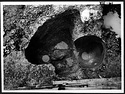
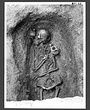
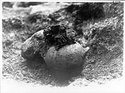
Disturbed pit with a skull. Pottery discarded. Late context; more likely Turkish than Geometric.
See Hesperia 14 (1945), p. 303 for skull description ... 4 May 1936 ... Disturbed pit with a skull. Pottery discarded. Late context; more likely Turkish than Geometric.
|
Pit in floor of cellar of House 634/19. Contents mixed to late Roman. Pottery 4th c. B.C. to 4th c. A.D. discarded ... 25 April 1958 ... Pit in floor of cellar of House 634/19. Contents mixed to late Roman. |
Found while cleaning wall running east-west over 57. Contained late glazed pottery ... Byzantine |
| Pit and drain at SE corner of Apollo Temple. Antedates building of Apollo Temple which was assigned to a date 'late in the third quarter' ... 3rd quarter 4th c. B.C ... Pit and drain at SE corner of Apollo Temple. Antedates building of Apollo Temple which was assigned to a date 'late in the third quarter'. |
Mixed filling in a well cut rectangular pit. Debris of the second half of the 5th. c., deposited as late as the second quarter of the 4th. c. B.C ... 4th c. B.C. and earlier ... Mixed filling in a well cut rectangular pit. Debris of the second half of the 5th. c., deposited as late as the second quarter of the 4th. c. |
A fair-sized pit in bedrock in Stoa Terrace opposite Pier 18, which contained a good deal of pottery mostly coarse. A little additional material as late as second quarter 4th. c. B.C ... Ca. 425-400 B.C ... A fair-sized pit in bedrock in Stoa Terrace opposite Pier 18, which contained a good deal of pottery mostly coarse ... A little additional material as late as second quarter 4th. c. |
Pit 6 in Grave area. South cut, Metroon Section. Pit with burning ... Late 5th. c. B.C. |
Refuse pit at 51/Ζ; it had been partly cut away at the north by the late Roman retaining wall; the dumped filling a homogeneous deposit of figured, black and plain wares. Red figure oinochoe in the style ... Ca. 450-420 B.C ... Refuse pit at 51/Ζ; it had been partly cut away at the north by the late Roman retaining wall; the dumped filling a homogeneous deposit of figured, black and plain wares. |
Pit in bedrock at SE corner of cut at N end of Stoa Terrace.
Small irregular pit, extending under Stoa foundations, containing a number of black-figured pieces ... Late 6th c. B.C. |
| A flask-shaped storage pit or cellar, cut in the rock at the south edge of the levelled top of Kolonos Agoraios. Filled late in first quarter of 6th. c. B.C. (2.95m from east to west by 2.70m from north ... First quarter 6th. c. B.C ... A flask-shaped storage pit or cellar, cut in the rock at the south edge of the levelled top of Kolonos Agoraios. Filled late in first quarter of 6th. c. |
Upper fill (top to around 4.50m.) was in a pit of large dimensions above the preserved well shaft. From the bottom and shaft proper no catalogued pottery. No tiling in place in well but fragments of tiles ... 3rd-4th c. A.D. |
| Kevin Daly ... Grave in north room of Roman temple, west of well J 2:4; adult inhumation ... Late Helladic IIIC Late-Final Mycenaean/Submycenaean |
Deposit associated with early walls West of the Stoa of Attalos ... Late 5th c. B.C. (?)- early 4th c. B.C. |
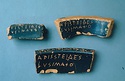
Ostrakon Pit (Horos Terrace Trench). Oval pit cut into bedrock. Packed filling of stones, coarse sherds and roof tiles; among these a few fragments of finer vases and 22 ostraka, probably from the ostracaphoria ... Ca. 490-480 B.C. and later ... Ostrakon Pit (Horos Terrace Trench). Oval pit cut into bedrock. ... A single fragment of a red-figured lid (P 23018) indicates that the filling of the pit must have taken place as late as the last years of the century (Deposit nb).
|
A circular cutting in bedrock ... Late 6th-early 5th c. B.C. |
Nb page 5044: Great shapeless pit with a well (62/Ξ) at its bottom which we were unable to dig because it was too dangerous. Fill in the pit was of sand and white ash. The finds and pottery 4th. and perhaps ... Late 4th.-early 3rd. c. |
Chronology mixed to late Roman ... Roman |
| Laura Gawlinski ... Circular pit uncovered in Early Building II, south of Room E latrine, adjacent to the preserved latrine floor surface. Continues beneath the latrine surface and the western scarp (unexcavated). Fill relatively ... Late 5th c. B.C. |
Well 6 = Pit 6 under Church but it antedates the church. Late Byzantine or early Turkish. Coins:
17 March 1936 #4-#5
18 March 1936 #5 ... Late Byzantine ... Well 6 = Pit 6 under Church but it antedates the church. Late Byzantine or early Turkish. |
| Pit in Layer 9, lined on the sides and bottom with small stones ... Late 5th c. B.C. |
Cistern C (pit) in West Room of late Roman House.
Mixed dump of material, with a little Classical, much Roman dating at least as late as 3rd century A.D., and large amount of late Hellenistic. Coins:
1 ... Late Hellenistic and Roman ... Cistern C (pit) in West Room of late Roman House.
Mixed dump of material, with a little Classical, much Roman dating at least as late as 3rd century A.D., and large amount of late Hellenistic. |
Large pit in the bedrock over Wells H and I. Fill of the pit thrown in after filling of Well H, containing almost entirely coarse ware. First 4m of Well I, filling the same. Below that Well I fill similar ... Late Roman- 1st c. A.D. (mainly early ?) |
| Laura Gawlinski ... Bronze foundry north of bridge on Piraeus street, east of Great Drain.
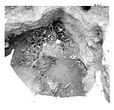
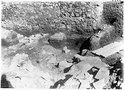
Keyhole-shaped bronze casting pit, cut into bedrock.
2016: Continuation of the excavation of a rectangular pit with foundry debris, ... Late 6th-early 5th c. B.C.
(Late Archaic/ Early Classical) |
Pit in bedrock under W drain of Square Peristyle ... Late 6th-early 5th century |
Pit in deep depression in bedrock. Also includes containers from early fill under late Roman floors down to bedrock at 81-83/ΚΗ-ΛΒ. Notebook cites early fill, ca. 6th. c., with some obviously late disturbance ... 7th c. to ca. 575 B.C ... Pit in deep depression in bedrock. Also includes containers from early fill under late Roman floors down to bedrock at 81-83/ΚΗ-ΛΒ ... Notebook cites early fill, ca. 6th. c., with some obviously late disturbance. |
Coins:
22 March 1933 #1-#44 ... Late Roman- Mid 5th c. |
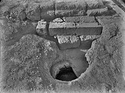
| The pit consists of an unlined, circular shaft measuring 1.10m. in diameter and at least 2.23m. in depth. The sides of the shaft have roughly cut hand-/foot-holds at irregular intervals and locations ... Late Roman to end of 4th c. A.D ... The pit consists of an unlined, circular shaft measuring 1.10m. in diameter and at least 2.23m. in depth. ... Below 50.90 masl, but still of the late 4th c. A.C. the fill yielded larger fragments of pots and a greater concentration of cooking ware, bones and ash. |
Indicated as "Grave 6" in notebook but recognized as not a grave: "probably a rubbish pit" [deposit notebook summary]. Concentration of pottery, burning, animal bones, snail shells and seashells, probably ... Late 4th-early 3rd c B.C. |
Lower filling mostly of second half of 4th c. B. C. and earlier, but perhaps dumped in 3rd c. B.C. Upper filling mixed to Roman (4th c. A.D.). Pottery in container (9-22-58) is mostly second half of 4th ... Ca. 375-325 B.C. with late-3rd-century disturbance |
Scanty filling over the top of a pit. Selected fragments. Black figure fragments ... Late 6th to early 5th c. B.C. |
| Rodney S. Young ... Grave 4 in notebook (E.L. Smithson: Grave XX: PG). Bones discarded. Grave of older child.
JP
Rectangular pit, cut into bedrock to a depth of 0.26m, approximately 0.97m long and 0.36m wide. Tomb oriented ... Late Protogeometric |
| Dorothy Burr Thompson ... Grave 11 in notebook (E.L. Smithson: Grave XII: PG). Bones discarded. Burned deposit in a rectangular trench in bedrock.
JP ... Late Protogeometric |
| Eugene Vanderpool ... Early Geometric grave (E.L. Smithson: Grave XXXIX) ... Late Protogeometric |
| David Scahill ... Roman temple north. Adult male inhumation. Pit tomb, partially stone-lined ... Late Mycenaean or Final Mycenaean/Submycenaean |
| Shallow pit in bedrock on the upper terrace, ca. 3m. southeast of the Rocky Outcrop. Uncatalogued material: 46 sherds, 61 terracotta figurines and 4 objects.
Early ware : Neolithic; Gray Minyan; Mycenaean; ... Archaic with intrusions ... Shallow pit in bedrock on the upper terrace, ca. 3m. southeast of the Rocky Outcrop ... Early ware : Neolithic; Gray Minyan; Mycenaean; Middle-Late Geometric: Protoattic; kalathos; Corinthian type kotyle.
... Intrusions : Classical ware; black glaze bowl; jug.
Late Roman ware : combed ware; coarse ware; red-glazed. |
| Dorothy Burr Thompson ... Grave 15 in notebook. Burial of child (E.L. Smithson: Grave XIV: PG). Single bone. Nb. says: few bones.
Skull fragment, few ribs and fingers (bones discarded). Negs. KK 24 and KK 30 431 ... Developed to Late Protogeometric |
| Eugene Vanderpool ... Grave (E.L. Smithson: Grave III: SM).
The close proximity and similarity of this tomb and tomb M 16-17:1 strongly suggests that they were intentionally laid out in relation to one another and were contemporary ... Late Mycenaean/Submycenaean-Earliest Protogeometric |
| Eugene Vanderpool ... Grave (E.L. Smithson: Grave II: SM).
Unlined trench, roughly the size of the deceased, cut into bedrock to a depth of just over 1.50m. Oriented north-south, the tomb pit measured 1.69m in length (length ... Late Mycenaean/Submycenaean-Earliest Protogeometric |
Pit and well at eastern edge of Kolonos Agoraios with uniform fill.
Diameter 1.90m; straight round shaft ... Late 8th-first half 7th c. B.C. |
Michael Laughy ... Debris pit, located in Room 2 of ΒΘ East. Pit measures ca. 2.30 by 1.70m., and nearly a meter deep. The pottery from the pit dates ca. 10th-12th c. A.D. The fill of the pit consisted of soft, black charcoal ... 10th-12th c. A.D ... Debris pit, located in Room 2 of ΒΘ East. Pit measures ca. 2.30 by 1.70m., and nearly a meter deep. The pottery from the pit dates ca. 10th-12th c. |
| Eugene Vanderpool ... "Submycenaean" grave into Mycenaean gully.
Rectangular trench cut partly in bedrock, partly through Mycenaean domestic filling. No pottery catalogued ... Late Helladic IIIC-Early Protogeometric |
| Dorothy Burr Thompson ... Grave 27. In some records as Grave I bis. Bones discarded; nothing catalogued.
Notebook says: few burned bones, few burned sherds. Cf. negs. KK 228, KK 237 ... Probably Late Geometric or Early Geometric I |
Geometric Well under Rubble Wall of Predecessor.
Classical pit above a Geometric well with a small amount of pottery from the late 6th to the middle of the 4th c. B.C. Estimated Grid ... Late 8th century B.C ... Classical pit above a Geometric well with a small amount of pottery from the late 6th to the middle of the 4th c. |
| John Camp ... Protogeometric grave (female inhumation) located about 0.60m northwest of T 15:1. It consisted of a roughly rectangular pit, with the corners slightly rounded, oriented approximately north-south. The pit ... "Submycenaean"/Early Protogeometric ... It consisted of a roughly rectangular pit, with the corners slightly rounded, oriented approximately north-south. The pit was cut to a depth of at least 0.45m at the south end and 0.25m at the north on account of the sloping bedrock. The original depth of the tomb would have been at least slightly greater, since the bedrock around it was leveled in Late Roman times, if not earlier. |
| Eugene Vanderpool ... Infant grave near Phaidon street cistern. No offerings.
Roughly rectangular, almost elliptical cutting in bedrock, measuring 0.70m long, 0.35m wide, and 0.40m deep, oriented south-southwest to north-northeast ... Late Helladic III C/Early Protogeometric (date uncertain) |
| Located in House H, Room 13 on the lower northwest slope of the Areopagus ... Late 2nd c. B.C. |
Within the precinct of the Hephaisteion, about 10m. north of the north stylobate of the temple.
Flask-shaped pit (W. (bottom) 3.14 x 2.73m) probably originally intended as a cistern; used for dumping ... Ca. 375-310 B.C.-Byzantine ... Flask-shaped pit (W. (bottom) 3.14 x 2.73m) probably originally intended as a cistern; used for dumping waste from a metal furnace. ... Subdivisions:
.1=Layer I, top (Mid-late Byzantine)
.2=Layer II of stones
.3=Layer III, bottom |
Manhole-square pit providing access to aqueduct; the dumped filling includes many fragments of coarse pottery, including 5 stamped amphora handles ... Late 2nd-1st c. B.C. |
Grave 11 in notebook. Grave disturbed by diggers of pit A.
Only skull and left arm of man's skeleton remained in position, head toward N.E. Cover slabs were piled near head ... Late Geometric |
House N, Room 4, Pit through layers 5-6. Debris filling, mixed context. Estimated Grid ... Late 4th. c. B.C. into early 3rd c. B.C. |
Pit in bedrock (disturbed child's grave?). No bones or ashes. No lots.
No coins listed. P 14520 was certainly from the north end, doubtless a grave offering; few sherds (first half of 5th century) came ... Late 6th - early 5th c. B.C. |
| Julia Shear ... Burial. Roman Temple south half, in fill south of temple crosswall and norh of polygonal wall, layer 37a.
Small, roughly circular pit. The diameter of the pit appeared to be only slightly greater than ... Late Helladic IIIC Late-Final Mycenaean/Submycenaean |
| Bronze-casting pit and furnace against S apse of Church (106/ΛΕ). Late Roman sherds of the 4th and the 6th c. A.D. were found with fragments of moulds from bronze casting. The west end was destroyed by ... 5th-6th c. A.D ... Bronze-casting pit and furnace against S apse of Church (106/ΛΕ). Late Roman sherds of the 4th and the 6th c. |
| Eugene Vanderpool ... Rectangular pit, oriented east-west, cut party into filling of Early Protogeometric pit-well (I 18:4), to a preserved depth of about 0.30m. A late Byzantine wall founded below the floor of the grave destroyed ... Middle Geometric I ... Rectangular pit, oriented east-west, cut party into filling of Early Protogeometric pit-well (I 18:4), to a preserved depth of about 0.30m. A late Byzantine wall founded below the floor of the grave destroyed the entire eastern half of the earlier burial. ... The tomb pit had a preserved length of about 1m and a width of ca. 0.80m. |
Pit (= collapsed cistern). Fill mixed, late Hellenistic to early Roman. The cistern floor has an E-W channel, no doubt running from the pit at 107/Ζ to the well at 107/ΙΓ (B 21:24). Coins:
10 June 1939 ... 150-100 B.C ... Pit (= collapsed cistern). Fill mixed, late Hellenistic to early Roman. The cistern floor has an E-W channel, no doubt running from the pit at 107/Ζ to the well at 107/ΙΓ (B 21:24). |
North of Eleusinion: Loose fill in pit outside Roman Building. 14 inventoried items, 22 objects, 325 sherds.
Objects : terracottas; handmade object; large figurine; lamps.
Early ware : Gray Minyan; Mycenaean; ... 6th c. B.C. and earlier ... North of Eleusinion: Loose fill in pit outside Roman Building ... Early ware : Gray Minyan; Mycenaean; Protogeometric-Late geometric; imitation Corinthian.
|
| Identified as pyre by SIR.
In room E. Burnt "pocket" found while digging red earth that contained late Hellenistic pottery, including a fragment of Pergamene (discarded). No pit was discerned, but concentration ... 3rd quarter 4th c. B.C ... Burnt "pocket" found while digging red earth that contained late Hellenistic pottery, including a fragment of Pergamene (discarded). No pit was discerned, but concentration in a "pocket" suggests that the pyre was in its original position and the layer in which it was buried contained late Hellenistic intrusions. |
| Rodney S. Young ... RSY/JP Disturbed Geometric burial over "Sacrificial Pit VI" (Grave B 21:22). Grave IX in notebook. Bones discarded?
Pottery found in the upper filling of a sixth century cremation pit, which had perhaps ... Middle Geometric II/Transitional to Late Geometric |
Rectangular pit over bedrock in north part of E. Building. Broken jars and household basins with a few black glazed and black-figured fragments (uninventoried). The figured pieces indicate the lower limit ... Late 6th-ca. 480 B.C. |
| Deposit of terracottas, molds and pottery in a shallow pit sloping downward from north to south. This deposit was located beneath a layer of fill under a Late Roman plaster floor (Lots ΒΕ 2093-2095). The ... 1st c. A.D ... Deposit of terracottas, molds and pottery in a shallow pit sloping downward from north to south. This deposit was located beneath a layer of fill under a Late Roman plaster floor (Lots ΒΕ 2093-2095). The deposit was cut at its south end by the Byzantine/Late Roman disturbance excavated in Lots ΒΕ 2087-2088, which explains the presence of terracottas in those contexts. |
Well 15: Mycenaean. It was situated about 35 meters down the slope northwest of the exit of the Mycenaean Fountain.
Well circular or roughly oval in section.
Diameter max. width to -4.0: ca. 1.50, below ... Late Mycenaean ... About 0.30m below, a late Roman pit which cut into the north side sherds occurred in fair quantity and the fill seemed to be pure.
|
Pocket of soft fill in bedrock at corner of Late Roman house, with a hoard of lead tokens. No pottery catalogued.
Herulian debris: cf. D 10:1, D 11:7 Coins:
25 May 1935 #8 Estimated Grid
No pottery catalogued ... 25 May 1935 |
| Pyre in House D, Room 4 (RSY=Pyre 4) in the industrial area west of the Areopagus.
Notebook refers to House N.
Pottery belongs late in third quarter of the 4th. c. BC. Pyre burned near beginning of last ... 350-300 B.C ... Pottery belongs late in third quarter of the 4th. c. ... Artifacts, burnt bone, and cinders in round pit. The east side of the pit was destroyed by a Roman pit, but the deposit appears to be largely intact. The pyre pit was dug through layer 1 and into layer 2, both of which overlay the foundation of the wall between rooms 3 and 4. |
Actually in 38/ΙΕ, nbp. 766).
Pit contained at top much pottery and a few coins; sand for about 0.70m below, produced little pottery but many coins including some 2nd century Imperial and one of Salonica ... 3rd c. A.D ... Actually in 38/ΙΕ, nbp. 766).
Pit contained at top much pottery and a few coins; sand for about 0.70m below, produced little pottery but many coins including some 2nd century Imperial and one of Salonica 253-268 A.D. The pottery should then be late 3rd and possibly just pre-Herulian. |
Grave 2 in notebook. The burial was destroyed by the digging of Pit A, at the edge of which was found a mass of sherds belonging to the grave amphora. Among the sherds were found small cups, fragments ... Late Geometric |
Child's burial in south wall of Marble Worker's House.
Bones examined 20 June 1975 and found to be an immature animal, not human (canid-puppy?).
Identified as pyre by SIR. Set into a shallow roughly ovoid ... Late 4th c. |
Grave of 38 year-old female, head NW, legs drawn up. Apparently unlined cist in bedrock or hard-packed dug-bedrock, its outlines no longer distinguishable from surrounding fill. Above skeleton, a number ... Mycenaean? ... If the offerings were at the feet they would have been disturbed by a late Turkish pit, and if at the head by the builders of the so-called "Burned Building".
|
| Rodney S. Young ... Grave 2 in notebook (E.L. Smithson: Grave XV: PG). Urn cremation (trench-and-hole), adult female.
JP
It consists of a roughly rectangular pit or trench cut into bedrock to a depth of 0.35m., measuring ... Late Protogeometric |
| Pyre in Room 1, area west of street (RSY=Pyre 11).
Early in the third quarter of the 4th. c. B.C.
In courtyard. Artifacts, bone, and cinders in irregular pit in floor sequence. The pit had been dug into ... 350-330 B.C ... Artifacts, bone, and cinders in irregular pit in floor sequence. The pit had been dug into a marble-and limestone-chip layer over bedrock, and was covered by a Late Hellenistic layer with tile fragments. |
Well at 18/ΜΓ, on the lower north slope of the Acropolis, under the course of the later Panathenaic Way, west of the Archaic Building.
Diameter 0.97m. Water level 8m.
At the mouth of the well and to a ... Late 8th to 675 B.C. |
| Late 4th-early 3rd c. B.C. |
| Pyre in House N, room 4 (RSY=Pyre 7), in the industrial area west of the Areopagus.
Pottery, mall pieces of calcined bone, log, wood cinders, and charcoal in diamond-shaped pit in floor sequence. The pyre ... Late 4th-early 3rd c. B.C. |
| Pit (6x10) in the valley between the Areopagus and the Hill of the Nymphs. Large cutting in bedrock with 540 ostraka, mainly of the late eighties of the 5th. c. B. C. Much pottery, principally of the early ... Ca. 500-450 B.C ... Pit (6x10) in the valley between the Areopagus and the Hill of the Nymphs. Large cutting in bedrock with 540 ostraka, mainly of the late eighties of the 5th. c. ... Much pottery, principally of the early 5th. c., but with some as late as the middle, at which time the fill was dumped. |
| Grave 1 in notebook (E.L. Smithson: Grave XXV: PG). No remains. Probable trench-and-hole.
JP
Roughly circular pit measuring 0.39m in diameter cut into bedrock to a depth of 0.72m. Pyre refuse-described ... Late PG/EG I |
| Dorothy Burr Thompson ... Grave 1. Urn cremation (trench-and-hole), adult female 30-40 years old).
Mentioned as Grave XVII in Deposit list.
Consisted of a roughly circular pit, approximately 0.30-0.40m in diameter, cut into ... Late Protogeometric |
| In room A. Concentration of artifacts and burning in stratum, no pit discerned. The pyre lay below a Late Hellenistic fill with a smooth earth surface. It is described as a black patch of earth with sherds, ... 350-250 B.C ... Concentration of artifacts and burning in stratum, no pit discerned. The pyre lay below a Late Hellenistic fill with a smooth earth surface. ... Strosis II, on which the pyre rested, covered the walls of Room A, demonstrating that the pyre postdates a change of plan or abandonment of this part of the building, other parts of which survived to the Late Hellenistic period. |
Washed-in filling at the base of the Acropolis cliffs, some 7m. east of the Klepsydra; the fill was characterized by teh fragments of a series of red-figured oinochoai of special shape, of the late 5th ... Late 3rd c. B.C ... The deposit seems certainly to have been formed at one time; the latest sherds and the coins show that this must have been as late as the end of the third c. ... It now seems more likely that the pit was hollowed out, and the filling washed in by water pouring from the ledges above.
... contents date to late 5th c. B.C., but deposited no earlier than the end 3rd c. |
| Eugene Vanderpool ... Grave (E.L. Smithson: Grave XVI: PG). Bones discarded.
Only the lower portion of the urn-hole was preserved in bedrock, roughly oval in outline, with a maximum preserved width at the top of 0.70m narrowing ... Late Protogeometric/Early Geometric I ... Only the lower portion of the urn-hole was preserved in bedrock, roughly oval in outline, with a maximum preserved width at the top of 0.70m narrowing toward the bottom: the pit had a preserved depth of about 0.30m, or just slightly under.
No trace of pyre debris was encountered in the vicinity of the tomb, and the material overlying the grave yielded material of Late Roman date, indicating that damage to the tomb probably dates to that time. |
| Rodney S. Young ... Grave 3 in notebook (E.L. Smithson: Grave XIII: PG). Urn cremation (trench-and-hole), adult female.
JP
Rectangular trench, measuring approximately 1.10x0.45m, but which may have been larger, cut through ... Late Protogeometric |
| Shallow pit below layer I in Stoa Shop VI (Pyre)
Diameter 0.90; D. 0.15m Under shop VI of the Stoa of Attalos Pottery, ash, burning and packing of small stones in pit in stratum. The pyre was covered by ... Ca. 350 or 325 B.C. ? ... Shallow pit below layer I in Stoa Shop VI (Pyre)
Diameter 0.90; D. 0.15m Under shop VI of the Stoa of Attalos Pottery, ash, burning and packing of small stones in pit in stratum. ... The pyre must date at least as late as layer II, and probably not too much later. |
N-S Cut on 20m. line (area of Road, area of Stoa, area N of Stoa)
various levels and dates over the three areas.
Investigations to the northwest of the market square in the area of the road that bordered ... Protogeometric to Late Roman |
Fills from construction and reconstruction of a house. "Brown House" = House A (RSY Hesp. 20) (and pit under Layer 4) in the industrial area west of the Areopagus.
Under the original floor of this house ... Second half of the 5th. c. B.C ... "Brown House" = House A (RSY Hesp. 20) (and pit under Layer 4) in the industrial area west of the Areopagus.
... Second period: late 5th. c. B.C. |
| David Scahill ... Behind northeast corner of Classical Building; east wall C. Below Hellenistic levels and early Classical pit. Chamber cut through bedrock, depth ca. 0.90m., diameter ca. 2m., roughly square in shape, angling ... LH III A:1 ... Below Hellenistic levels and early Classical pit. Chamber cut through bedrock, depth ca. 0.90m., diameter ca. 2m., roughly square in shape, angling inward toward top. ... Loose fill of stones and earth filling tomb with large number of geometric sherds ranging early to late Geometric. Fallen bedrock in northeast corner with geometric pot imbedded in the top. |
| Dorothy Burr Thompson ... Grave 2. Urn cremation (trench-and-hole). In some records as XXIII.
Variously labeled as grid 7/Δ, 7/Γ and 7/Γ-Δ.
Rectangular pyre trench cut through earth into bedrock, with only the lowest 0.04m surviving ... Transitional Late Protogeometric/Early Geometric I |
Accumulated fillings in a system of underground drains at west end of section ΔΔ with northward continuation into and across Section Υ.
The filling in the "underground passages" in section ΔΔ appears to ... 3rd c. B.C.
2nd c A.D ... ; but drain channels, pits and cuttings, etc. in Υ are partly Early Roman, some mixed to Late Roman or later.
... Section Υ: pit at 31-32/ΜΘ-Ν, 31-32/ΜΣΤ-ΜΖ, 36-38/ΞΔ, 33/ΝΒ, 31-32/ΜΓ-ΜΣΤ, 31/ΜΑ-ΜΓ
two fragments of semi-glazed bowls with everted rim (late 2nd c.?) |
Well at 15/ΙΕ = Pocket in side of Turkish Pit at 15/ΙΔ.
Shallow well on the lower slopes of the Acropolis, east of the Panathenaic Way, in the area later occupied by the Archaic Building.
Located 3.5m ... 700-675 B.C. with intrusions ... Well at 15/ΙΕ = Pocket in side of Turkish Pit at 15/ΙΔ.
Shallow well on the lower slopes of the Acropolis, east of the Panathenaic Way, in the area later occupied by the Archaic Building.
Located 3.5m north of the Archaic peribolos wall, in a spot later covered by the Temple of Triptolemos. The pit was disturbed by two Ottoman pits on the east and north sides and by the wall of a modern cellar sunk through part of it ... Intrusions: Archaic ware; terra cotta figurine; blac figure; black glaze; lamp; Roman ware; Late wares: green glaze; yellow glaze; orange/brown glaze; green/white ware; grooved ware, white slip; incised wavy ware; white slip ware, amphora; globular jug; lamp; jug; unglazed plate; micaceous coarse ware; other coarse ware. |
| Rubbish Dump in mouth of abandoned well in Tholos Trench F, Kitchen. Filled with ash, charcoal, broken pottery, roof tiles.
Also from Trench L.
13 March 2014 by Ann Steiner
The deposit has four components ... Ca. 425-400 B.C ... Component 1: At the top is an extensive oval-shaped pit, c. 3.20 by 1.60, distinguished by signs of burning: the Tholos Kitchen Dump: Lots Ζ 271-287 (425-400 B.C.E.)
Component 2: The second segment, moving downward, includes the top-most curb stones of a collapsed well together with ceramic material all jumbled up with the roof tiles from the Tholos, but with no signs of burning: Lots Ζ 687-690 (late 6th-late 5th c. B.C)
Component 3: A second set of collapsed curb stones, ,below the first two, and the material below it to the top of what was still preserved of the well shaft proper: Lots Ζ 691-693; and Ζ 686 (Geometric-late 6th c.)
Component 4: The bottom of the well and what is apparently pottery from a very short period of use. |
| Pyre /Burial (?) disturbed, in the area of the Poros Building west of the Areopagus. In northeast corner of room 4 west.
Concentration of artifacts, tiny slivers of bone, and burning in a layer of fill ... Early 4th c. B.C ... Concentration of artifacts, tiny slivers of bone, and burning in a layer of fill 0.25m thick below a pebble mosaic (ΟΟ 651). No pit discerned. Below the pyre was a trodden surface of fill with roof tiles. ... The fill topped by roof-tiles represents tile fall from the late 5th c. B.C. destruction of the building, which if the pyre was found more or less in situ, was in the past by the time the pyre was burnt. |
|
|