|
|
Tomb at 53-54/ΛΕ-ΛΣΤ-ΛΗ (Late Roman), on the lower north slope of the Areopagus Nb. says ΛΕ-ΛΗ. Deposit list and deposit DB say: ΛΕ-ΛΣΤ ... 350-400 A.D ... Late Roman Tomb |
| Kevin Daly ... Grave in north room of Roman temple, west of well J 2:4; adult inhumation ... Late Helladic IIIC Late-Final Mycenaean/Submycenaean |
| David Scahill ... Roman temple north. Adult male inhumation. Pit tomb, partially stone-lined ... Late Mycenaean or Final Mycenaean/Submycenaean |
| John Camp ... Burial north of Roman temple, E. of polygonal wall.
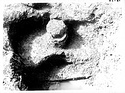
The tomb, as preserved, consisted of the cinerary urn, which stood in an upright position, its upper part damaged by later disturbance. It contained ... Late Helladic IIIC Late-Final Mycenaean/Submycenaean |
| Eugene Vanderpool ... Grave (E.L. Smithson: Grave XVI: PG). Bones discarded.
Only the lower portion of the urn-hole was preserved in bedrock, roughly oval in outline, with a maximum preserved width at the top of 0.70m narrowing ... Late Protogeometric/Early Geometric I ... No trace of pyre debris was encountered in the vicinity of the tomb, and the material overlying the grave yielded material of Late Roman date, indicating that damage to the tomb probably dates to that time. The flat, evidently cut bedrock immediately to the southwest of the urn-hole suggests that the tomb may have been originally a standard trench-and-hole cremation. |
| David Scahill ... Below packed clay floors in Room 2 of Classical Building II; bordered on east and south sides by polygonal cross wall and back wall extension for Classical Building. Late Roman wall and drain installation ... LHIII A:1 ... Below packed clay floors in Room 2 of Classical Building II; bordered on east and south sides by polygonal cross wall and back wall extension for Classical Building. Late Roman wall and drain installation above west side. ... Upper part of tomb cut away by leveling for floors of Classical Building. Loose fill of stones and earth with large number of Geometric sherds ranging from Protogeometric to late Geometric in date, from top of cutting extending down into layer of tomb contents. |
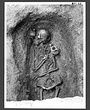
| John Camp ... Protogeometric grave (female inhumation) located about 0.60m northwest of T 15:1. It consisted of a roughly rectangular pit, with the corners slightly rounded, oriented approximately north-south. The pit ... "Submycenaean"/Early Protogeometric ... The original depth of the tomb would have been at least slightly greater, since the bedrock around it was leveled in Late Roman times, if not earlier. The tomb pit measured 1.65-1.70m long by about 0.63m wide; the floor of the tomb was at 68.30-68.40 masl., 1.65-1.70m long by about 0.63m wide; the floor of the tomb was at 68.30-68.40 masl.
... A substantial Late Roman wall ran across the tomb, covering but not disturbing the skeleton from mid-thigh to instep; the bones were recovered by tunneling. |
| Mycenaean Chamber Tomb occupies a considerable part of the western half of section ΕΕ; lies about half way up the north slope of the Areopagus towards its eastern end, just below the highest point of the ... Myc. III A:1 ... It was originally several meters longer but its northern end was cut off by a late Roman retaining wall. ... High above the chamber to the south, about five meters above its floor, is the remains of a wall of a late Roman house, part of which passed over the southwest corner of the chamber and had to be removed. ... Neither of these walls disturbed the tomb proper in any way.
|
| Julia Shear ... Burial. Roman Temple south half, in fill south of temple crosswall and norh of polygonal wall, layer 37a.
Small, roughly circular pit. The diameter of the pit appeared to be only slightly greater than ... Late Helladic IIIC Late-Final Mycenaean/Submycenaean |
| Eugene Vanderpool ... Grave (adult female). (In some records as Grave XXXI).
The tomb was partly destroyed in antiquity; there are sherds of all periods down to Late Roman (and later) note din the fill immediately above it ... Middle Geometric I ... (In some records as Grave XXXI).
The tomb was partly destroyed in antiquity; there are sherds of all periods down to Late Roman (and later) note din the fill immediately above it. A modern well was partly cut into the northeast portion of the tomb as preserved, and an ancient block, reused in a modern wall, was founded directly on bedrock just to the southwest of the tomb.
As preserved, the tomb consisted of a roughly oval cutting, 1.40m long, oriented southeast to northwest. |
|
|